
Last updated: November 3rd, 2026 · Written by the MatchPal Advising Team · Reviewed by Daniel Veyg, DO
It’s interview season, and if you’re a DO applicant, you have probably heard some version of the same warning: “Take the USMLE too, just to be safe. Programs don’t really trust COMLEX.”
This summer, the people who run residency training sat down to decide whether that advice still holds.
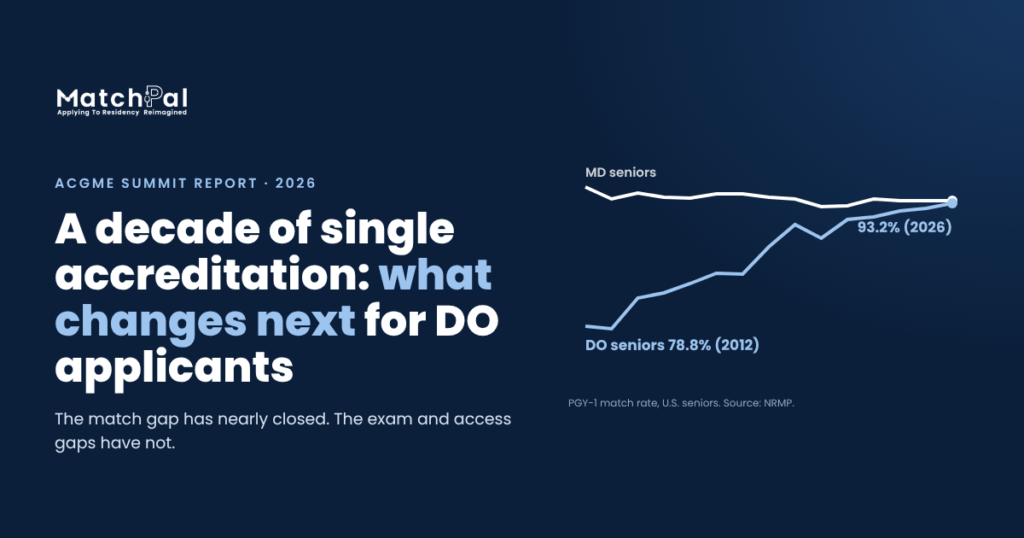
The ACGME’s Single GME Accreditation System Summit Report is the first official look back at a decade of DOs and MDs training in one system. It confirms the good news, names the gaps nobody likes to talk about, and puts the two-exam expectation on notice.
Quick answer: In the 2026 Match, 93.2% of U.S. DO seniors matched to a PGY-1 position, compared with 93.5% of U.S. MD seniors. That gap was 16.3 points in 2012. The ACGME’s 2026 summit report says single accreditation worked, but gaps remain in competitive specialties, licensing exams and rotation fees. Its first priority: stop expecting DO students to take both COMLEX-USA and USMLE.
The report at a glance
| Measure | Number | Source |
|---|---|---|
| DO senior match rate, 2026 | 93.2% (MD seniors: 93.5%) | NRMP |
| DO senior match rate, 2012 | 78.8% | NRMP |
| Share of 2026 PGY-1 positions filled by DO seniors | 19.3% | NRMP |
| Programs requiring USMLE Step 1 from DO applicants | 37% | NRMP 2026 Program Director Survey |
| Programs with ACGME Osteopathic Recognition | 280 (18 in 2015) | ACGME |
| Summit priorities | 6, two of them immediate | ACGME summit report |
What is the ACGME single accreditation report?
The Single GME Accreditation System Summit Report is a 16-page ACGME summary of a summit held June 23 and 24, 2026, in Chicago. Leaders from the ACGME, AOA, AACOM, AAMC, NRMP, NBOME and NBME reviewed the first decade of one accreditation system for DO and MD residency training, then set six priorities for what comes next.
Quick history, because it matters for the numbers below. From July 2015 to June 30, 2020, residency programs accredited by the American Osteopathic Association moved under the ACGME (the change many students call the AOA ACGME merger). Since then there has been one accreditation system and one Match.
About 60 people took part, co-chaired by David Forstein, DO, and Daniel Dent, MD. The CEOs of the AOA and NRMP, the president of AACOM and the AAMC’s chief academic officer each gave a national view. Then participants worked through three questions:
- Getting in: how applicants learn what programs actually want
- Getting picked: how program directors screen and choose residents
- Fitting in: how new residents, especially DOs, are supported once they arrive
One thing to know before you read further: the report itself has almost no numbers in it. Every figure in this post comes from the NRMP, the ACGME or peer-reviewed research, and each one names its source.
What is the DO match rate in 2026?
In the 2026 Main Residency Match, 93.2% of U.S. DO seniors matched to a PGY-1 position, according to the NRMP. U.S. MD seniors matched at 93.5%. That 0.3-point gap is the clearest win of single accreditation, and the ACGME report says so.
Here’s the part that’s easy to miss.
In 2012, the gap between DO and MD seniors was:
16.3 points.
In 2026 it was:
0.3.
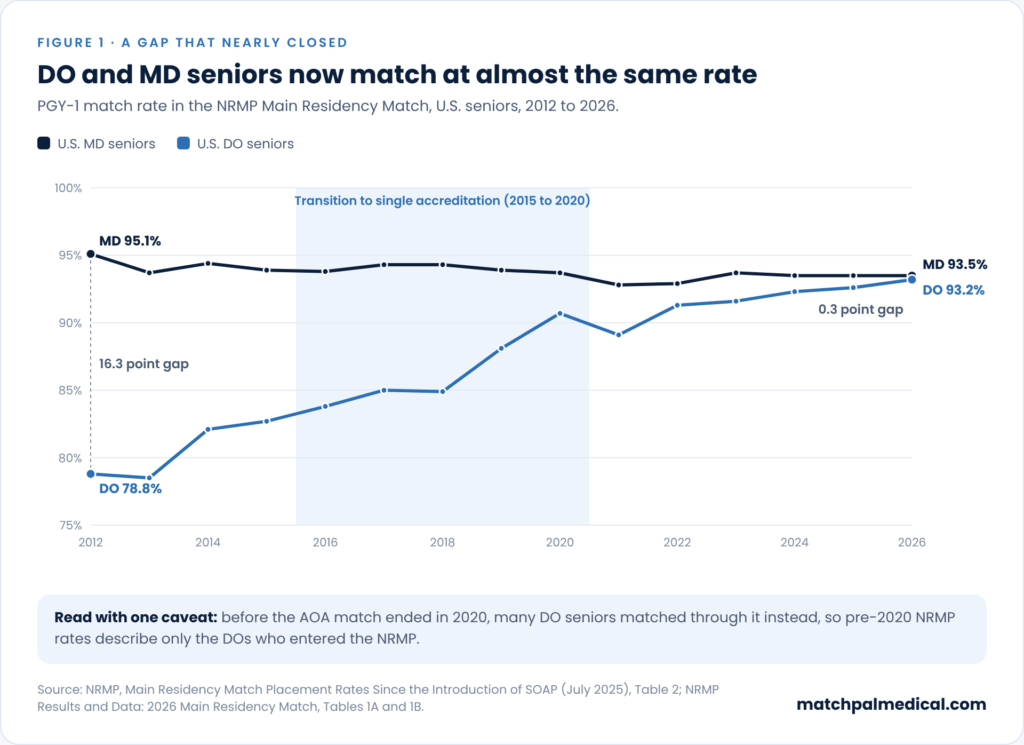
The NRMP’s CEO told the summit that DO seniors’ Match outcomes now approach or exceed those of MD seniors. One honest caveat: before 2020, many DO seniors matched through the separate AOA match, so pre-2020 NRMP rates describe only the DOs who entered the NRMP.
The volume is real too. The NRMP counted 8,503 active DO senior applicants in 2026, up 16.4% from 2022, and DO seniors filled 7,928 PGY-1 positions, or 19.3% of all PGY-1 positions offered.
You can see the shift inside programs. ACGME data from its February 2026 conference shows:
- DO residents: from about 11% of residents to around 25% between 2015 and 2025
- DO program directors: from 2.5% to about 8.5%
- ACGME Osteopathic Recognition: from 18 programs in 2015 to 280 in 2026
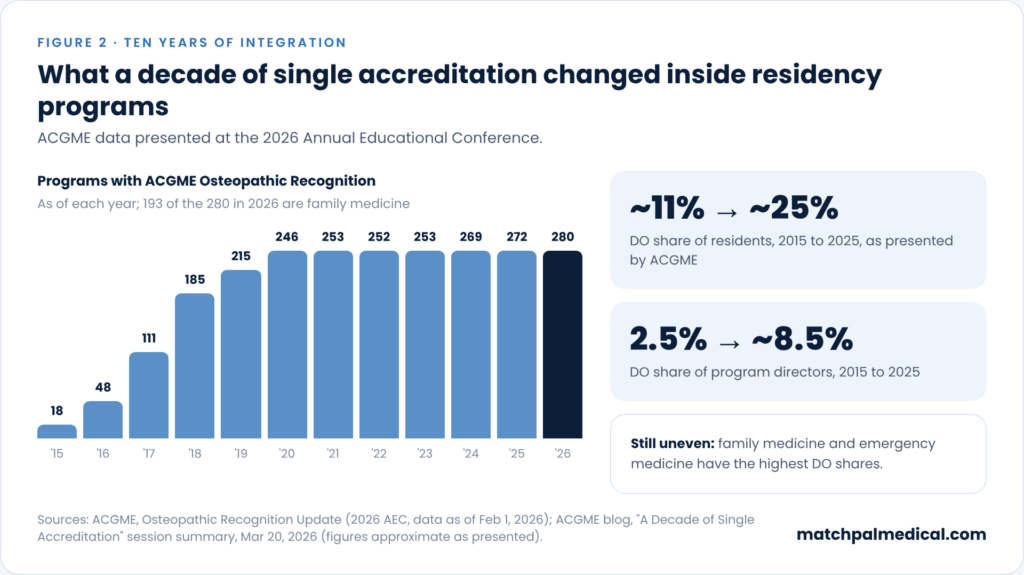
Osteopathic Recognition marks programs that formally teach osteopathic principles and practice. The catch: 193 of the 280 are in family medicine. Osteopathic training is everywhere in primary care and still thin almost everywhere else.
The overall gap is all but closed. The specialty gap isn’t.
Which specialties are the most DO friendly in 2026?
Measured by the share of PGY-1 positions filled by U.S. DO seniors in the 2026 Match, the most DO friendly specialties were PM&R (40.7%), emergency medicine (35.0%), family medicine (25.6%), psychiatry (22.5%), OB/GYN (20.1%) and pediatrics (19.7%). The least: plastic surgery (1.7%), neurosurgery (3.2%), otolaryngology (5.7%) and vascular surgery (7.3%).
Across every specialty, DO seniors filled 19.3% of PGY-1 positions. In orthopaedic surgery, it was 12.6%.
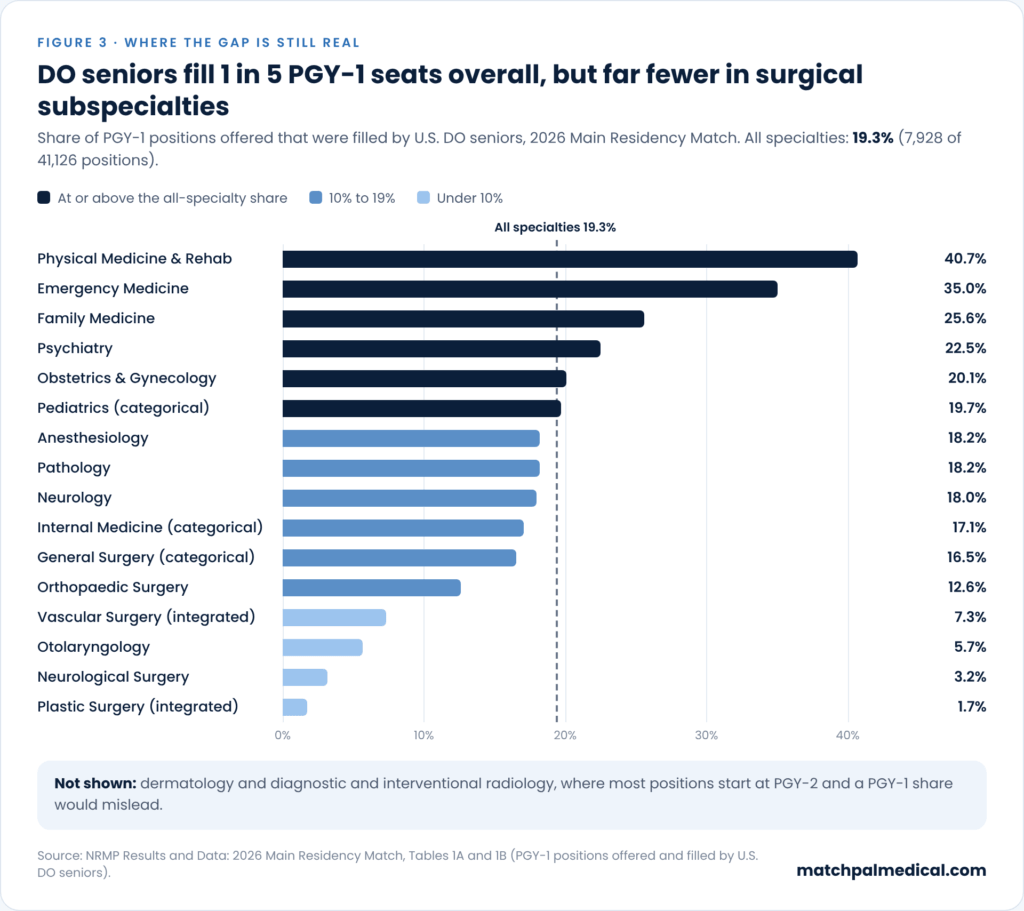
The AACOM president put it plainly at the summit: technical integration is done, cultural integration is not. The NRMP added that overall opportunity has grown, but access to specific specialties is still uneven.
A low share isn’t proof of bias on its own. It also reflects how many DOs apply to each field. But the summit named the barriers that help keep these numbers low:
- Bias against osteopathic applicants, newer schools and community-based training
- Uneven access to specialty-specific advising and mentors
- Program directors less fluent in osteopathic training, COMLEX-USA scores and AOA board certification
- Automated screening filters that can drop a qualified applicant before anyone reads the application
How to spot a DO friendly residency program (before you spend a signal on it):
- Current residents: look for DOs on the program’s resident page, ideally from more than one school.
- Exam policy: check whether the website or FREIDA listing accepts COMLEX-USA without USMLE.
- Osteopathic Recognition: a recognized program has committed to osteopathic training on paper.
- Residency Explorer: compare the program’s past matched applicants with your profile.
For the full specialty-by-specialty picture, see our breakdown of DO and MD match rates by specialty.
Specialty-Specific Residency Application Advising · 100% Resident-Run
Navigate the road to residency with an expert resident advisor in your target specialty by your side.
From VSLO rotations and ERAS strategy to signal token allocation, personal statement line-edits, and mock interviews, get longitudinal, specialty-specific mentorship from residents who evaluate applicants every day. Work within your future specialty and put your best foot forward at every step.
Do DO students still need to take the USMLE in 2026?
Sometimes, and less every year. The ACGME’s 2026 summit report says DO students should no longer be expected to take both COMLEX-USA and USMLE. But that’s a recommendation, not a rule: in the 2026 NRMP Program Director Survey, 37% of responding programs still required USMLE Step 1 from DO applicants.
For years, the standard advice was “take the USMLE to be safe.” In 2026, that advice is too blunt to be useful. Whether you need it depends on your specialty and the exact programs on your list.
The report is clear about where it wants this to go. The summit agreed that the dual requirement should not continue, because it adds cost and logistical burden, and called universal acceptance of each degree’s own exam a foundational step toward parity. Ending it is the first immediate priority, and the report asks the NBOME, NBME, AAMC and AACOM to:
- Issue joint guidance that treats COMLEX-USA and USMLE as equivalent, valid routes into residency
- Publish evidence-based guidance on how to read licensing exam scores
- Work with program directors to remove policies that require both exams
Now the reality check. In the 2026 NRMP Program Director Survey, 76% of responding programs required COMLEX-USA Level 1 from DO applicants, and 37% required USMLE Step 1. (Only 12.7% of surveyed program directors responded, 861 of 6,806, so treat these as directional.)
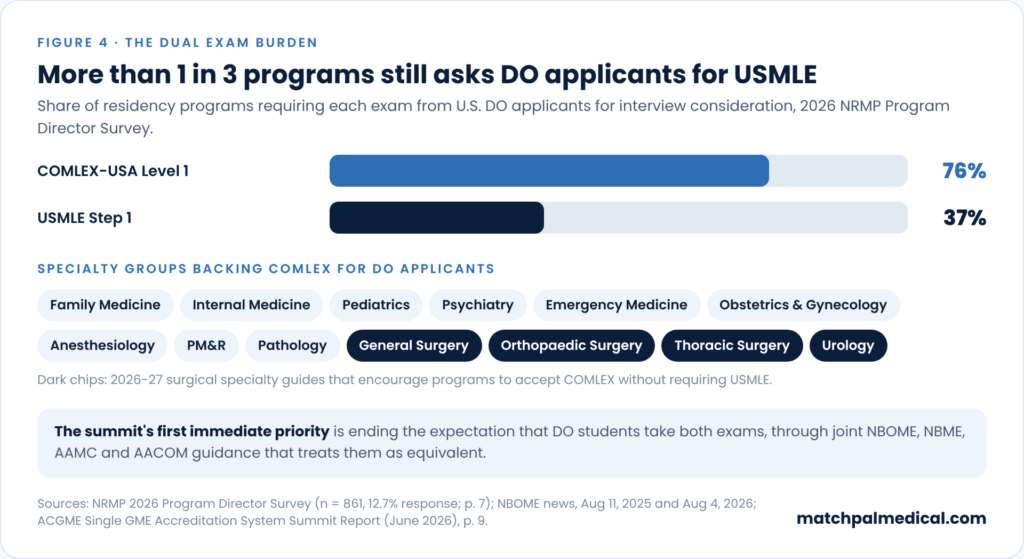
The momentum is on your side. Specialty groups in family medicine, internal medicine, pediatrics, psychiatry, emergency medicine, OB/GYN, anesthesiology, PM&R and pathology support using COMLEX-USA for DO applicants. For the 2026-27 cycle, the general surgery program director guide no longer requires USMLE from DO applicants, and the orthopaedic surgery, thoracic surgery and urology guides encourage programs to accept COMLEX-USA without a second exam.
Here’s how we tell our DO students to decide:
- DO friendly field (family medicine, emergency medicine, psychiatry, PM&R, most of IM and pediatrics): COMLEX-USA alone is usually enough. Spot-check your top programs anyway.
- Competitive or historically MD-heavy field: look up every target program’s exam policy first. If a real share of your list still asks for USMLE, plan for Step 2 CK.
- Still undecided on a specialty: keep the option open. Deciding late is harder than deciding early.
If a program’s website is vague, ask. Something like:
“Hi, I’m a fourth-year DO student applying to [specialty] this cycle. Does your program accept COMLEX-USA Level 2-CE in place of USMLE Step 2 CK when deciding on interviews? Thank you for your help.”
Then make your COMLEX score easy to read. Our guides to what your COMLEX percentile means and the Step 2 CK and Level 2-CE scores you need by specialty show you how. If you’re still prepping, COMLEX tutoring from residents who took the exam is built for exactly this.
Free COMLEX Prep Kit
Studying for COMLEX Level 2? Lock in your study plan today.
Don't leave easy osteopathic points on the table during dedicated. Grab the exact schedules and high-yield OMM frameworks built by DO residents who scored 700+ on COMLEX:
- The Ultimate Step 2 / Level 2 Dedicated Study Plan: How to structure a 4–8 week dedicated block and balance COMLEX Level 2-CE with Step 2 CK.
- Comprehensive OMM Review Guide (Level 1 & 2): Viscerosomatics, Chapman points, sacral/cranial diagnoses, and Fryette's laws organized for 15-minute daily blocks.
Or jump straight to the resource pages: OMM Review Guide · Level 2 Dedicated Study Plan
Do DO students pay more for away rotations?
A small and shrinking number of programs still charge visiting DO students more or bar them from rotating, and the ACGME’s 2026 report calls ending those differential fees an immediate priority. In a 2024 study of 194 orthopaedic surgery programs, one charged DO students more, and 6.2% barred them, both down from 2021.
The report asks AACOM, the AOA, the AAMC, academic health centers and clinical sites to adopt fee-parity policies, publicize institutions that have already dropped differential fees, and look for levers, such as accreditation standards, that could end the practice. Its bibliography cites an AMA policy on equal fees for osteopathic and allopathic students and a 2025 AOA policy on audition rotations.
The 2024 JBJS Open Access study (2023 application cycle) found:
- Restrictions: 12 of 194 programs (6.2%) did not let DO students rotate, down from 18 (9.3%) in 2021. None restricted MD students.
- Higher fees: one program charged DO students more, down from five in 2021.
- No published fees: 44 programs (22.7%) listed no rotation fee on their website or in VSLO.
That last number is the one that bites. You can’t budget for a fee you can’t see.
Before you submit in VSLO, confirm every program’s eligibility rules and fees for DO students. Our Sub-I and away rotation playbook and how many away rotations to do by specialty cover the rest.
What are the six priorities in the ACGME report?
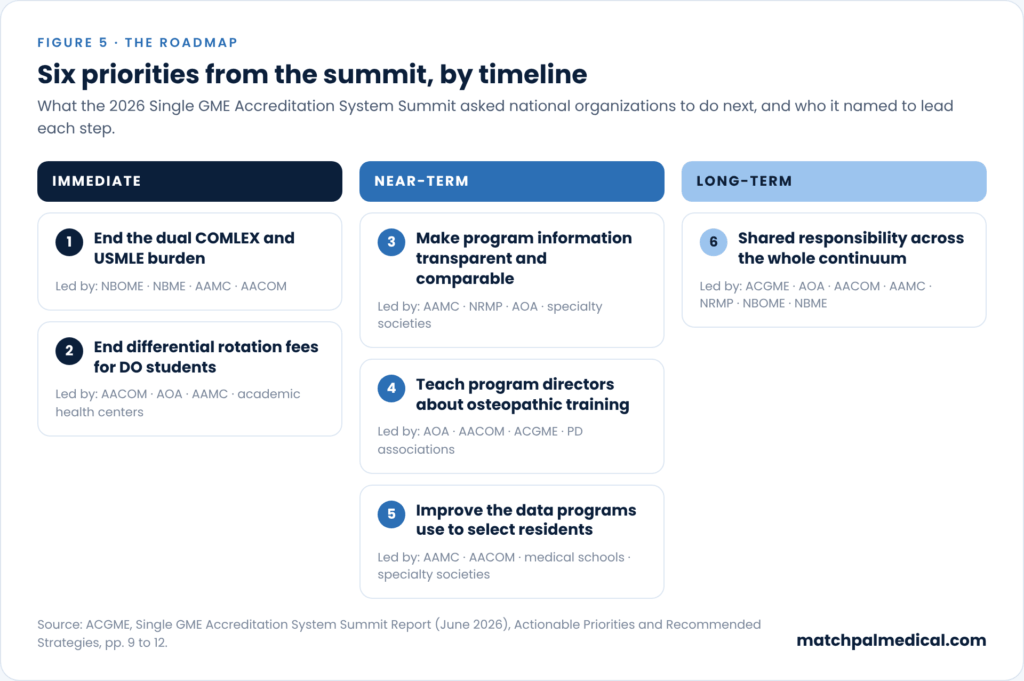
The report ranks six priorities across three timeframes and names who should lead each. Two are immediate: ending the dual COMLEX-USA and USMLE burden, and ending differential rotation fees for DO students. Three are near-term, on transparency, program director education and better selection data. One is long-term: shared responsibility across medical education.
Immediate
- End the dual COMLEX-USA and USMLE burden. Joint guidance that treats both exams as valid, plus outreach to programs that still require both. (NBOME, NBME, AAMC, AACOM)
- End differential fees and barriers for DO students on rotations. Fee-parity policies and public examples of institutions that already changed. (AACOM, AOA, AAMC, academic health centers, clinical sites)
Near-term
- Make program information transparent. Standard applicant profiles across Residency Explorer, FREIDA and ResidencyCAS, published selection criteria and graduate outcome data. (AAMC, NRMP, AOA, specialty societies)
- Teach program directors about osteopathic training. Specialty-specific modules on osteopathic education, COMLEX-USA, certification and identity, including joint NBOME and NBME sessions. (AOA, AACOM, ACGME, specialty societies, program director associations)
- Give programs better information for choosing residents. Stronger MSPEs, letters and clinical descriptions, structured holistic review tools, and less reliance on single metrics and unvalidated screening cutoffs. (AAMC, AACOM, medical schools, specialty societies)
Long-term
- Shared responsibility across the continuum. National organizations, specialty societies, schools, boards, programs and learners working toward the same goals and reporting progress together. (ACGME, AOA, AACOM, AAMC, NRMP, NBOME, NBME, specialty societies)
The report also looks past Match Day. It calls for real transition-to-residency support, with mentors, peer support and safe feedback, and for treating different training backgrounds as strengths. That matters most for the DO resident who is the only osteopathic physician in the program. It suggests keeping osteopathic identity alive through OMT electives, scholarly work and guidance on AOA board certification.
What should DO students do now?
Act on the rules programs use this cycle, not the ones the report hopes for. Check every program’s exam policy, audit your away rotations for DO eligibility and fees, and make your COMLEX-USA score easy for any program director to read. Here’s the playbook by year.
A recommendation isn’t a rule until a program changes its website.
MS1 and MS2 DO students
- Decide on USMLE by specialty, not by fear. If you lean toward a competitive surgical field, check how your target programs treat COMLEX-USA before you build your board plan.
- Find a mentor in your field now. The summit named uneven access to specialty advising as a core problem. A resident in your specialty fixes that faster than anything else. Take a look at our Competitive Specialty Accelerator Program to get specialty-specific guidance now.
MS3 DO students
- Audit your aways before VSLO opens. Confirm DO eligibility and fees for every program on your list, and flag any that don’t publish them.
- Time your Level 2-CE (and Step 2 CK, if you need it) so scores land before programs start reviewing. Our COMLEX score release dates post has the timing.
MS4s applying now
- Don’t wait for policy to change. If a program still asks for USMLE, that’s its rule this cycle, whatever the summit recommended.
- Make your application easy to read. Program directors less familiar with COMLEX-USA respond to context: your percentile, your clinical performance and specific letters.
- Spend signals on programs that already take DOs in your specialty. Our guide to where to send your program signals shows how.
MD students win here too. Standard program profiles, published selection criteria and fewer score cutoffs would make the Match more transparent for everyone.
Stop Guessing. Start Strategizing.
The report confirms what DO applicants already feel: the system is unified on paper, but the path still looks different depending on your specialty, your exams and how well a program understands osteopathic training.
Generic advice can’t account for that. A resident who just matched into your specialty can.
MatchPal’s 80+ resident physician advisors include DOs who matched across competitive and primary care specialties. We’ll tell you whether you need the USMLE, build an away rotation list that works for a DO applicant, and help you present your COMLEX-USA scores so any program director can read them.
FAQ
What is the DO match rate in 2026?
In the 2026 Main Residency Match, 93.2% of U.S. DO seniors matched to a PGY-1 position, according to the NRMP. U.S. MD seniors matched at 93.5%, so the gap was 0.3 percentage points. In 2012 the gap was 16.3 points.
Do DO students need to take the USMLE?
It depends on your specialty and your programs. The ACGME’s 2026 summit report says DO students should no longer be expected to take both COMLEX-USA and USMLE, and many specialty groups now back COMLEX-USA alone. But programs still set their own rules: in the 2026 NRMP Program Director Survey, 37% of responding programs required USMLE Step 1 from DO applicants.
What is the single accreditation system?
It is the system under which the ACGME accredits all U.S. residency programs, including those once accredited by the American Osteopathic Association. The transition ran from July 2015 to June 30, 2020. Since then, DO and MD graduates have applied through one accreditation system and one Match.
What are the most DO friendly specialties?
By the share of PGY-1 positions filled by U.S. DO seniors in the 2026 Match, the most DO friendly specialties were PM&R (40.7%), emergency medicine (35.0%), family medicine (25.6%), psychiatry (22.5%), OB/GYN (20.1%) and pediatrics (19.7%). Across all specialties, DO seniors filled 19.3% of PGY-1 positions.
What is ACGME Osteopathic Recognition?
It is a designation for ACGME-accredited residency programs that formally teach osteopathic principles and practice. As of February 2026, 280 programs held it, up from 18 in 2015. Family medicine accounts for 193 of them.
Do residency programs charge DO students more for away rotations?
Fewer do every year. In a 2024 study of 194 orthopaedic surgery programs, one program charged DO students more than MD students, down from five in 2021, and 6.2% did not allow DO students to rotate. The ACGME’s 2026 summit report lists ending differential fees as an immediate priority.
Sources
- ACGME, Single GME Accreditation System Summit Report (June 2026)
- NRMP, Results and Data: 2026 Main Residency Match, Tables 1A and 1B
- NRMP, Main Residency Match Placement Rates Since the Introduction of SOAP (July 2025), Table 2
- NRMP, 2026 Program Director Survey Results
- ACGME, Osteopathic Recognition Update (2026 Annual Educational Conference)
- ACGME, #ACGME2026 Session Summary: A Decade of Single Accreditation (Mar 20, 2026)
- Modica et al., Revisiting Differences in Fourth-Year Orthopaedic Away Rotation Opportunities and Fees, JBJS Open Access (2024)
- NBOME, Momentum Builds Across Surgical Specialties for COMLEX-USA Acceptance (Aug 4, 2026)
- NBOME, Pathology Leaders Urge COMLEX-USA and USMLE Parity (Aug 11, 2025)