
DO vs MD in the Residency Match: What the 2026 Data Actually Shows
Last updated: October 26, 2026 · Written by the MatchPal Advising Team · Reviewed by Joseph Gofman, DO
Quick answer: DOs and MDs complete equivalent medical training, and DOs add osteopathic manipulative medicine (OMM) on top of a standard curriculum. In the 2026 Main Residency Match, 7,928 DO seniors matched, with a 93.2% DO senior match rate (NRMP, 2026). That strong overall match number hides specialty-specific gaps in MD and DO match outcomes, which are evolving and change every cycle. In Anesthesiology, for example, about 87.4% of MD applicants matched in 2026 versus about 72.5% of DO applicants, roughly a 15-point difference. For the full specialty-by-specialty breakdown, go straight to our 2026 DO vs MD match rates by specialty deep-dive.
You are a DO student, and at some point this year someone is going to tell you, directly or online, that your degree is going to hold you back. Sometimes that’s said to scare you away from applying a competitive specialty or to encourage you to focus on applying to “DO-friendly” programs. Sometimes this cautionary advice might seem like it has the ulterior motive of preserving a school’s match outcome. Is this true? Does being a DO really hold you back in the residency match?
The more useful take is also more complicated. DO and MD training are equivalent and the match outcomes for DOs are strong overall, but there are gaps between DO and MD outcomes are specialty-specific and evolving every year. Knowing the data prepares you to make an educated decision when it comes time to apply.
Are DO and MD medical training actually equivalent?
Yes, with one addition. Both DO and MD students complete four years of medical school and then a residency in their chosen specialty, under the same single accreditation system since the 2015 to 2020 transition that fully merged osteopathic and allopathic graduate medical education under the ACGME. DO students complete an additional curriculum in osteopathic manipulative medicine (OMM), a hands-on, musculoskeletal-focused approach to diagnosis and treatment.
OMM may or may not be part of your clinical practice, but it is an added skill set on top of the same core training. A strong, fundamental understanding gained through structured OMM education can make this educational requirement a useful asset in many specialties (e.g., PM&R).
What do the 2026 NRMP numbers say about DO match rates?
7,928 DO seniors matched in the 2026 Main Residency Match, a 93.2% DO senior match rate, per NRMP’s official release. That is a strong overall outcome, but doesn’t tell the whole story because it averages together specialties where DO and MD match outcomes are similar with ones that have real gaps.
Where is the DO vs MD match gap actually real?
Anesthesiology provides a clean example for the 2026 cycle. Roughly 87.4% of MD applicants matched into Anesthesiology in 2026, compared to roughly 72.5% of DO applicants, meaning about 28% of DO Anesthesiology applicants went unmatched versus about 13% of MD applicants. Despite this sometimes being thought of as a relatively “DO friendly” specialty, the gap is real. In more competitive specialties (e.g., surgical supspecialties, dermatology, internventional radiology), that gap widens dramatically.
Other specialties (e.g., IM, EM, FM, pediatrics) show similar outcomes between MDs and DOs. Our specialty-by-specialty breakdown has the complete, current picture, and if you’re still deciding between specialties, this is key info to be aware of.
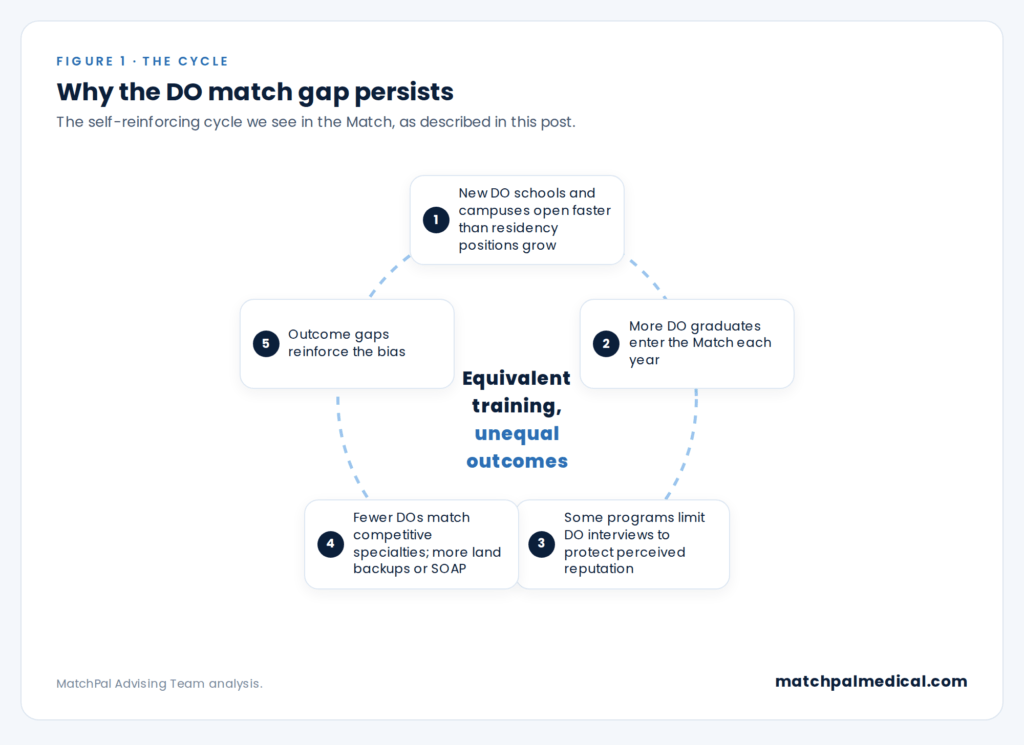
Why does the gap exist in some specialties and not others?
The answer is multi-faceted, and comes down to a mix of applicant competitiveness, bias and hidden advantages, as well as historical factors.
Just looking at objective metrics, there are small differences in MD and DO applicants on average. For example, the mean Step 2 score for matched applicants was 250 versus 248 for MDs and DOs.
These small gaps don’t tell the whole story, however. Students at MD schools generally have the benefit of most robust infrastructure for test prep, research, advising, and making connections through alumni networks. Some programs may favor some applicants because of perceived school prestige or past experiences with residents from that school. Some might have unconscious bias against applicants from a new DO school, for example. If a DO applies with only COMLEX scores to a program that defaults to USMLE for evaluating applicants, this is another opportunity to introduce biases. These are the gaps that MatchPal exists to close with specialty-specific, near-peer and up-to-date test prep and residency advising.
An additional nuance is that some residencies were historically allopathic or osteopathic training programs, and despite the unification of graduate medical education in the past decade, historical preferences likely still play a role in applicant selection.
Ultimately, these differences add up to real gaps in match outcomes, particularly in competitive specialties.
Do DO applicants need higher board scores to match the same specialty as an MD?
In highly competitive specialties (e.g., orthopedic surgery, dermatology), matched DO seniors post stellar Step 2CK and COMLEX Level 2-CE scores, with Step 2 scores that are in the ballpark of (though on average a few points lower than) matched MD seniors. With the existing data, it is not possible to say that for two similar applicants, one DO and one MD, that the DO would need a higher score to match on average. Given the gaps we have already discussed, though, maximizing your scores should be given top priority.
Achieving a high score doesn’t tell the whole story. Matching competitively also requires maximizing the other parts of the application and excelling on away rotations. Achieving the highest score possible for you can do nothing but help your match outcome, but a higher score does not gurrantee a match.
Our full 2026 Step 2 CK and COMLEX Level 2-CE medians by specialty post lays out every specialty side by side so you can see exactly where your own score sits.
What can DO applicants actually do about the gap this cycle?
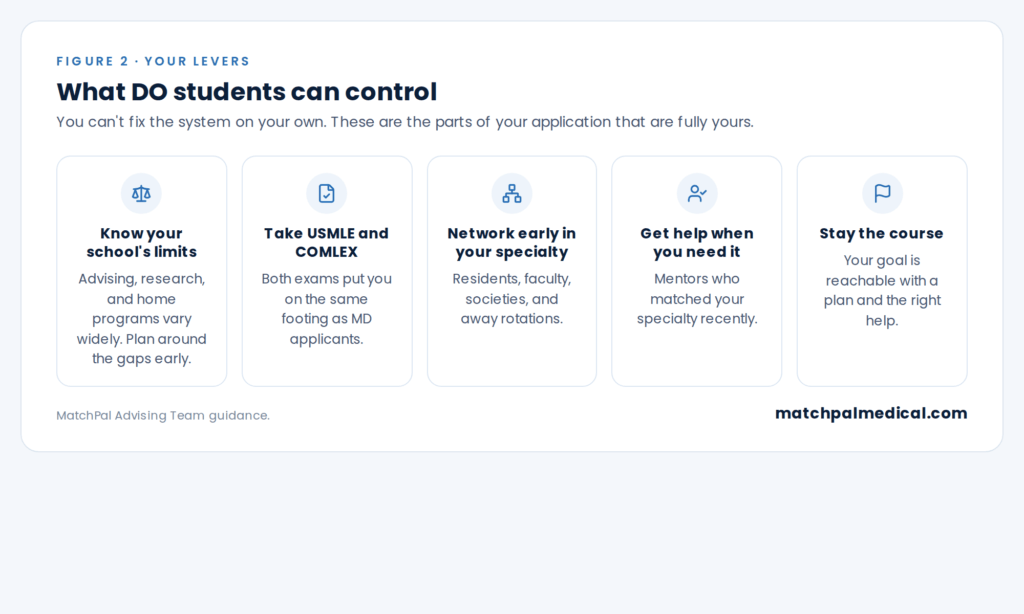
Here’s the gameplan.
Take both the USMLE and the COMLEX. Unless you’re applying exclusively to DO-only Family Medicine programs, sitting for both exams puts you on the same footing as MD applicants at programs that default to Step 2 CK comparisons, and it removes a reason for a program to screen you out before they’ve read anything else.
Network inside your target specialty early. “Early” means MS1 and MS2, not MS3. If your school does not provide the infrastructure (e.g., alumni network), create it yourself through cold outreach.
Learn from successful applicants with a similar background. This might be someone from your school who matched your target specialty last year. It might be someone online who can provide advice. For anesthesiology specifically, two first-person match stories from DO residents who navigated this exact gap are worth reading in full: one matched into anesthesiology as a DO and documented what their school never told them, and another discussed how they matched academic anesthesiology without a home program.
Know when to ask for help, and ask before its too late to make changes. Waiting to get advice on your application until its too late can be more damaging than lack of research or missing a few points on Step 2.
What should DO and IMG applicants know about the match outcome gap?
For DO applicants, we have already discussed the highlights of knowing the DO match rate for your specialty, looking at the median test scores and other metrics, and preparing accordingly. Where possible, weight your list toward programs with a track record of ranking DO residents in your specific specialty.
For IMG applicants, much of the same advice applies. Whether you are a US-IMG or FMG, knowing the specific metrics for your specialty, meeting those thresholds, and then closing the gap in the subjective aspects of the application (e.g., networking, away rotations) are the most important things you can be doing to improve your match outcome.
Stop Guessing, Start Strategizing.
Knowing that a gap exists in your specialty is the first step. Don’t rely on outdated or secondhand advice for closing that gap.
MatchPal is 80+ resident physicians across every specialty, many who recently matched as DOs themselves into competitive specialties and can help you navigate the process.
Book a free strategy call and walk through your own specialty’s numbers so you can plan your next steps.
Built by residents. For the students who are next.
Is DO training equivalent to MD training?
Yes. Both complete four years of medical school and a residency in their chosen specialty under the same ACGME accreditation system. DO students additionally train in osteopathic manipulative medicine (OMM), which adds an additional skill set.
What was the DO match rate in the 2026 Main Residency Match?
7,928 DO seniors matched in the 2026 Main Residency Match, a 93.2% DO senior match rate, according to NRMP’s official 2026 results.
Which specialties had a DO/MD match gap in 2026?
Anesthesiology is a clear example: roughly 87.4% of MD applicants matched in 2026 compared to roughly 72.5% of DO applicants. The gaps are specialty-specific and evolving, nonexistent in some specialties and wider in the most competitive ones.
Do DO applicants need to take the USMLE if they already took the COMLEX?
In almost every case, you should. Unless you’re applying exclusively to DO-only Family Medicine programs, taking both the USMLE and COMLEX puts you on the same footing as MD applicants at numerous programs that default to Step 2 CK comparisons.
What should a DO applicant do if their target specialty has a wide match gap?
Start by reading the specialty-specific data rather than the overall DO match rate, network inside the specialty as early as MS1 or MS2, make sure both board exams are on your transcript, and rotate at and apply to programs with a track record of ranking DO residents in that specialty.