
Clinical Rotation Tips: The Unwritten Rules of Surviving, and Standing Out, During Your MS3 Year
Last updated: October 25, 2026 · Written by the MatchPal Advising Team · Reviewed by Joseph Gofman, DO
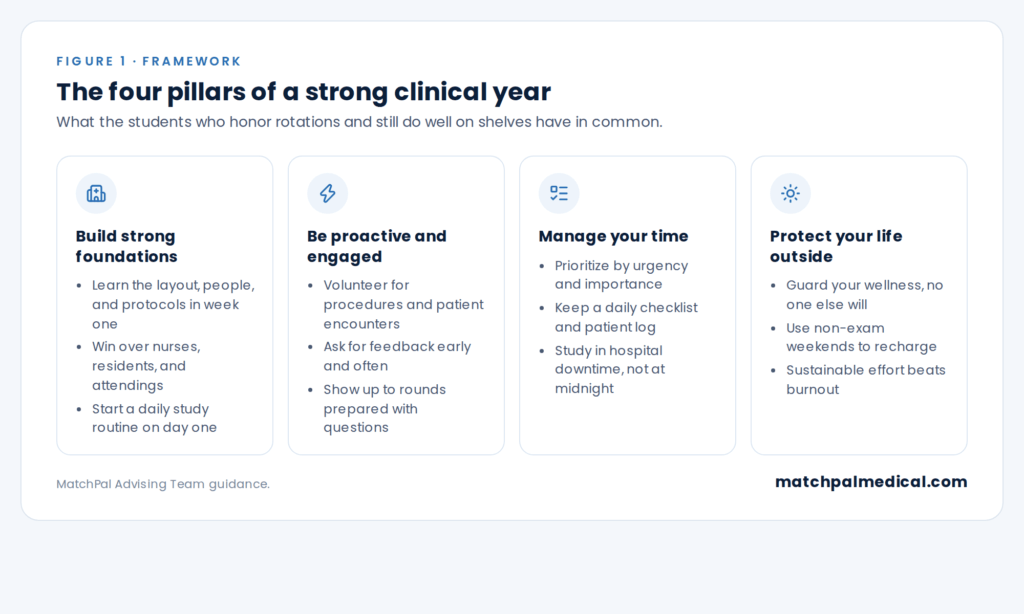
Quick answer: Clinical rotation success is not just about being the smartest person on the team. They are about building key relationships and rapport early on, being proactive without being annoying, managing your time efficiently to maintain your study schedule, and protecting your wellness. Attendings and residents fill out your evaluations based on the impression you make and their memories of your performance. This process rewards students who were consistent in how they showed up prepared, asked good questions, and were pleasant to work with.
You just finished two years of preclinicals, in which your performance was mostly assessed objectively through exams. At most medical schools, clinical rotation grades factor in subjective evaluations, in addition to the shelf exam or other metrics. No one gives you an effective syllabus for how to excel in this new academic environment. If you soon to be starting clinical rotations, or early in your transition, this post found you right on time. The transition out of preclinical years is challenging, and it is worth reading our MS2 to MS3 transition guide to lay a foundation so you aren’t caught off guard early on. This post complements that guide. These are the clinical rotation tips that actually separate students who get strong evaluations and letters or recommendation from students who get forgettable ones.
How do I prepare for my first day of a clinical rotation?
Familiarizing yourself with the logistics of a rotation sets you up for success. Knowing where to show up on day one so you aren’t late, knowing how to navigate the hospital to find patient rooms, the ED, a supply closet, etc., and knowing how to use the EMR to write a progress note or H&P are knowledge that you are (perhaps unreasonably) expected to know.
Show up early your first day to try and figure these things out ASAP. Other things to do early on:
- Carefully observe how your residents use the EMR to chart check patients, use note templates, and access order sets. The more efficient and effective you are at doing this, the more likely your resident will be to see your work as a helpful draft to sign off, rather than something to ignore or start from scratch on.
- Introduce yourself to your patients nurses on day one, and to other support staff (e.g., health unit coordinator, social work) early on. The nurses see more of your patients than you do, and you are expected to know the overnight events they observed. Knowing how to interact with the different members of the patient care team early on will make you look like more like a seasoned Sub-I than fresh M3.
- Set up a study routine from the very first day. Clinicals truly test your ability to juggle multiple responsibilities, and effectively studying for at least one hour despite a full day at the hospital will set you up for success.
How do I stand out and get good evaluations on rotations?
Being prepared and proactive are the biggest factors in your control. Clinical knowledge gaps are expected at your level, but being noticably unprepared or passive is not.
For preparation: demonstrate that you can gather data, interpret it, and form a plan. The first two are commonly done well by students early in their rotation, but forming a reasonable plan will separate you from you classmates. If that means showing up earlier so you have time to gather, interpret, and plan for all your patients, or forming effective rapport with a trusted resident so you can run your plan by them before rounds, going to this next level and operating at the level of a sub-I or early intern will certainly make you stand out.
Be proactive. Volunteer before you are asked. If there is a procedure happening and nobody has specifically assigned you elsewhere, go watch it. If a resident is drowning in discharge paperwork, offer to help draft one. Come to rounds prepared, every time. Know your patients’ overnight events, current vitals and trends, and active problem list before anyone asks.
Finally, ask for feedback mid-way through your rotation, not just near the end. Some rotations will have this built in. You need this data so that you can act on it before the rotation is already ending. Residents and attendings notice when a student actually improves after feedback.
What is the best way to manage time on a clinical rotation?
Twelve-hour days at the hopsital do not leave room for a leisurely study schedule, so your time management needs to be highly effective.
What does not work:
- Planning to study for three hours every evening after a 12-hour shift. It sounds disciplined on paper but collapses quickly.
- “Winging it” when it comes to pre-rounding, presenting on rounds, or scrubbing into a case
What actually works:
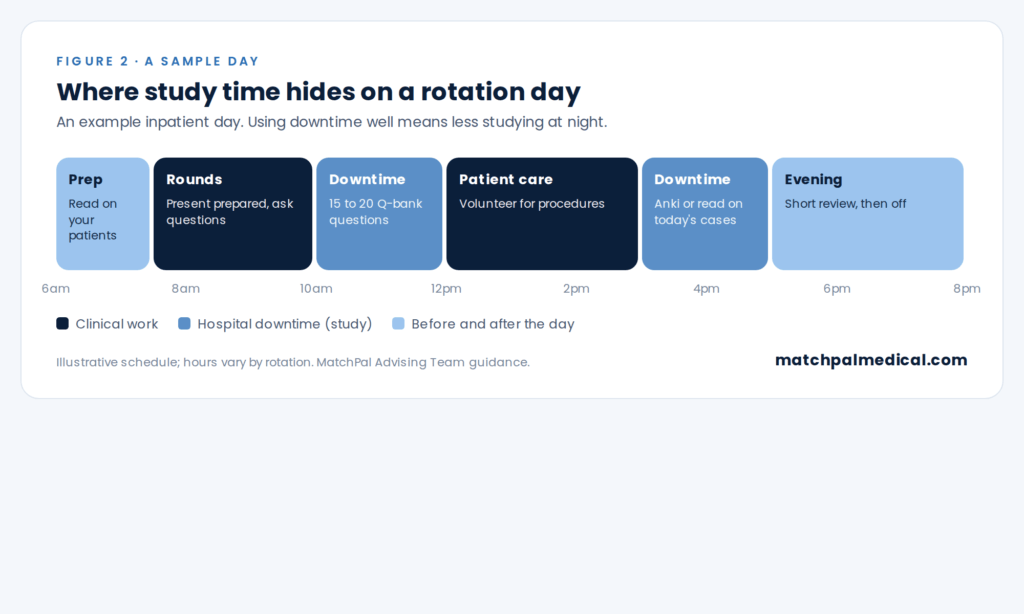
- Studying in small, high-yield bursts during downtime (a quiet afternoon between admits, a slow call night, the twenty minutes between finishing pre-rounding and rounds starting). Anki flashcards or UWorld questions on iPad or phone work great here.
- Creating a realistic goal for studying at home, like doing UWorld for one hour before going to bed.
- Build an efficient workflow and checklist for chart checking and pre-rounding on each patient (preferably organized in SOAP format) so you are not missing important data or trying to regurgitate from memory on rounds.
- Study based around your actual patients. If your patient has new-onset atrial fibrillation, and you haven’t studied it in depth yet, read the AMBOSS article on Afib and do the associated practice questions. It will both make you look highly prepared, but also benefit your long-term studying.
- Note: Some rotations require the student to give a presentation, so you can consider getting ahead of the curve by volunteering yourself to present on one of these topics if it seems appropriate.
How do you avoid burnout during third year?
Medical school selects for people who are used to enduring long days and intense study schedules, and third year will test how far you can stretch that.
Pushing yourself nonstop is going to backfire in the long run. You need to schedule in wellness time the same way you would a study block. Protect at least one evening a week for something that has nothing to do with medicine. Use weekends to actually recharge instead of only catching up on studying. Short but consistent daily exercise beats an ambitious routine you abandon after a few late nights.
- Do build a wellness habit that survives a bad day/week, even if it is just a short daily walk.
- Don’t sacrifice sleep to get back time studying or to reclaim leisure time you are missing out on (so-called “revenge bedtime procrastination“)
- Do give yourself grace for missing a day of studying due to unavoidable factors like a late or complex admission, or volunteering to stay for a late procedure
What happens after you get comfortable on your core rotations?
Strong core rotation performance is the starting point, that sets you up for what comes next. A few strong letters of recommendation in your back pocket. Preparation and habits that will let you stand out on your Sub-Is and away rotations. Memorable patient vignettes that you can come back to when you are composing your personal statement or preparing for interviews (see the Ultimate Residency Interview Checklist for how you can deploy rotation stories as effective talking points).
Once you have core rotations down, the next strategic move is preparing to excel on sub-internship/away rotations, which come with a new set of expectations. We cover this in depth in the Sub-I and Away Rotation Playbook. Check out our free VSLO guide below so you are prepared to effectively apply for aways.
What should DO and IMG applicants know about clinical rotations?
If you are a DO or IMG student, rotations carry extra weight because they are often your clearest chance to prove clinical competence to programs that may be less familiar with your school.
Approach every rotation as if it was your Sub-I at your top choice program, because it is the single biggest factor at improving your chances at getting an interview there (if the rotation has an associated residency), and strong, specific letters from attendings who know your work well will be a real benefit to your application in general. If you are applying to a specialty and don’t have a home program, these rotation sites are the closet thing you have, especially if you left a good impression.
Stop Guessing, Start Strategizing.
Clinical rotation tips from a blog post can only take you so far. If you need support, what can actually improve your outcome is having someone who actually evaluates medical students, reviews residency applications, and interview candidates look at your situation.
MatchPal’s team of 80+ resident physicians, currently training across every specialty, works with students on exactly this kind of clinical rotation support. If you want support built on your rotation schedule, specialty interest, exam goals, and application timeline, book a free strategy call today.
Built by residents. For the students who are next.
What are the most important clinical rotation tips for a new MS3?
Learn hospital layout, EMR, and resident workflow in your first 48 hours. Build relationships with nurses and residents from day one. Come to rounds prepared with your patients’ data gathered, interpreted, and formed into a plan every day. Build a study and wellness routine you can sustain through long days on rotation.
How do I get good evaluations during clinical rotations?
Be prepared and proactive. Volunteer for procedures before being asked, come to rounds with a clear plan for each patient, and ask for feedback at the midpoint of the rotation rather than waiting until the end, so you have time to actually act on it.
How can medical students manage time during clinical rotations?
Study in short, high-yield bursts during downtime and short blocks after rotation, instead of an intense but unrealistic study schedule. Develop an efficient workflow/checklist for pre-rounding and presentations. Study around your actual patients pathologies. It’s more efficient and you will be remembered as well-prepared and engaged.
How common is burnout during third year of medical school, and how do you prevent it?
Burnout is common enough that it deserves a real plan to avoid it. Treat wellness as a scheduled, non-negotiable habit. Protect at least one evening a week and part of your weekends for wellness. Build small, sustainable routines rather than ambitious ones you abandon after a hard week.
What should I be focusing on after I get comfortable on clinical rotations?
Strong performances on core rotations leads to strong performances on sub-internships and away rotations, where stakes and expectations rise. If you plan for it, your rotation can generate strong letters of recommendation, and memorable patient stories for your personal statement and interviews.