
How to Choose a Medical Specialty: A Complete 2026 Framework
Last updated: October 27, 2026 · Written by the MatchPal Advising Team · Reviewed by Ian Rumball, MD
Quick answer: Choosing a specialty is a specific process for each medical student, but typically comes down to some common inputs: which of the core fields of medicine stimulate your curiosity and energize you on rotations, whether you want to perform procedures, preference for longitudinal patient relationships, how much lifestyle flexibility you need, and if there is a particular population or age group you want to care for. You also need to take into account your competitiveness (e.g., board scores, research) relative to the average matched applicant from that specialty. You no longer have to guess your way through this process. Start with this post, and check out MatchPal’s free specialty selector quiz to give you a data-driven starting point on possible specialty interest in under a minute.
If you’re reading this, you’re probably somewhere between MS1 and MS3, and everyone keeps asking the same question: “What specialty are you thinking?” There is pressure to commit to a specialty choice before you have even had enough time on that service to know it is right for your future career.
Having a preliminary interest can be helpful as it allows you to get involved with a specialty earlier, to ensure your CV is ready when it comes time to apply. It can also help you by giving you a reference point when you are on rotations, so you can assess if a different specialty you are currently rotating on might actually be a better fit. This guide is written so you can have that starting point. Even if you change your mind, it is better to consider this pivotal choice earlier rather than later.
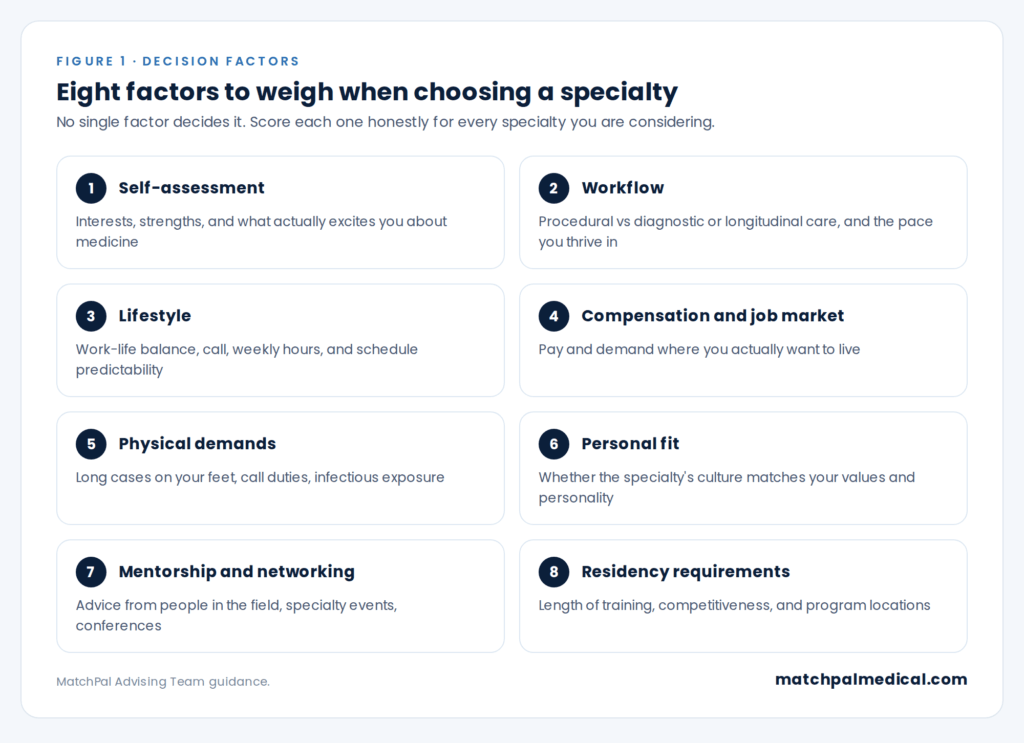
What are The core medical specialties?
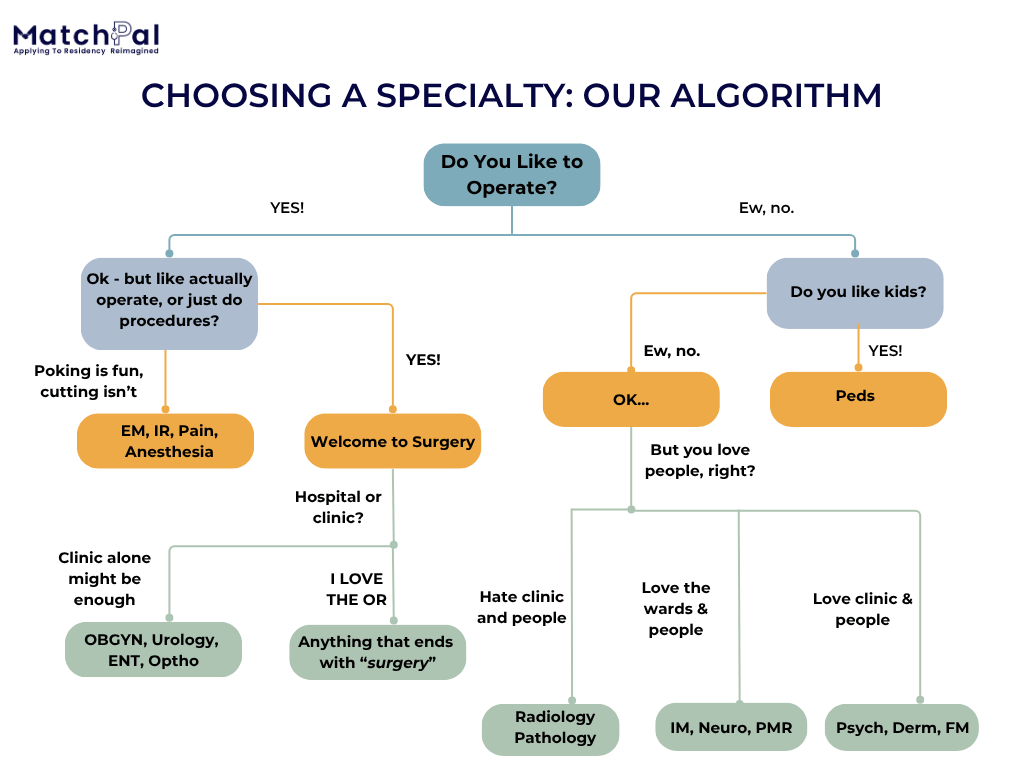
There are different ways to break down this question. Some might split it into surgery or not surgery. Some might say there are procedural specialties (e.g., general surgery), medial specialties (e.g., internal medicine), or somewhere in between (e.g., anesthesiology). We think that there are ultimately a few key questions you need to ask yourself.
The first is do you like to operate? And by operate, do you mean the OR, or do you just like procedures in general? This is the first major branch point, that differenties true surgical specialties, from those with plenty of procedures, from the medical and diagnostic specialties.
If you’ve decided you don’t want to focus on procedures, some important questions include do you want to work with kids? If so, apply pediatrics. Next, how much direct patient interaction do you want? If you want to be a clinician first, then you are looking at inpatient and outpatient medical specialties. If you want to focus on a specific branch of diagnostics, you are looking at diagnostic radiology or pathology.
There are certainly exceptions to this framework shown below (e.g., applicants applying Dermatology who want to do Mohs microsurgery). However, ultimately medical specialties can generally be placed into one of a few core categories:
- Surgical
- Procedural
- Pediatrics
- Medical (inpatient or outpatient focused)
- Diagnostic
Procedural or not? How do I know what’s right for me?
This is usually the first real fork in the decision, and it is bigger than just “do you like surgery?” or “do you like the OR?”
Ask yourself: Do you feel most useful solving a problem with your hands in a focused window of time, or do you feel most useful building a relationship with a patient over months and years? Do you prefer a day that is scheduled around cases and blocks, or a day built around a clinic panel and a changing mix of acute and chronic problems?
Neither answer is “better” or more impressive than the other. What matters is being honest about which one actually sustains you, because residency and you career are a long time to be doing something that doesn’t fit your personality.
How much should lifestyle and work-life balance factor into my decision?
More than your school or most attendings will tell you, and more than most students admit out loud or on social media.
Every specialty has its own baseline for call frequency, shift structure and length, and how much of your schedule you actually control once you are an attending. Surgical subspecialties and some procedural fields tend to demand longer and less predictable hours, especially during training. Many longitudinal and outpatient-heavy fields offer more schedule control, though “more control” is not the same as “easy.”
The truth is that a lifestyle preference is not a weakness to hide from your advisors or even residency interviewers. Programs would rather match someone who is honest about what sustains them than someone who burns out early in residency because they picked a field for the wrong reasons. At the same time, don’t rub people wrong way. For example, don’t go onto a dermatology or radiology rotation and exclusively emphasize how lifestyle factors are the main reason you are choosing the specialty.
Should specialty competitiveness influence my choice?
It should factor in, but it shouldn’t outright stop you from applying to something you love. It should change how you prepare, not necessarily what you pursue.
Board score and research expectations vary widely by specialty, and the gap between the least and most competitive fields is significant. MatchPal’s full breakdown of 2026 Step 2 CK and COMLEX Level 2-CE medians by specialty lays out exactly where matched MD and DO applicants landed this cycle, specialty by specialty.
To put it simply, if your current trajectory puts you below the median for a field you are drawn to, you need to act on this information. Either this means you need to make adjustments to your current approach to board exam prep, research, or away rotations; or it may mean you need to be realistic with your competitiveness and consider dual applying or targeting another specialty.
If this is a decision you are currently dealing with, you aren’t in this alone. This is the gap that MatchPal exists to close. Schedule a free strategy call in the form below, and we can start planning your next steps.
Can research expectations influence my competitiveness for my chosen specialty?
For some fields, this is a resounding yes. Research-heavy specialties expect a track record that demonstrates a similar level of interest in the field to other applicants.
Starting with the 2026 cycle, the NRMP shifted how it reports applicant research output, moving from a single combined reporting of all research output, to more precise averages by category (abstracts, presentations, and publications). That is a more honest number than the old combined averages, and it means the specialty you are drawn to may have a very different research average than you assumed from prior data. MatchPal’s breakdown of what the 2026 NRMP data really says about research and the match walks through exactly how that shift changes the picture, and the post on research after Step 1 went pass/fail covers the role of research in the residency application after other objective metrics like Step 1 scores have been removed.
How do core rotations and away rotations help me decide?
On paper, a wide variety of specialties sound interesting. Who wouldn’t want to successfully perform an emergency surgery? Who wouldn’t want to feel like Dr. House as they diagnose and treat an emergent metabolic derangement? When you see the day-to-date reality of the general surgery or internal medicine services on you core rotations, however, you will get a much better sense of not only the interesting, but the mundane and draining aspects of a given field.
Use your core clerkships deliberately: pay attention not just to whether you like the material and the exciting times, but to whether you like the people, the pace, and the actual daily rhythm of the team you are rotating with.
Once you have narrowed your specialty choice, away rotations and Sub-Is are where the decision gets tested under real conditions, and where programs also get a chance to evaluate your fit. MatchPal’s Sub-I and away rotation playbook covers how to choose which rotations to pursue and how to perform once you are there.
Is there a free tool that can help me choose a specialty right now?
Yes, MatchPal’s specialty selector is a free quiz built specifically for medical students weighing this exact decision. It takes less than a minute and gives you a data-driven starting point based on your actual interests and preferences, not just a guess. It will not replace rotations or mentorship, but it is a genuinely useful starting point.
What should DO and IMG applicants know about choosing a specialty?
The same self-assessment framework applies regardless of your degree or pathway. What changes is how you need to weigh competitivenes. DO and IMG applicants should look specifically at DO- and IMG-specific board medians and match-rate data rather than assuming MD benchmarks apply evenly across every field.
MatchPal’s 2026 DO vs MD match rates by specialty breakdown shows exactly where that DO/MD gap is real and where it has closed, specialty by specialty.
Bottom line: A specialty having a lower DO or IMG match rate is not the same as it being closed to you specifically. It changes your strategy around board score and research expectations, away rotations, program signaling, and decision to dual-apply, not your right to pursue the field.
Stop Guessing, Start Strategizing.
A specialty decision made from secondhand or outdated advice is one you might have to go back and change later.
MatchPal’s advising team is built from 80+ resident physicians, currently in training across every specialty, many of them sitting on their own programs’ admissions committees right now. They know what a realistic applicant profile looks like for their field because they are evaluating applicants for it this cycle. That is the kind of insight your school or a quiz might not be able to give you. Book a free strategy call and talk through your specific situation with someone who has been exactly where you are.
Built by residents. For the students who are next
What are the core medical specialties?
There are exceptions, but most specialties can be categorized into the following groups: Surgical, procedural, pediatrics, medical (inpatient or outpatient focused), and diagnostic.
What is the best way to decide between a procedural and a non-procedural specialty?
Pay close attention on your core clerkships and be honest about which kind of day actually interests and energized you: focused procedural blocks or longitudinal relationships with patients. MatchPal’s free specialty selector quiz is also a useful first pass before you narrow your list.
Does my board score limit which specialty I can choose?
It should inform your choice and next steps, not rule out a specialty outright. Check the 2026 Step 2 CK and COMLEX Level 2-CE medians by specialty to understand where you stand, then build a plan around research, away rotations, signaling, and possibly dual-applying to close the gap.
Is the MatchPal specialty selector tool actually free?
Yes, it is free and takes around a minute to complete.
Do DO and IMG students need a different approach to choosing a specialty?
The self-assessment process is the same, but DO and IMG applicants should weigh specialty-specific match-rate data for their own degree pathway rather than assuming MD benchmarks apply across the board.