
Away Rotations in Medical School: What to Consider Before You Apply (Updated for 2026)
Last updated: October 28, 2026 · Written by the MatchPal Advising Team · Reviewed by Ian Rumball, MD
Quick answer: Away rotations are clinical electives you complete outside your home institution, applied for through VSLO (the Visiting Student Learning Opportunities platform) at a $15 fee per elective program. Your biggest responsibilities are having your documents ready early, picking a realistic mix of target and safety programs, timing your applications to the review cycle, and knowing how an away rotation fits your specific specialty strategy. If you want to know more about how you will be evaluated on the rotation and how to impress, check out the Sub-I and Away Rotation Playbook.
If you are staring at the VSLO portal for the first time, you are at an important juncture in your road to residency. Away rotations can open doors at programs that might otherwise skim over your application. They can also eat away at your free time and budget, especially if you start applying to them without a plan. This post provides an introduction to what away rotations involve, what they cost, and a handful of key considerations as your plan your away rotation strategy.
How much does it cost to apply for away rotations?
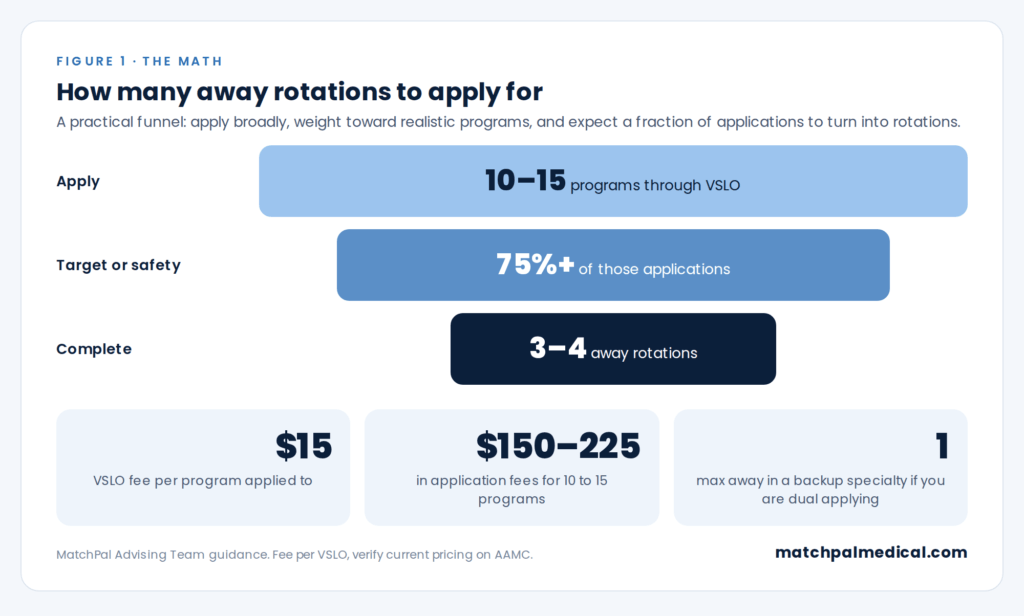
Away rotation applications cost $15 per elective program through VSLO, per AAMC’s VSLO FAQ. Requesting alternate dates for the same elective at the same institution does not add an additional fee, which matters if a program’s first available block does not fit your schedule.
The total number will depend on your specific application strategy, and this is just the cost for submitting your application. You also have to consider travel, housing, local transportation. Some programs may assist with housing, but this is case-by-case.
How many away rotation programs should I apply to?
A reasonable starting range is 10 to 15 program applications to secure 3 to 4 actual rotations, since not every program will offer you a spot even if you are a strong applicant.
Split your list deliberately rather than applying to your dream programs only:
- Target and safety programs: a strong majority of your list, meaning places that match your applicant profile (MD vs DO vs IMG, board scores, specialty specialty competitiveness)
- Reach programs: a small minority, reserved for places you would take a real chance on but should not anchor your strategy around.
Use your own school’s match list as data. If students from your school have matched into a given institution recently, or if you are an osteopathic student and see that this program has recently matched DOs, these are strong signals the program is realistic for someone with your background.
If you have not built a working list of programs yet, MatchPal’s free VSLO Database and Ultimate VSLO Guide are both free resources to check out.
How does applying to away rotations work?
Away rotations are applied for almost entirely through VSLO, the centralized platform most U.S. medical schools use for visiting student electives. There are rare exceptions where you may need to reach out to the institution directly.
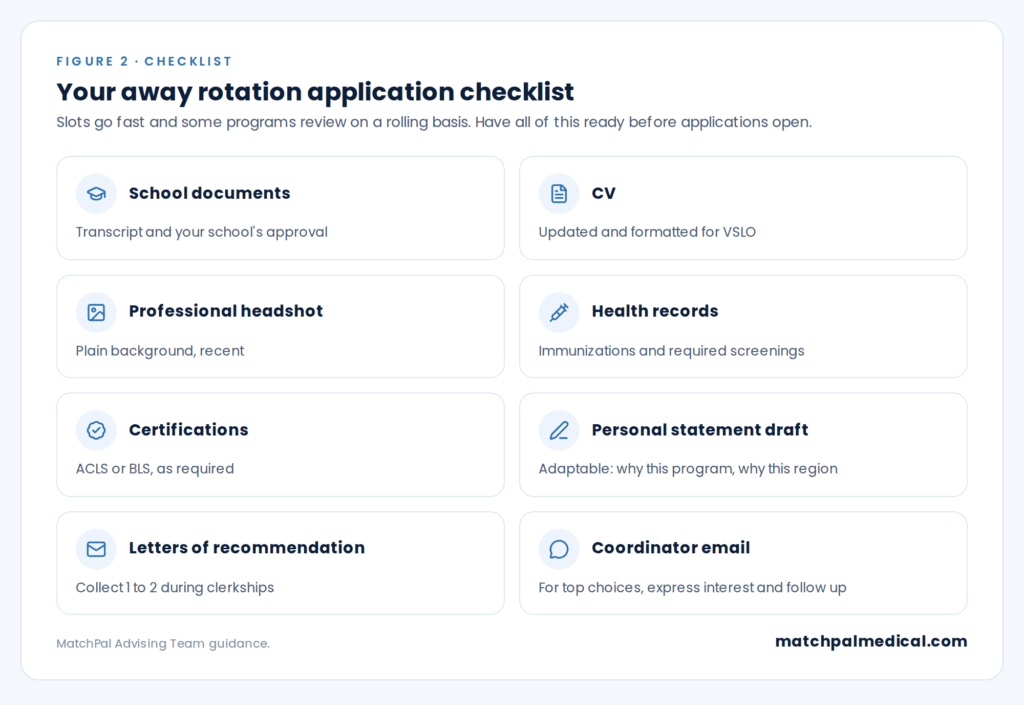
Before you can submit your VSLO application, you need:
- Your school’s approval to participate in visiting rotations, and an official transcript release.
- A current CV and a professional headshot.
- Immunization and health records, typically including a recent TB test or titers.
- Certifications (e.g., BLS or ACLS), depending on the specialty and institution.
The single biggest mistake students make here is procrastination. Every one of these documents has its own turnaround time, and schools process transcript releases and approvals on their own schedule, not yours. Have everything assembled well before you plan to submit.
How do away rotation applications get reviewed, and should I follow up?
Programs review applications differently. Some work on a rolling basis and extend offers as applications come in, while others wait until a submission deadline and review the full pool at once.
This is a situation where a short, professional follow-up email genuinely helps, especially for rolling-review programs where visibility can matter.
A script that works: “Dear [Program Coordinator], my name is [Name], and I am a [MS4] from [School] who recently submitted a VSLO application for [Rotation] during [block dates]. I wanted to confirm my application was received and express that [Program] is a strong priority for me this cycle. Please let me know if there is any additional information I can provide. Thank you for your time.”
Keep it short, specific, and free of generic flattery. Program coordinators get a lot of these, but in some cases they lead to more focused or prompt consideration of your application.
Should I prepare before starting an away rotation?
Programs hosting away rotators are almost always evaluating whether you would be a good fit as an eventual resident, not just as a visiting student for four weeks. Have a draft answer ready for “why this institution,” because you will likely be asked some version of that question during the rotation, whether informally by residents or more directly by faculty. A vague answer reads as a vague interest in the program itself.
When it comes to impressing on service, being well-prepared with regards to content and logistics is key. This is especially important for sub-internships, when you are trying to demonstrate you are capable of operating at the level of an early intern. Best methods for preparation are going to vary by specialty, so this is where talking with a mentor in your specific specialty is essential. For more high-yield prep, check out our Sub-Internship Bootcamp series.
How should dual applicants approach away rotations?
If you are applying to two specialties, your away rotation strategy should reflect your intended match outcome.
The majority of your rotations should be in your primary/intended specialty, especially if this is a competitive field, since this is one of the single biggest factors to improve your chances at matching at one of these programs.
In your secondary/backup specialty, you should complete at least one rotation to demonstrate interest, obtain a strong letter of recommendation, and gain experiences that you can refer to in your interviews.
How do away rotations affect letters of recommendation?
Letters obtained during clerkships, including away rotations, carry weight because they come from people who know your work.
In addition to at least 1 to 2 letters generated during your core clerkships, aim to obtain at least 2 letters of recommendation in your specialty between away rotations and sub-internships. You can obtain more if possible. Get your core letters (the ones that you think with be the strongest endorsements) that you plan to assign to most or all programs. Also know that ERAS rules allow you to assign different letters to different programs. For example, if you are applying to Program X that accepts 3 letters per applicant, swapping a core letter out for one from an attending at program X could carry a lot of weight.
In general, ask for a letter while the attending’s impression of you is fresh, ideally before the rotation ends. “Can you write me a strong letter of recommendation?” Then, if they accept, follow up promptly via email with your most updated personal statement and CV. Don’t wait to reach out until months later when they hardly remember you.
Stop Guessing, Start Strategizing.
The basics above will get you started. They can’t tell you exactly which programs make sense for your specific board performance, specialty, and timeline, or how to turn a four-week rotation into a strong letter and a real shot at an interview invite.
MatchPal’s 80+ resident physicians, training across every specialty, help students build exactly that kind of personalized away rotation strategy. More in depth advice can also be found in our Sub-I and Away Rotation Playbook.
If you want a plan built around your specific specialty and application cycle, a free strategy call is the fastest way to get one.
Built by residents. For the students who are next.
How much does it cost to apply to away rotations through VSLO?
Each program application costs $15 through VSLO. Requesting alternate dates for the same elective at the same institution does not add an additional fee.
How many away rotation programs should I apply to?
A reasonable starting range is 10 to 15 program applications to secure 3 to 4 actual rotations. Most of that list should be realistic target and safety programs for your MD or DO background and specialty, with only a small number of reach programs included.
Should I follow up with away rotation program coordinators after applying?
Yes, a short, specific, professional follow-up email confirming your application and expressing genuine interest can help, especially for programs that review applications on a rolling basis rather than all at once.
How should dual-specialty applicants split their away rotations?
The majority of away rotations should go toward your primary specialty, where impressing and increasing match odds, and obtaining letters of recommendation matter most. One away rotation should go toward a backup specialty, used to confirm genuine interest and obtain a letter of recommendation.
What documents do I need ready before applying for away rotations?
You need your home school’s approval and transcript release, a current CV and headshot, immunization and health records, and relevant certifications (e.g., BLS or ACLS). Some programs will require a letter of recommendation or personal statement. Assemble all of these before you plan to apply, since each has its own turnaround time.