
The USMLE Cheating Scandal: What Happened and Where We Stands in 2026
Last updated: October 28, 2026 · Written by the MatchPal Advising Team · Reviewed by Ian Rumball, MD
Quick answer: In January 2024, the USMLE (the testing program administered by the NBME and FSMB) invalidated scores of 832 examinees after an investigation found anomalous testing patterns. The examinees called into question were tied to a leaked exam-recall document that had circulated through chat groups and covered more than 90% of live test content, concentrated at testing centers in Nepal and several other countries. ECFMG certification was invalidated for affected examinees, and NRMP status reports previously sent to residency programs were corrected. A federal court later denied an emergency motion from an examinee seeking to restore a score, upholding the invalidation. As of this writing, the matter is closed and no appeals are pending.
The USMLE exams are a rite of passage for every MD, DO, and IMG applicant pursuing residency in the United States, and the security measures around it exist because the exam’s credibility depends on every score meaning the same thing. In early 2024, that credibility was tested directly. Here is what actually happened, what the investigation found, and where things ended up legally. Ultimately, none of this should change how an honest test-taker thinks about their approach.
What happened in the USMLE Nepal cheating scandal?
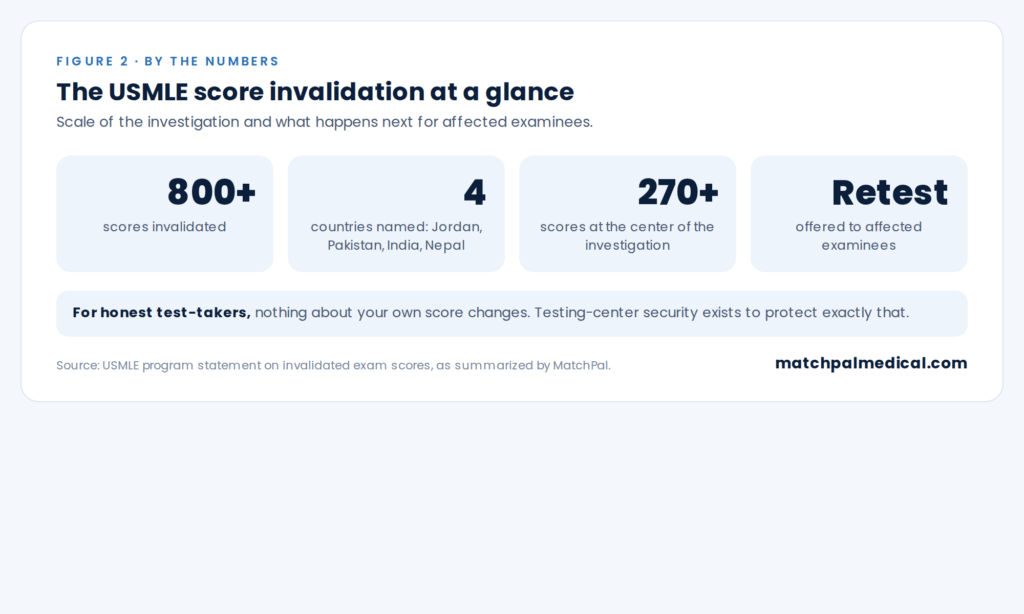
In January 2024, the United States Medical Licensing Exam (USMLE) program, co-administered by the National Board of Medical Examiners (NBME) and Federation of State Medical Boards (FSMB), announced it had invalidated the test scores of 832 examinees.
The exams were flagged as suspicious due to irregular resting patterns, and the anomalous performances were traced to a leaked exam-recall document that had circulated through chat groups and reportedly covered more than 90% of live test content, with the affected activity concentrated at testing centers in Nepal.
As part of the same action, ECFMG certification was invalidated for the affected examinees, and NRMP status reports that had already been sent to residency programs were corrected to reflect the change.
How did USMLE detect cheating?
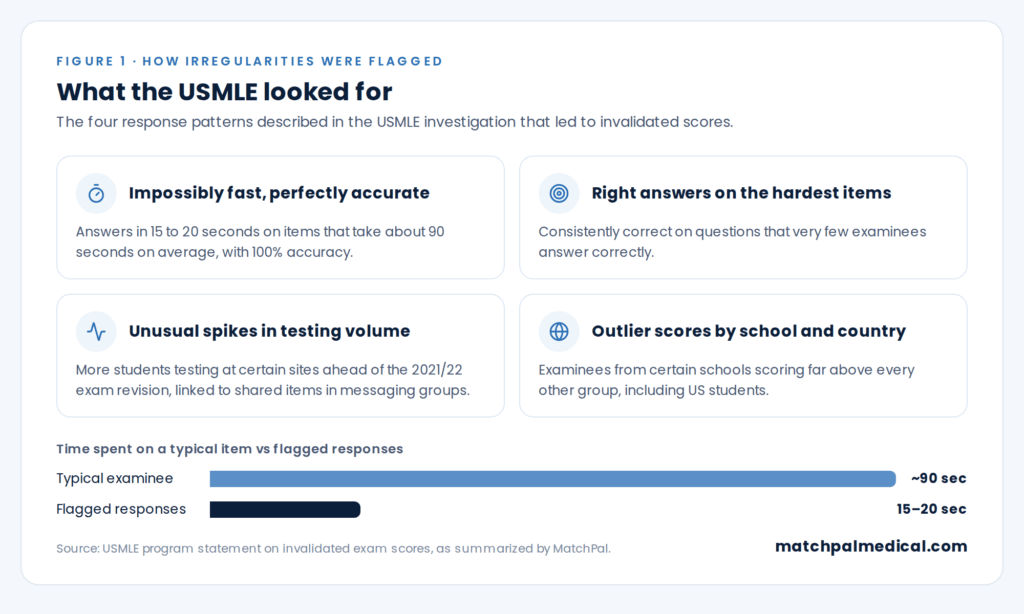
While not explicitly stated in the official announcements, documents from the subsequent legal case Giri v. National Board of Medical Examiners provides useful insights into how cheating was detected. Red flags that an applicant is utilizing an illegal exam-recall document included:
- Abnormally fast response times, for example responses in 15 to 20 seconds on questions that typically take about 90 seconds, paired with unusually high accuracy on those same questions.
- Consistently correct answers on questions with historically low correct-response rates across the test-taking population.
- Abnormal testing-site volume in the period leading up to an exam revision, consistent with test-takers seeking out specific sites where exam content may have been shared and discussed through chat groups.
- A geographic scoring anomaly, with examinees testing from Nepali medical schools scoring significantly higher, as a group, than test-takers from any other country, including the United States.
Taken together, these amounted to strong evidence of academic dishonesty.
How many USMLE scores were invalidated?
832 examinees, predominantly testing in Nepal.
What happened to the examinees whose scores were invalidated?
Affected examinees had both their USMLE scores and their ECFMG certification invalidated, and residency programs that had already received status reports on those examinees had those reports corrected.
Examinees affected by the invalidation were given the opportunity to retest. At least one examinee pursued a legal challenge (Giri v. National Board of Medical Examiners). In summary, a judge denied the examinees emergency motion for preliminary injunction to reinstate her test scores, in January 2025 the court granted the NBME’s motion to dismiss the complaint, and the appeal initiated in February 2025 was officially terminated a few months later. There are no active legal proceedings at this time.
Where do things stand now, in 2026? How does the cheating scandal impact me?
There are no active legal proceedings at this time. As stated, affected examinees had an opportunity to re-test and continue their medical careers. For current test-takers, this history is relevant to understand the measures in place to protect exam integrity.
If you test honestly, you have nothing to be concerned about. Clearly if you utilize illegal exam-recall documents, there is a possibility of your performance being flagged and your score invalidated.
What should IMG applicants know about test security and this case?
The investigation centered on testing centers outside the United States, so it is natural that IMGs would be curious how the case may impact their exam experience or general perception of IMG applicants.
In short, this case should have no impact on your test-taking experience assuming you test honestly. While there may have been negative sentiment towards IMG applicants in the months following the scandal announcement, largely unfair given the concentrated nature of the cheating, the case should not affect your perception in the residency application process going forward. It is highly unlikely that a residency program in 2026 will look at your USMLE score with suspicion based upon a prior highly-concentrated cheating incident.
Stop Guessing, Start Strategizing.
The USMLE cheating scandal has come and gone, and reinforces both the impact of these examinations and the robust exam integrity procedures in place. What hasn’t changed is the impact of an excellent, honest score on your Match outcome, and what it takes to get there. A real plan, consistent practice, and someone experienced checking your blind spots.
MatchPal’s 80+ resident physicians, with a 99% USMLE/COMLEX pass rate including retakers, help students build exactly that kind of plan, with no shortcuts and nothing that would ever put your certification at risk.
If you want a resident physician in your corner for your own Step or COMLEX prep, start with USMLE and COMLEX tutoring or book a free 15-minute strategy call to talk through your timeline.
Built by residents. For the students who are next.
How many USMLE scores were invalidated in the Nepal cheating scandal?
832 examinees had their scores invalidated, tied to anomalous testing patterns traced to a leaked exam-recall document that circulated through chat groups and covered more than 90% of live test content.
Is the USMLE cheating scandal still an open investigation?
No. As of this writing it is a closed, resolved case. The invalidations were upheld, affected examinees were offered the opportunity to retest, and a federal court denied an emergency motion and subsequent appeals from an examinee seeking to have their score restored.
How did the USMLE program detect the cheating?
Through detection of statistical anomalies: unusually fast, highly accurate responses, correct answers concentrated on questions with historically low correct-response rates, abnormal testing-site volume, and a cluster of examinees scoring far above every other country’s test-takers.
Were any scores restored after the investigation?
No. A federal court in the District of Columbia denied an examinee’s emergency motion and subsequent appeals to restore an invalidated score.
What does the USMLE cheating scandal mean for honest test-takers?
It means the exam’s statistical integrity checks worked as designed. The investigation targeted a specific, identifiable pattern tied to a leaked exam-recall document. There was no impact on examinees who tested honestly.