Your away rotation is a four-week interview that decides your career. And yet, most medical schools spend zero time teaching you how to actually perform on one.
The data is consistent across specialties: roughly 50% of matched applicants match at a program where they rotated. Your away rotation isn’t just one part of your application anymore. It’s often the deciding part — the de facto interview that happens before you’re actually invited to interview.
So if Sub-Is and aways are this important, why are you left to figure it out on the fly?
Across the hundreds of students we advise each cycle, the pattern is consistent. The students who match into their top programs aren’t necessarily the smartest. They’re not necessarily the highest-scoring, either. They’re the ones who understood the unwritten rules of every rotation.
Here’s what they know that everyone else doesn’t.
What Program Directors Actually Evaluate
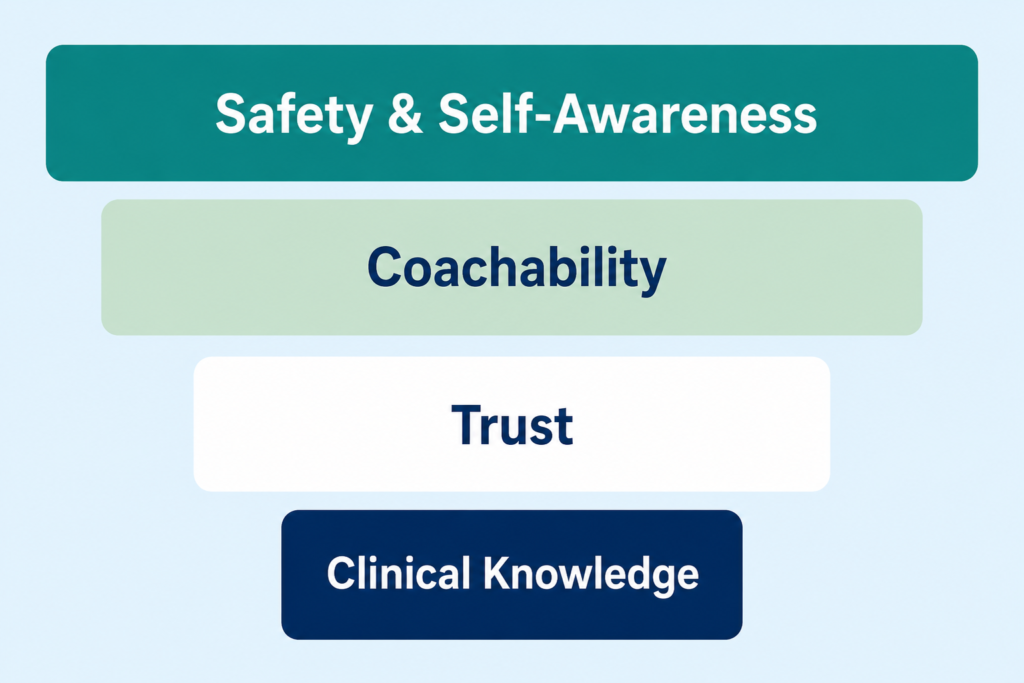
Most students walk into a Sub-I assuming clinical knowledge dictates their evaluation . It doesn’t.
Based on our surveys of program directors and chief residents across multiple specialties, here is what they are actually looking for, roughly in order:
- Are you safe and self-aware?: Do you know what you don’t know?
- Are you coachable?: When given feedback on Tuesday, are you better on Wednesday?
- Can they trust you?: When you say you’ll do something, does it get done?
- Clinical knowledge + genuine interest: Yes it matters. But it’s fourth, not first.
- Do you take initiative without overstepping?: Can you own your patients, know their charts, AND know when it’s time to let someone else take over?
- Are you professional with every team member? Not just the attendings. Every team member.
The students who match into competitive programs internalize this hierarchy. They are the ones who don’t spend their rotation trying to demonstrate how much they know – and instead show that they are good, trustworthy co-workers who know how to be part of the team.
The First 48 Hours
The single most undervalued window in any rotation is the first two days. So take advantage, and show them you will be a valuable member of the team as early as possible.
How to start off on the right foot:
- Show up 15 minutes early on day one. Not 30. Eager but not desperate.
- Introduce yourself to every team member by name – including nurses, techs, coordinators, and unit clerks. Use their names by day two. They talk to the residents.
- Find the chief resident in your first shift. Ask one question: “What’s the best way for me to be useful to you over the next four weeks?”
- Watch how the team functions before you try to insert yourself. Week one is for listening, not performing.
What kills rotations in the first 48 hours:
- Trying to impress the attending on day one
- Volunteering for things you can’t deliver on
- Asking residents questions you should be asking the intern
- Disappearing without telling anyone where you went
The students who match are the ones who spend week one absorbing the system. No one is expecting you to perform right away. Take your time, secure the right rotation, and learn how to do things their way.
How to Get Pimped Without Losing the Room
Every rotator gets pimped. Every rotator gets questions they can’t answer. Being unforgettable doesn’t mean knowing everything, it means knowing how to handle not knowing.
So here’s what to do when you inevitably get asked a question you can’t answer:
1. Don’t guess. Wrong answers stated confidently are worse than admitting you don’t know. Attendings can tell when you’re bluffing, and your credibility will take weeks to rebuild.
2. Show your reasoning. “I’m not sure of the exact answer, but my approach would be to consider X, Y, and Z because…” This demonstrates how you think, which is what they’re actually evaluating.
3. Close the loop. Look it up that night. Come back the next day and say: “You asked about X yesterday – I read up on it and here’s what I learned.”
Doing step three even once will be remembered for the entire rotation. Doing it consistently puts you in the top 10% of rotators residents have ever had.
The Letter of Recommendation Play
A strong Sub-I should produce a strong letter. Leaving this to chance results in generic, lukewarm endorsements that actively dilute your ERAS application.
The protocol that works:
- Week 2: Identify which attending has worked with you most and seems to like you. This is your target letter writer.
- Week 3: Ask in person. The exact phrasing matters: “I’ve really enjoyed working with you this rotation. Would you feel comfortable writing me a strong letter of recommendation for [specialty]?” The word “strong” is the test. If they hesitate or qualify, believe them, and pick someone else.
- Week 4: Provide a packet. CV, personal statement draft, specialty list, programs of interest, deadline. The easier you make it, the more specific the letter.
- Within 48 hours of finishing: Thank-you email referencing one specific thing you learned from them.
The biggest mistake almost everyone makes is asking on the last day. Writers who feel ambushed write generic letters. Generic letters don’t move the needle.
A weak letter is worse than no letter at all.
The Silent Killer
The number one reason strong students get average evaluations isn’t a knowledge gap. It’s communication.
What gets you quietly downranked:
- Disappearing after rounds without checking in
- Not closing the loop on assigned tasks
- Body language signaling you’d rather be anywhere else
- Being on your phone in down time
- Talking negatively about other programs, rotators, or staff
What protects you:
- “Grabbing a quick coffee, back in 10.”
- “Patient in room 4 is updated, vitals stable, plan in chart.”
- Eye contact. Engaged posture. Thoughtful questions when invited.
Programs aren’t looking for the smartest student. They’re looking for the one they trust to communicate when things get hard. Be that student.
After the Rotation Ends
The work doesn’t stop when the rotation does. The students who match into their top programs stay in their target programs’ orbits.
These are our five recommended post-rotation touchpoints:
- Send a thank-you email within 48 hours. Reference one specific thing you learned from each key person.
- Milestone updates. When ERAS opens/you submit.
- Research involvement. If there’s an opportunity to stay involved with their projects, take it.
- Case or procedure follow-ups. If you saw something memorable, follow up with thoughtful questions.
- Ranking-season notification. When you mean it, let your top programs know they’re your top programs.
These touchpoints are how a rotation that ended in May becomes a ranking call in November.
The Honest Truth About All of This
Sub-Is and aways are the most important interviews of your career, and they happen before you’re invited to interview.
You’ll spend four years of medical school learning medicine. Your school will spend almost zero time teaching you how to perform on the audition month that decides where you train.
That’s the gap MatchPal was built to fill. Our advisors are 80+ resident physicians actively in training. The same residents who were on the other side of these evaluations last year.
We help students prepare for Sub-Is, aways, ERAS, personal statements, interviews, and everything in between.