Last updated: July 29, 2026 · Written by the MatchPal Advising Team & reviewed by Daniel Veyg, DO
Every year the headline number gets passed around: DO seniors match their preferred specialty less often than MD seniors.
It is true, but it is also the least useful way to read the data. Because when you break the 2026 numbers down by specialty, the “DO disadvantage” stops looking like one thing and starts looking like a very specific thing you can actually plan around with the right strategy & resources.
What the 2026 data shows overall
From NRMP’s 2026 Charting Outcomes, percentage of seniors who matched to their preferred specialty (the specialty they ranked first):
- U.S. MD seniors: 86.1%
- U.S. DO seniors: 71.5%
A 14.6-point gap. Held at that altitude, it reads like a verdict on the degree. Drop down to the specialty level and it becomes a map.
Where DO and MD applicants are nearly equal
In the largest, less score-gated specialties, osteopathic and allopathic seniors match at almost the same rate:
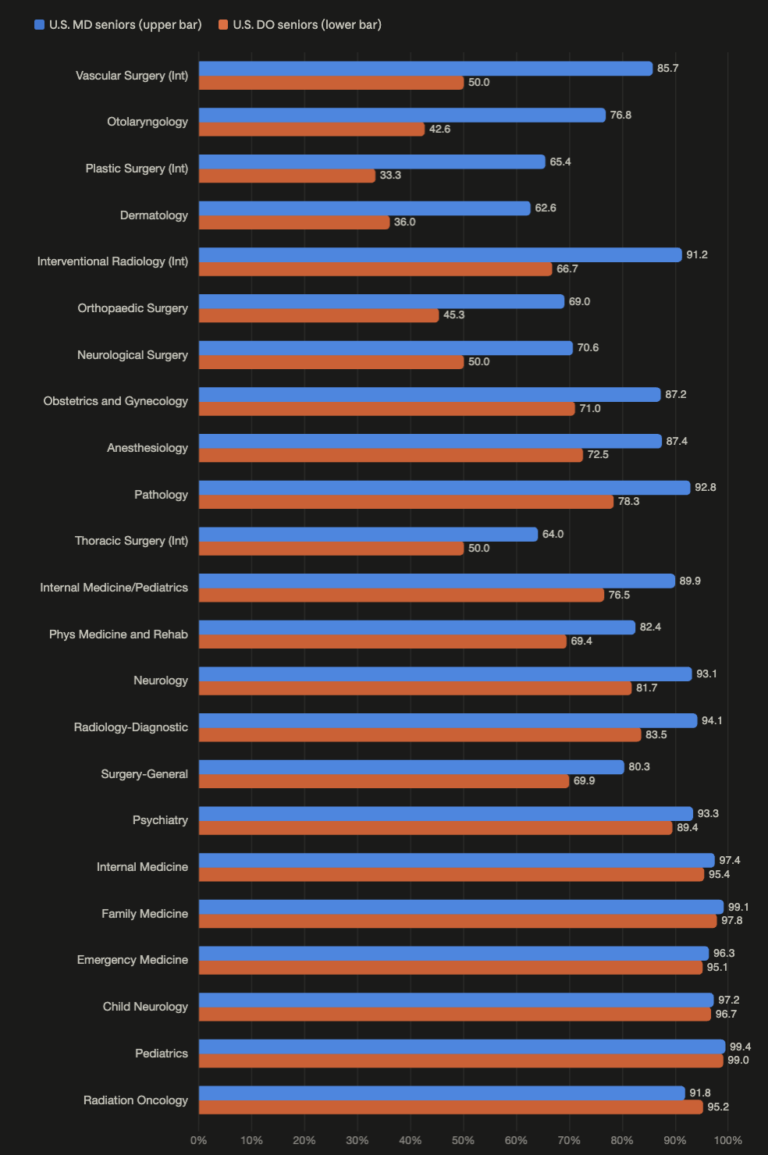
- Pediatrics: DO 99.0% vs MD 99.4%
- Family Medicine: DO 97.8% vs MD 99.1%
- Internal Medicine: DO 95.4% vs MD 97.4%
- Emergency Medicine: DO 95.1% vs MD 96.3%
- Child Neurology: DO 96.7% vs MD 97.2%
If your goal is one of these fields, the numbers say the osteopathic pathway is on essentially equal footing. The “DO penalty” narrative simply does not hold here.
Where the gap becomes a cliff
Now the competitive specialties:
- Dermatology: DO 36.0% vs MD 62.6%
- Plastic Surgery (Integrated): DO 33.3% vs MD 65.4%
- Otolaryngology: DO 42.6% vs MD 76.8%
- Orthopaedic Surgery: DO 45.3% vs MD 69.0%
- Interventional Radiology (Integrated): DO 66.7% vs MD 91.2%
- Vascular Surgery (Integrated): DO 50.0% vs MD 85.7%
A DO applicant to dermatology matched their preferred specialty about one in three times, while their MD counterpart matched closer to two in three.
Why the gap exists
The concentration of the gap tells you what is actually driving it. Competitive specialties are decided by a stack of factors that reward planning and access: board scores at the top of the range, early and sustained research, strategic away rotations, program targeting, and signaling. These are exactly the areas where a specialty-agnostic advising office, however well-meaning, struggles to go deep enough on one field for one cycle. Osteopathic students are also more likely to attend schools without a home program in a competitive specialty, which limits mentorship, research, and rotation access in that field.
None of that is a fixed property of being a DO. It is a strategy and access problem that hundreds of students attempt to solve for every single year.
What this means if you are a DO applicant
The data is not telling you to lower your sights. It is telling you to run a different, more deliberate race than the overall number implies. If you are targeting a competitive specialty as a DO:
- Take, and report, USMLE Step 2 CK in addition to COMLEX if you are competitive on it. Many programs in these fields screen on USMLE, and the 2026 reports show DO seniors increasingly reporting both.
- Target DO-friendly programs deliberately. Look at where DOs actually appear in current resident classes, not at brand names.
- Start research early. In the most competitive fields, matched applicants carry substantial scholarly output. Build it over years, not weeks.
- Get specialty-specific mentorship, ideally from someone who matched that specialty as a DO recently. The playbook for DO ortho or DO derm is not the general advising playbook.
- Apply and signal strategically. In these fields, your signal list is closer to your real interview list than your application list.
The applicants who beat the average are almost never the ones with a “better” application in the abstract. They are the ones who understood, early, that a competitive specialty is a different game and prepared accordingly.
Turn the Data Into a Plan
The 2026 numbers are not a ceiling. They are a map of where strategy matters most.
If you are a DO aiming at a competitive specialty, that is exactly the situation our team is built for: 80+ resident physicians, including advisors who matched these specialties as DOs, who help you build the personal statement, application, signaling, and program-list strategy that optimizes for your success.
We’ve matched 99% of our students into their preferred choice specialty & over 80% match into one of their top 3 ranks.
Click here to Book Your Free Strategy Call to learn more
FAQ
What is the DO match rate compared to MD in 2026? In the 2026 Match, 71.5% of U.S. DO seniors and 86.1% of U.S. MD seniors matched to their preferred specialty, per NRMP Charting Outcomes.
Can DOs match into competitive specialties like dermatology or orthopedics? Yes, but at lower rates than MD seniors: Dermatology 36.0% (DO) vs 62.6% (MD), Orthopaedic Surgery 45.3% vs 69.0%. It requires a deliberate, specialty-specific strategy: strong USMLE and COMLEX scores, early research, DO-friendly program targeting, and strategic signaling.
Is the DO disadvantage the same across all specialties? No. In primary care specialties (Pediatrics, Family Medicine, Internal Medicine, Emergency Medicine), DO and MD match rates are nearly identical. The gap is concentrated in competitive specialties.
Should DO students take the USMLE in addition to COMLEX? For competitive specialties, often yes. Many programs in those fields screen on USMLE Step 2 CK, and DO seniors increasingly report both exams. Discuss the tradeoff with an advisor in your target specialty.
Data note: 2026 figures are from NRMP Charting Outcomes and reflect the percentage of seniors matching to the specialty they ranked first. Figures are match rates, not cutoffs; individual outcomes vary.