Last updated: August 2026 · Written by the MatchPal Tutoring Team & reviewed by Ian Rumball, MD.
Since Step 1 went pass/fail, one number carries more weight in your application than it ever has: your Step 2 CK (and, for DO applicants, your COMLEX Level 2-CE).
It’s the first standardized filter most programs apply, the number that decides whether a human reads the rest of your file or your application gets archived by a threshold you never see. So the question every applicant asks the second scores come back is the right one: is my score good enough for the specialty I want?
Here’s the honest, data-backed answer using the newest 2026 numbers published by the NRMP.
Step 2 CK by specialty: 2026 matched medians (U.S. MD and DO seniors)
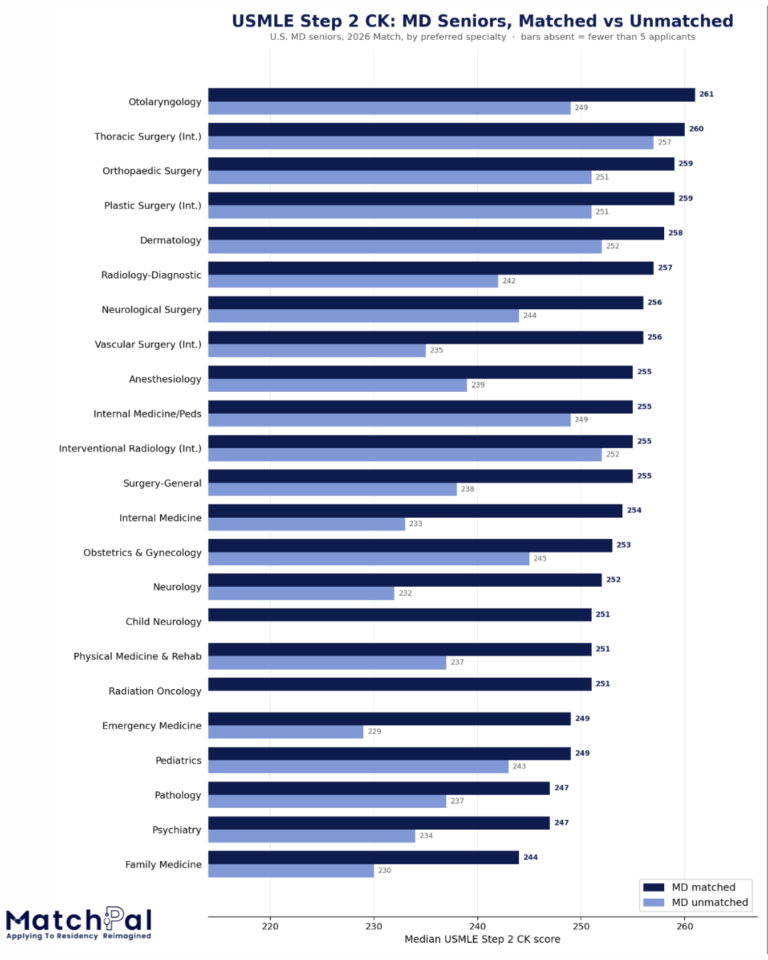
These are the median Step 2 CK scores of MD seniors who matched into the specialty they ranked first (NRMP Charting Outcomes 2026). Grouped by tier:
Most competitive (mid-to-high 250s): Otolaryngology 261 · Thoracic Surgery 260 · Orthopaedic Surgery 259 · Plastic Surgery 259 · Dermatology 258 · Diagnostic Radiology 257 · Neurological Surgery 256 · Vascular Surgery 256
Strong mid-tier (mid-250s): Anesthesiology 255 · Internal Medicine/Peds 255 · Interventional Radiology 255 · General Surgery 255 · Internal Medicine 254 · Obstetrics and Gynecology 253 · Neurology 252
Lower-average, still 240s to low 250s: Child Neurology 251 · Physical Medicine and Rehabilitation 251 · Radiation Oncology 251 · Emergency Medicine 249 · Pediatrics 249 · Pathology 247 · Psychiatry 247 · Family Medicine 244
The bottom line: there is no universal “good” Step 2 score. A 258 is a matched-median score in dermatology and a top-decile score in family medicine. Scores are relative to your specialty, not the national average.
Matched vs unmatched: what the gap actually says
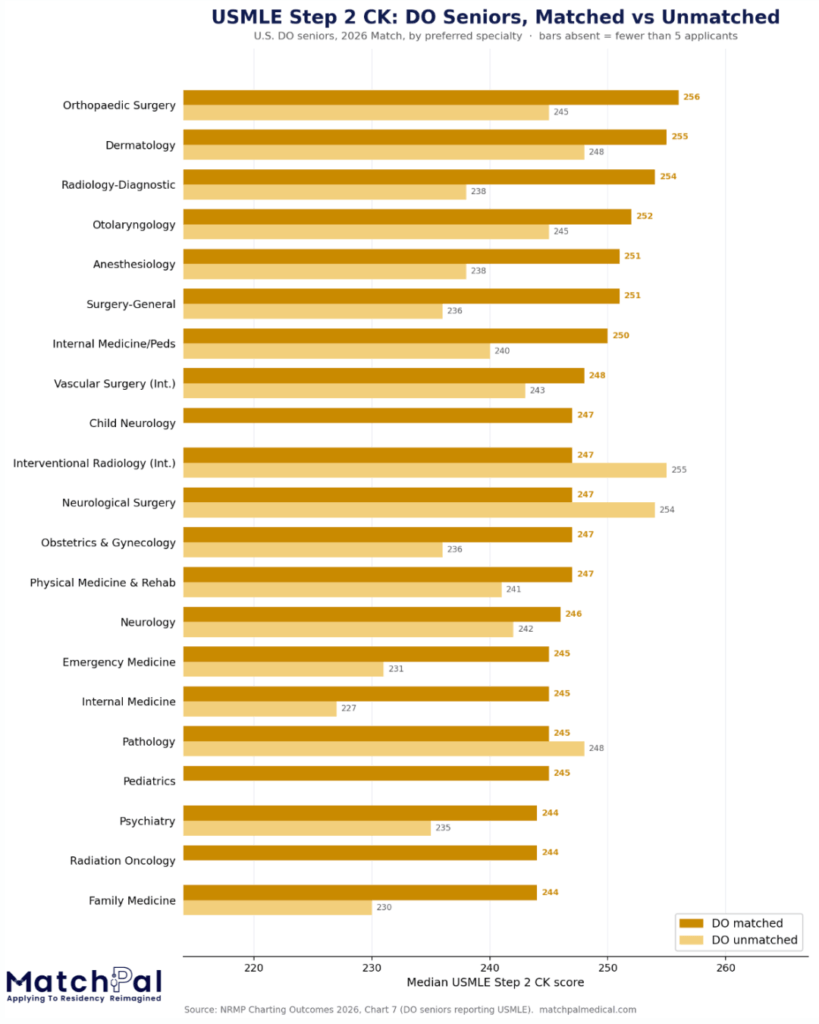
In nearly every specialty, matched applicants outscored unmatched applicants, so yes, scores correlate with matching.
But the number that reframes everything is how well unmatched applicants scored. Unmatched MD seniors posted median Step 2 CK scores in the 230s to low 250s in most fields. In dermatology, even unmatched applicants had a median of 252.
These are not applicants who failed on scores. They cleared the bar and still didn’t match. Which tells you the score was never the whole story.
A strong score gets your file opened; the rest of your application decides the interview yield, rank, and match.
So what’s a “good” Step 2 CK score for me?
Aim for at or above the matched median in your target specialty. Meet it and your score stops being the reason a program skips your file. Clear it by 5 to 10 points and it starts opening doors, especially now that Step 1 gives programs no standardized number.
Rough interpretation:
- 260+: Strong for any specialty; in the most competitive fields it moves you from “in the pile” to “flagged.”
- 250 to 259: Competitive across the board; at or above the matched median for most specialties.
- 240 to 249: In range for mid-tier and primary care; below the median for the most competitive fields, so the rest of your application has to carry a lot more weight.
- 230 to 239: Workable for less competitive specialties with a strong overall application; a strategy conversation for the most competitive ones.
- Below 230, or a Step failure: Not disqualifying, but it changes your entire strategy, exactly where signaling, program-list construction, and application volume have to be built deliberately. (We covered the volume math in How Many Programs Should I Apply To.)
COMLEX Level 2 by specialty – for DO applicants
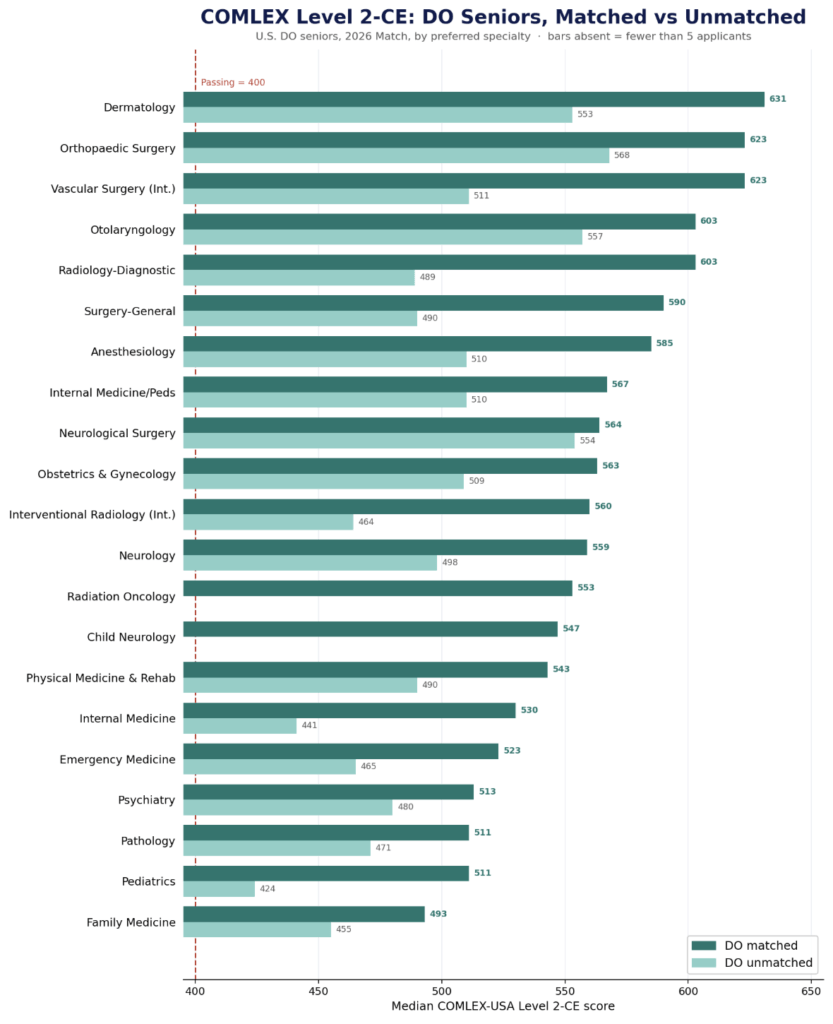
COMLEX Level 2-CE is the exam every DO applicant takes, and the 2026 data shows the same pattern as Step 2 CK: matched applicants score higher, and the bar rises sharply with specialty competitiveness. The passing score is 400. Median COMLEX Level 2-CE for DO seniors who matched their preferred specialty, by tier:
Most competitive (600+): Dermatology 631 · Orthopaedic Surgery 623 · Vascular Surgery 623 · Otolaryngology 603 · Diagnostic Radiology 603
Strong (560 to 590): General Surgery 590 · Anesthesiology 585 · Internal Medicine/Peds 567 · Neurological Surgery 564 · Obstetrics and Gynecology 563 · Interventional Radiology 560
Mid and primary care (490 to 560): Neurology 559 · Radiation Oncology 553 · Child Neurology 547 · Physical Medicine and Rehabilitation 543 · Internal Medicine 530 · Emergency Medicine 523 · Psychiatry 513 · Pathology 511 · Pediatrics 511 · Family Medicine 493
The matched-vs-unmatched gap is real here too: matched DO applicants in internal medicine had a median of 530 vs 441 for unmatched, and in pediatrics 511 vs 424. As with Step 2 CK, clearing your specialty’s matched median is the goal, and it is a floor to clear, not a finish line.
The strategic point for competitive-specialty DOs: COMLEX alone often is not enough.
The DOs who match competitive specialties frequently take and report the USMLE Step 2 CK as well, and when they do, they score right alongside MD applicants (matched DO dermatology USMLE 255 vs MD 258; orthopaedics 256 vs 259). If you are targeting a competitive field as a DO, plan to be strong on both exams, not just COMLEX.
What the numbers can’t tell you:
Programs take a holistic view. Your score does not include your PS, ERAS experiences, LORS, MSPE, clinical evaluations, research, or how you performed on an away rotation, all of which program directors rate as major factors.
- A median score doesn’t guarantee a match. Applicants at or above the median go unmatched every year, usually from a mispositioned program list, weak signaling, or an application that didn’t cohere. Your score gets you read; the rest of the file gets you ranked.
- A below-median score doesn’t necessarily doom you. Applicants below the median match into competitive specialties every year when their aways, letters, and geographic strategy do the convincing.
The applicants who struggle are rarely the ones with a “bad” score. They’re the ones who let a single number, high or low, substitute for a strategy.
Your Score Is Set. Your Strategy Isn’t.
Whatever your Step 2 CK or COMLEX Level 2 came back as, it’s now a fixed input.
The variable you still control is everything you build around it: your specialty fit, your program list, your signals, your letters, and how your application makes its case as unique and compelling amidst thousands of other qualified candidates.
If your score is a strength, our team helps you make sure the rest of your application matches it.
If your score is the part you’re worried about, that’s the application we optimize to ensure your other experiences and attributes outshine it.
Our team of 80+ resident physician advisors know exactly how programs in your specialty actually read an application – and we work with you tirelessly to ensure you are putting your best foot forward this ERAS cycle.
If you’re an MS4 reading this post and wondering if your application is actually in its final form (or if it blends in with everyone else’s) – this is your sign to schedule a free call with our team to learn more about how we can help you match your dream specialty.
Book Your Free Strategy Call

FAQ
What is a good Step 2 CK score? “Good” is relative to your specialty. Aim at or above the matched median in your target field. In 2026, matched MD medians ranged from 244 (Family Medicine) to 261 (Otolaryngology), with most competitive specialties in the mid-to-high 250s.
What COMLEX Level 2-CE score do DO applicants need by specialty? Aim at or above your specialty’s matched median. In 2026, matched DO medians ranged from 493 (Family Medicine) to 631 (Dermatology). The most competitive specialties (dermatology, orthopaedics, vascular surgery, ENT, radiology) cluster at 600+. The passing score is 400.
What Step 2 CK score do I need for a competitive specialty like dermatology or orthopedics? Matched MD applicants in the most competitive specialties cluster in the mid-to-high 250s (ENT 261, ortho 259, derm 258, radiology 257). Treat that as a target to meet or exceed, not a guaranteed cutoff.
Should DO students take the USMLE in addition to COMLEX? For competitive specialties, often yes. Many programs in those fields screen on USMLE Step 2 CK, and the DOs who match them frequently report both exams, scoring within a few points of MD peers.
Can I still match with a below-average score? Yes. Applicants below their specialty’s median match every year when their letters, aways, and program strategy do the convincing. A below-median score changes your strategy; it does not end it.
Does Step 2 CK matter more now that Step 1 is pass/fail? Yes. With Step 1 scored pass/fail, Step 2 CK (and COMLEX Level 2 for DOs) is the primary standardized screening number for most programs, which raises its weight in interview selection.
Data note: 2026 figures are NRMP Charting Outcomes medians for applicants matching their preferred specialty. Cells with fewer than five consented applicants are not reported. DO USMLE data reflects the subset of DO seniors who report USMLE; COMLEX Level 2-CE is the universal DO exam.