It’s July, which means ERAS is officially open and at some point, you are probably going to stare at your program list, watch the application fees multiply, and wonder if you’ve cast a wide enough net.
For years, the standard advice from well-meaning attendings was to “just apply to 80 residency programs to be safe.” It was considered an expensive, but necessary, insurance policy.
In 2026, that advice isn’t just outdated – it is actively terrible.
The expansion of the multi-tiered preference signaling system (Gold/Silver) has fundamentally broken the old approach. Application volume no longer equals interview volume. Today, applying to programs you don’t signal is, in most specialties, the equivalent of setting your money on fire.
Here is exactly how many programs you should be applying to this cycle, and the math behind why.
The 2026 Signaling Math: Your New Baseline
If you want to understand how residency programs filter the ERAS dashboard, look at the data from recent match cycles in competitive specialties.
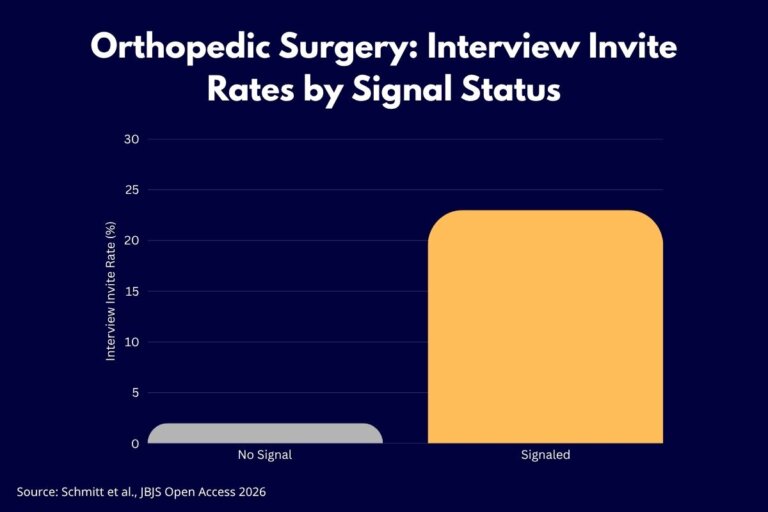
In Orthopedic Surgery, which utilizes a high-signal model (30 signals), the interview rate for applicants who signaled a program was 23%. The interview rate for applicants who applied without a signal?
2%.
In fact, nearly half of all orthopedic programs offered zero interviews to non-signaling applicants.
In Anesthesiology, which utilizes a tiered system (5 Gold, 10 Silver), the reality is even starker. According to a recent paper, applicants sending Gold signals had a 56.7% interview rate, Silver signals had a 31% interview rate. Applicants who did not send a program signal made up only 3% of the total interviewed group.
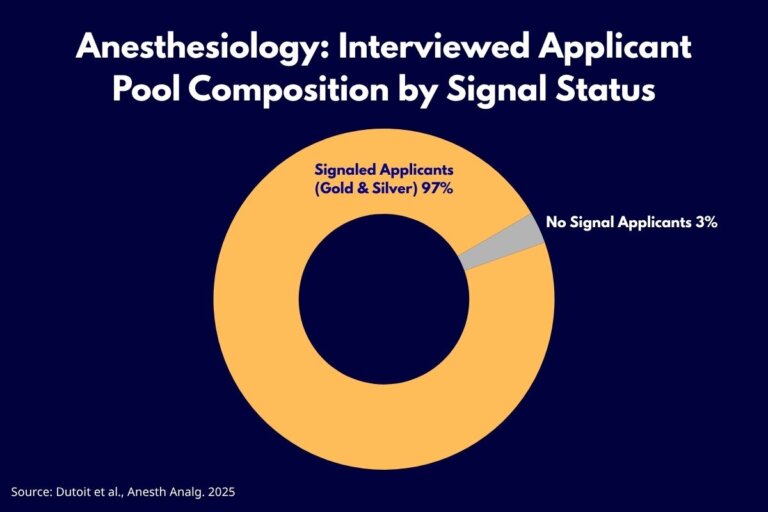
Let that sink in. At $30 per application, applicants can end up wasting thousands of dollars on non-signaled programs that they will never even get a chance to interview at.
Your new baseline number of applications should orbit your specialty’s signaling cap, plus a calculated 20-30% buffer for strategic geographical plays and home programs.
Application Targets By Specialty
Here is the realistic application volume you should target, based on U.S. MD senior data and 2026 signal caps.
Highly Competitive (High Signal Caps) These specialties give you enough signals to cover almost your entire application list. If you don’t signal them, they will not read your application.
- Orthopedic Surgery (30 signals): Apply to 35-45 residency programs.
- Otolaryngology (ENT) (25 signals): Apply to 30-40 residency programs.
- Dermatology (3 Gold, 25 Silver signals): Apply to 35-45 residency programs.
Moderately Competitive (Tiered or Mid-Level Caps) These specialties force you to make hard choices. Your list should consist of your signals, plus a strategic buffer of geographic ties.
- Internal Medicine (3 Gold, 12 Silver): Apply to 30-45 residency programs.
- General Surgery (15 signals): Apply to 30-45 residency programs.
- Anesthesiology (5 Gold, 10 Silver): Apply to 30-45 residency programs.
Primary Care & Less Competitive (Low Signal Caps) In these specialties, geographic alignment and program fit can still overcome a lack of a signal, but your list should remain highly targeted.
- Family Medicine (5 signals): Apply to 20-35 residency programs.
- Pediatrics (5 signals): Apply to 20-35 residency programs.
The Reach, Target, Safety Distribution
The most common mistake we see isn’t under-applying. It’s a student applying to 45 residency programs, but 35 of them are “Reaches” because they miscalculated their own competitiveness.
Your signaled list needs a strict distribution ratio:
- 25% Reach: Your Step 2 CK is at or slightly below their historical average.
- 50% Target: Your scores and profile align perfectly with their current residents.
- 25% Safety: Your Step 2 CK is 15+ points above their average, and you have a geographical tie or did a Sub-I there.
A community hospital in a state you have never visited is not a safety program. They know you are using them as a backup, and without a signal, they will quietly archive your application.
The DO & IMG Multipliers (The Unwritten Rules of How Many Residency Programs to Apply to)
The baselines above are for U.S. MD seniors. If you are a DO or an IMG, the math changes.
For DOs
The 2026 Match was strong for DOs, but you still need a volume bump. Add 15-20% to the baseline numbers above. Your signals carry the most weight when directed at former AOA-accredited programs or programs with a demonstrated history (look at their current PGY-1s) of taking DOs. Do not waste a Gold signal on a legacy ivory-tower academic program that hasn’t matched a DO in a decade.
For IMGs
IMGs must often double the baseline numbers (60-80+ residency programs). However, volume only works if it’s targeted. Do not apply to 100 random programs. You must ruthlessly filter for historical IMG match rates and J1/H1B visa sponsorship. A signal from an IMG to a program that doesn’t sponsor visas is a wasted signal.
When to Break the Rules of "How Many Residency Programs" (regardless if MD/DO/IMG)
There are applicants who should apply to 80+ residency programs. You are an exception to the rules above if you have any of the following red flags:
- A Step 1 failure.
- A Step 2 CK score 15+ points below your specialty’s mean.
- Course remediations or a leave of absence.
- You are applying as a couple (not a red flag – but couples matching inherently requires higher volume to align locations).
If you have a red flag, volume can compensate, but only if that volume is directed at the right type of programs. Applying to 80 academic centers with a board exam failure won’t save you.
Stop Guessing. Start Strategizing.
ERAS is expensive. Applying to 30 of the wrong programs costs the exact same as applying to 30 of the right ones.
Your medical school does not have the bandwidth to build you an individualized, data-backed program list that accounts for the new realities of Gold & Silver signaling – and that is one of the ways we save our students hundreds in application fees every single year.
Our team of 80+ resident physicians understand how programs are filtering applications, how to leverage signal tokens strategically, and how to position your application in a way that actually stands out to the programs you do apply to.
We build custom, data-backed program lists and signaling strategies so you don’t waste your signals, your money, or risk your Match.
Interested in learning more about what working with our team can do for your application cycle?