
Last updated: October 19, 2026 · Written by the MatchPal Advising Team · Reviewed by Ian Rumball, MD
Quick answer: The AAMC’s 2026 Graduation Questionnaire reports away rotations by intended specialty, and the honest headline is that the number varies less than the participation rate does. Among graduates who did at least one away, almost every specialty clusters between 1.6 and 2.7 rotations. What separates fields is whether students do aways at all: 99.5% in neurological surgery, 97.1% in orthopaedic surgery and 98.0% in urology, against 24.5% in internal medicine and 29.5% in med-peds. Overall, 54.1% of 17,498 respondents reported at least one away. Orthopaedic surgery is the only specialty averaging more than 3 (3.5, median 3). One caution: the AAMC does not publish an all-student average that includes people who did zero, so any single “average aways per specialty” figure you see circulating is a derived estimate, not a published number.
If you are an MS3, you’ve probably already heard that away rotation decisions are the next big thing on your calendar after this block of clerkships, and you are probably trying to work out how many is normal for the field you want.
The AAMC just made that question answerable with real data rather than hallway advice.
Its 2026 Graduation Questionnaire includes a report on away rotations by intended specialty, built from students who graduated in the 2025-2026 academic year. Here is what it actually says, which number you should plan against, and where the version circulating on social media gets ahead of the source.
How many away rotations do students actually do, by specialty?
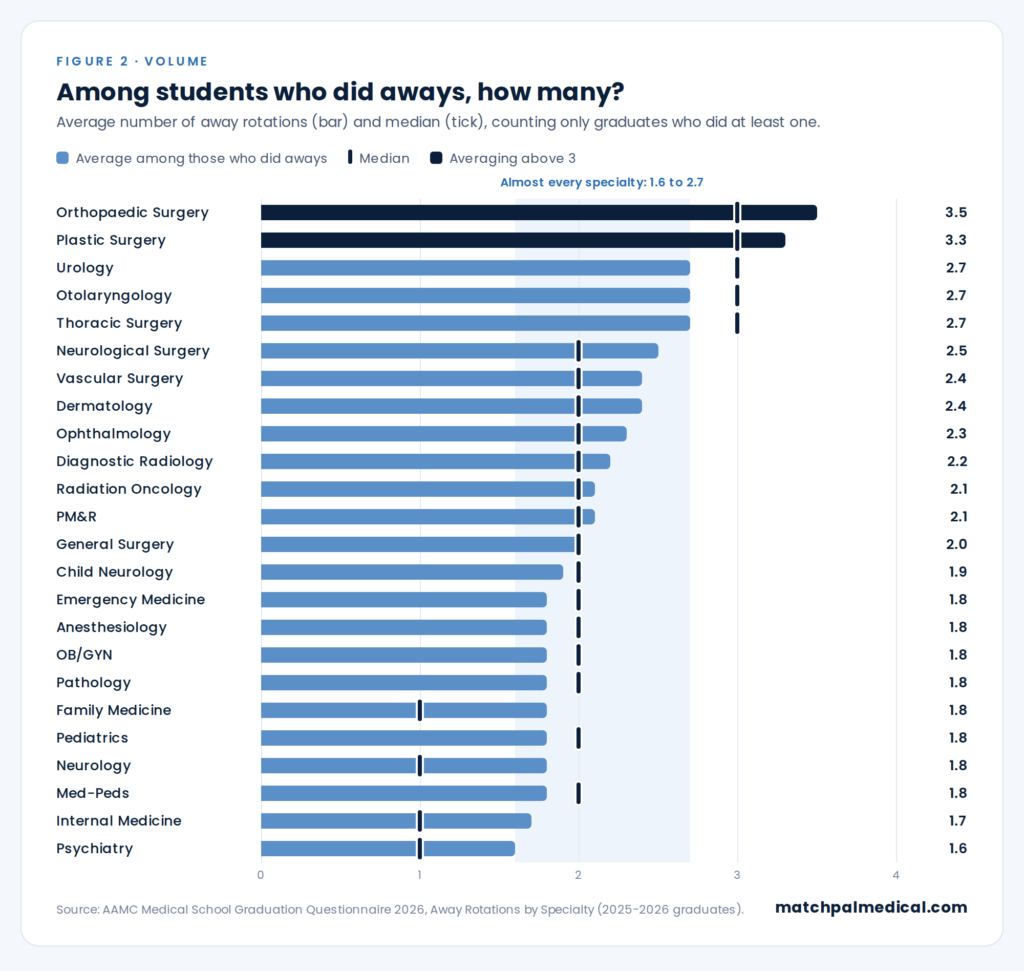
Among students who did at least one, almost everybody lands between 1.6 and 2.7.
Here is the 2026 GQ away rotation data for the largest specialties (averages and medians reflect only students who completed at least one away rotation):
| Specialty | % Doing ≥1 Away | Average | Median | Sample Size (n) |
|---|---|---|---|---|
| Orthopaedic Surgery | 97.1% | 3.5 | 3 | 736 |
| Plastic Surgery | 95.1% | 3.3 | 3 | 226 |
| Otolaryngology | 95.3% | 2.7 | 3 | 360 |
| Urology | 98.0% | 2.7 | 3 | 304 |
| Thoracic Surgery | 86.3% | 2.7 | 3 | 95 |
| Neurological Surgery | 99.5% | 2.5 | 2 | 214 |
| Dermatology | 89.3% | 2.4 | 2 | 523 |
| Vascular Surgery | 96.1% | 2.4 | 2 | 76 |
| Ophthalmology | 83.5% | 2.3 | 2 | 395 |
| Diagnostic Radiology | 53.7% | 2.2 | 2 | 791 |
| Radiation Oncology | 91.5% | 2.1 | 2 | 118 |
| Physical Medicine and Rehabilitation | 76.4% | 2.1 | 2 | 275 |
| Surgery | 66.0% | 2.0 | 2 | 1,037 |
| Child Neurology | 41.7% | 1.9 | 2 | 120 |
| Anesthesiology | 52.7% | 1.8 | 2 | 1,312 |
| Emergency Medicine | 91.9% | 1.8 | 2 | 1,205 |
| Obstetrics and Gynecology | 52.4% | 1.8 | 2 | 1,053 |
| Pathology | 47.5% | 1.8 | 2 | 217 |
| Pediatrics | 36.8% | 1.8 | 2 | 1,229 |
| Family Medicine | 39.2% | 1.8 | 1 | 1,284 |
| Neurology | 35.6% | 1.8 | 1 | 595 |
| Internal Medicine/Pediatrics | 29.5% | 1.8 | 2 | 285 |
| Internal Medicine | 24.5% | 1.7 | 1 | 3,361 |
| Psychiatry | 35.6% | 1.6 | 1 | 1,120 |
Two specialties in the report have samples too small to plan from: medical genetics and genomics (n=18) and public health and general preventive medicine (n=9). Treat those as noise, not guidance.
What percentage of medical students do away rotations at all?
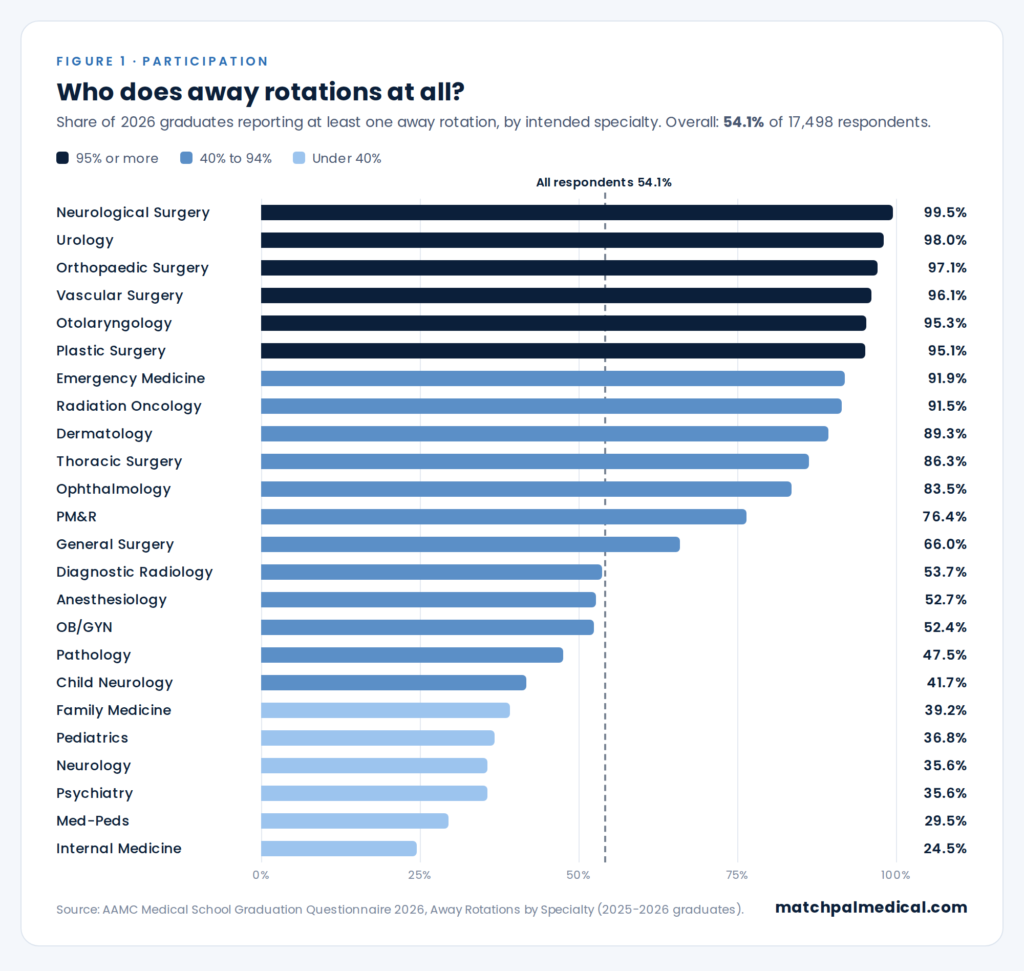
54.1% of 17,498 respondents, which is the number most applicants underestimate.
Just over half of US graduates do any away rotation. Broken out, 53.7% reported at least one in-person away and 1.7% reported at least one virtual away. Aways may or may not have run through VSLO.
What to do with this: if you are in a field where most students skip aways entirely, doing one is a deliberate strategic choice rather than a default box to tick, and it should be driven by a specific reason such as a geographic tie, a program you are targeting, or a specialty you lack a home department in.
Which specialties do the most away rotations?
Ask it by participation rate and the surgical subspecialties separate from everything else immediately.
Over 95% of students do at least one away in neurological surgery (99.5%), urology (98.0%), orthopaedic surgery (97.1%), vascular surgery (96.1%), otolaryngology (95.3%) and plastic surgery (95.1%).
Under 40% do in internal medicine (24.5%), med-peds (29.5%), psychiatry (35.6%), neurology (35.6%), pediatrics (36.8%) and family medicine (39.2%).
Emergency medicine is the interesting outlier. 91.9% of EM-bound students did at least one away, but they averaged only 1.8. Nearly everyone does one, almost nobody does four. That is a field where the away is close to an expectation but the volume is not an arms race.
Why is the "average number of away rotations" everyone is sharing misleading?
Because the AAMC never published it.
The GQ report gives three things per specialty: the percent reporting one or more aways, the average among those students, and their median. It does not publish an all-student average that folds in everyone who did zero.
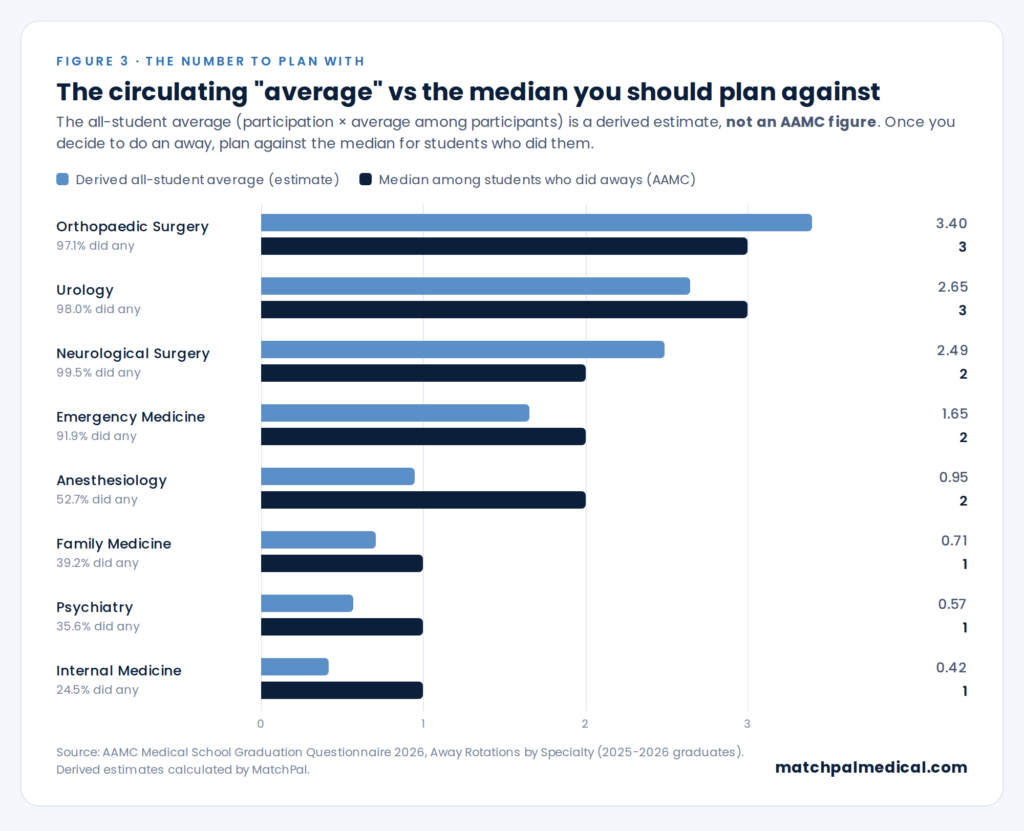
A chart making the rounds right now shows exactly that kind of all-student average, with orthopaedic surgery around 3.40 and internal medicine around 0.42. Those are reasonable derived estimates (participation rate multiplied by the average among participants), and the person who made them labeled them as estimates. But they are not AAMC figures, and they answer a question you probably are not asking.
Here is the practical difference. Internal medicine’s derived all-student average of roughly 0.42 does not mean an IM applicant should plan for half an away. It means three quarters of IM students do none, and the quarter who do one usually do one or two. If you have already decided to do an away, the all-student average is the wrong planning number, because you are no longer in the denominator that makes it small.
Plan against the median for students who did aways in your field. For orthopaedics that is 3. For internal medicine, family medicine, neurology and psychiatry it is 1.
How many away rotations should I actually plan and budget for?
Start from your specialty’s median among students who did aways, then adjust for your own situation.
Adjust upward if you have no home program in your specialty, if you are targeting a specific geographic region far from your school, or if your field sits in that 95%-plus participation tier where an away is effectively the norm.
Adjust downward if your field is one where most students do none, if you have a strong home department that will write your residency recommendation letters, or if the cost of a rotation would meaningfully damage your ability to prepare for Step 2 CK.
And budget for more applications than rotations. VSLO charges $15 per elective application, with no extra fee for alternate dates at the same institution, and most students apply to considerably more programs than they end up attending. Our basics guide on what to consider before applying for away rotations covers the realistic application-to-offer ratio, and the full Sub-I and Away Rotation Playbook covers timing and performance once you are on service.
Should DOs, IMGs, and applicants without a home program do more away rotations?
Often, yes. Read the medians above as a floor, not a target.
Start with who is in the data. The AAMC Graduation Questionnaire surveys graduates of US MD-granting schools, most of whom had a home department in their specialty to lean on. If you are a DO student, an IMG building US clinical experience, or an MD student without a home program in your chosen field, you are planning without that safety net. The strategic case for an away rotation is stronger than your specialty’s average suggests because each rotation has to do more of the work.
For applicants without a home department or US clinical footprint, a single away rotation stands in for four things at once:
A specialty letter: With no home faculty in your field, an away is often where your strongest specialty-specific letter of recommendation comes from.
A four-week audition: Programs see how you work on service, not just how you look on paper.
Proof you belong: You gain direct clinical evidence in the specialty at the exact type of institution you are applying to.
A tie to the program: You establish a concrete reason for a program to rank you, especially in regions or institutions with no prior connection to your school.
That is why DO, IMG, and no-home-program applicants often plan more away rotations than their specialty’s median, particularly in competitive fields where the DO vs. MD match gap has not closed. Our 2026 DO vs MD match rates by specialty breakdown shows which fields those are; read it alongside this data before deciding how many aways to fund.
Once you are ready to map out programs, our free VSLO Database and Ultimate VSLO Guide are built for that exact step. And if board scores are part of your calculus, our 2026 Step 2 CK and COMLEX Level 2-CE medians by specialty post is the companion dataset to use alongside these numbers.
When should I start planning next year's away rotations?
Away rotation planning runs months ahead of the rotation itself: school approvals, transcript releases, immunization records and certifications all move on your institution’s timeline rather than yours, and the most competitive blocks fill first.
What to do with this: pick your target number from the data above this month, build the program list next, and have your documents assembled before applications open rather than during.
Stop guessing, start strategizing.
National averages tell you what the median student in your field did. They cannot tell you whether you specifically need three aways or none, which programs to spend them at, or how to turn four weeks on service into a letter that actually moves your application.
That is what we do here at MatchPal: our team of 80+ resident physicians has helped thousands of students build away rotation and ERAS strategy that help them match their top choice specialty and program every single year.
Schedule a free strategy call below to get an accurate assessment on where you currently stand and learn about how working with our team can help you match your dream specialty.
Frequently asked questions
How many away rotations should I do for my specialty?
It depends almost entirely on the specialty. In the 2026 AAMC Graduation Questionnaire, orthopaedic surgery graduates who did any aways averaged 3.5 (median 3), while internal medicine graduates who did any averaged 1.7 (median 1). The bigger difference is whether students in your field do aways at all: 97.1% of orthopaedic surgery respondents reported at least one, against 24.5% in internal medicine.
What percentage of medical students do away rotations?
Overall, 54.1% of the 17,498 respondents to the 2026 AAMC Graduation Questionnaire reported completing at least one away rotation. 53.7% reported at least one in-person away and 1.7% reported at least one virtual away.
Which specialties require the most away rotations?
By share of students doing any, neurological surgery (99.5%), urology (98.0%), orthopaedic surgery (97.1%), vascular surgery (96.1%), otolaryngology (95.3%) and plastic surgery (95.1%) are the highest in the 2026 GQ. By volume among those who do aways, orthopaedic surgery (3.5) and plastic surgery (3.3) lead.
Does the AAMC publish an average number of away rotations per student?
Not as a single all-student average. The 2026 GQ report publishes the percent of students reporting one or more aways, plus the average and median number among only those students who did at least one. Any figure presented as an average across all students in a specialty, including those who did zero, is a derived estimate rather than a published AAMC number.
How much do away rotations cost to apply for?
VSLO charges $15 per elective application, with no additional fee for requesting alternate dates for the same elective at the same institution. That is only the application fee, and it does not include travel, housing or lost income during the rotation.
Do DO students need more away rotations than MD students?
Yes, especially if they have no home program in their specialty. The AAMC data covers MD graduates, so there is no published DO average, but an away is frequently a DO applicant’s main source of a specialty letter, a program relationship and in-specialty clinical evidence. Plan from your specialty’s median and adjust upward.