
Last updated: October 15, 2026 · Written by the MatchPal Advising Team, reviewed by Dr. Violeta Foss, DO
Quick answer: Your COMLEX percentile tells you how your three-digit COMLEX Level 2-CE score compares to other osteopathic students who tested in the same cycle. The only official source is the NBOME’s own percentile conversion tool, and the percentile you see mid-cycle is interim: NBOME does not finalize percentiles until the testing cycle closes, so your number can move. COMLEX Level 1 has been pass/fail since 2023 and has no reported score or percentile. For residency applications, the more useful benchmark than your percentile is the matched median for your target specialty, which in 2026 ranged from 493 in Family Medicine to 631 in Dermatology.
Almost every DO student asks the percentile question in the same two weeks: scores drop, a number appears, and nobody is quite sure what it means or who to believe about it. We’re breaking down COMLEX percentiles MatchPal style, including what the actual numbers show, what each specialty averages, and tips for any MS3/4 taking COMLEX Level 2 soon!
The Math Behind COMLEX Percentiles
There is a lot of secondhand percentile math circulating on forums and prep blogs. Most of it is estimated rather than published. This post sticks to what the NBOME actually reports, then answers the question you are really asking underneath the percentile question, which is whether the score is good enough for the specialty you want.
What even is a COMLEX percentile, anyway?
Remember – a percentile is a relative measure. For example, if your Level 2-CE score sits at the 70th percentile, roughly 70% of the osteopathic candidates who received scores in that testing cycle scored at or below you.
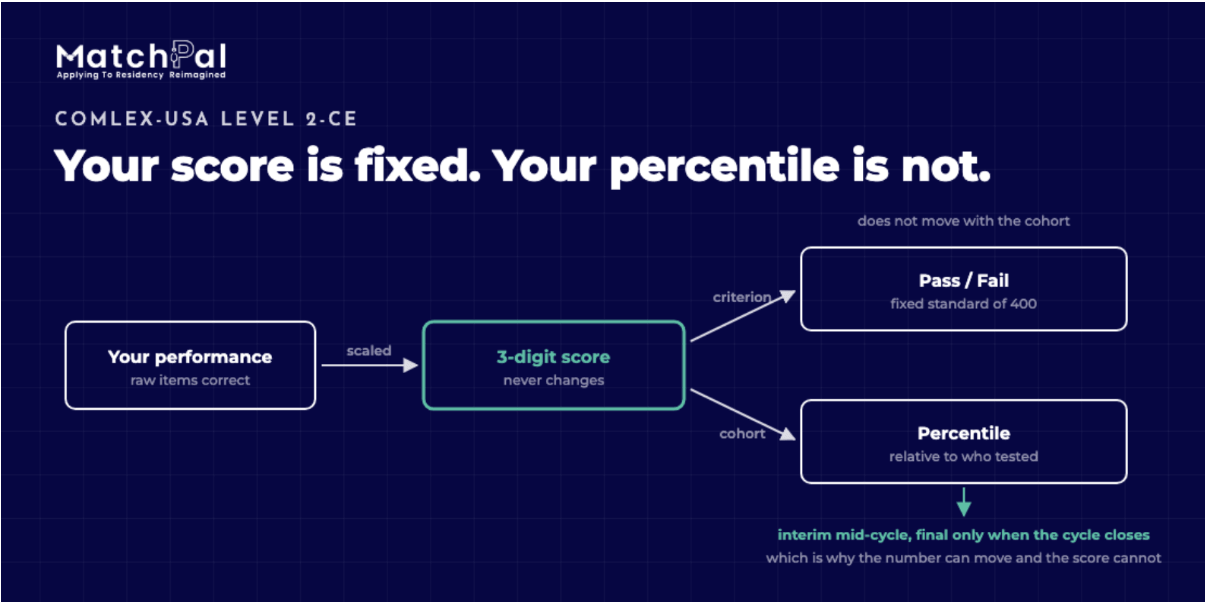
That is different from your three-digit score, which is a standard score produced from your raw performance. As NBOME puts it, percentiles “offer understanding of COMLEX-USA performance by providing relative information compared to other individuals who have also already received their scores for this cycle”.
Two things follow from that definition:
- Your percentile depends on who else tested. The same score can land at a slightly different percentile in a different cycle.
- Pass/fail is not percentile-based. NBOME uses a criterion-based standard, not a fixed percentage of candidates. The minimum passing score for Level 2-CE is 400, and it does not move because a cohort performed well or poorly.
Does COMLEX Level 1 have a percentile?
No. COMLEX-USA Level 1 has been reported as pass/fail since 2023. There is no three-digit score and therefore no percentile. You receive a pass or fail result with a formative performance profile.
This is exactly why Level 2-CE now carries so much weight. It is the only numeric COMLEX score most program directors will ever see from you.
Where do you find your official COMLEX percentile?
Use the NBOME’s own percentile conversion tool, available through your NBOME portal and referenced in the Bulletin of Information. It is the only authoritative converter.
Be skeptical of percentile charts published by test-prep companies. Some are reasonable estimates and some are years out of date, but none of them are NBOME data, and a percentile is only meaningful against the cohort it was calculated from.
Why did my COMLEX percentile change?
Because the one you saw first was interim.
NBOME releases an interim percentile converter during the cycle, and is explicit that “this percentile is preliminary, as final percentiles are not established until the end of each COMLEX-USA testing cycle.” They recommend candidates check again once the cycle closes for their final number (NBOME, 2025-2026 interim converter).
Practically: if you tested early in a cycle, your percentile is being calculated against a partial cohort. It is normal for it to shift. Your three-digit score does not change.
What is a good COMLEX Level 2-CE score?
“Good” only means something relative to a target. For example, a 540 is comfortably above the bar for Family Medicine and well below the matched median for Dermatology. So rather than chasing a percentile, anchor on three questions:
- Am I above the matched median for my target specialty? See the table below.
- If not, how far below, and in which specialty? In some fields the score gap between matched and unmatched applicants is large. In others it is nearly nonexistent, which means something else decided those outcomes.
- What else in my application can carry weight? Program signals, recommendation letters, away rotations, research and program list strategy all move outcomes, and all of them are still changeable after your score is fixed.
What COMLEX Level 2-CE score do you need for your specialty?
These are the 2026 median COMLEX Level 2-CE scores among US DO seniors who matched their preferred specialty, from NRMP’s Charting Outcomes in the Match, 2026. Passing score is 400.
| Specialty | 2026 matched DO median |
|---|---|
| Dermatology | 631 |
| Orthopaedic Surgery | 623 |
| Vascular Surgery | 623 |
| Otolaryngology | 603 |
| Diagnostic Radiology | 603 |
| General Surgery | 590 |
| Anesthesiology | 585 |
| Internal Medicine/Pediatrics | 567 |
| Neurological Surgery | 564 |
| Obstetrics and Gynecology | 563 |
| Interventional Radiology | 560 |
| Neurology | 559 |
| Radiation Oncology | 553 |
| Child Neurology | 547 |
| PM&R | 543 |
| Internal Medicine | 530 |
| Emergency Medicine | 523 |
| Psychiatry | 513 |
| Pathology | 511 |
| Pediatrics | 511 |
| Family Medicine | 493 |
A median means half of matched applicants scored below it. It is a benchmark, not a cutoff.
The more revealing comparison is matched versus unmatched within the same specialty. In internal medicine, matched DO seniors had a median of 530 against 441 for those who did not match. In pediatrics it was 511 against 424. Those are large gaps, and they sit in fields students often treat as the safe option.
In the most competitive fields the pattern inverts. Among DO applicants in dermatology the matched and unmatched Step 2 CK medians were 255 and 252, a three-point difference. When nearly everyone applying has a strong score, the score stops being the deciding variable and your letters, aways, signals and program list do the work instead.
We broke the full picture down, MD and DO side by side, in our guide to what Step 2 and Level 2 score you need for your specialty, and covered where the DO disadvantage is real and where it is not in our DO vs MD match rates by specialty analysis.
Should DO students take the USMLE as well?
If a competitive specialty is even remotely on your radar, we strongly recommend it.
Many competitive programs are more fluent in Step 2 CK scores than COMLEX scores, and a strong Step 2 CK remains a meaningful way to demonstrate your candidacy at programs that have historically taken few DOs.
It is additional work and additional risk, so it is a decision worth making deliberately rather than by default, ideally before your dedicated period rather than during it. To help structure that dedicated time, grab our free Step 2 CK / COMLEX Level 2 Study Guide. It breaks down the exact study plans, resources, and strategies used by applicants who scored in the 90th+ percentile.
What should you do if your score is below your specialty's median?
First, do not re-plan your entire career in the 48 hours after score release. Remember, half of matched applicants in every specialty scored below that specialty’s median.
Then work the variables you still control:
- Program list strategy. Apply where DO applicants actually match. A program with no DOs in its last three classes is usually not a realistic target regardless of fit.
- Signals. Send them where your file is competitive, not where you wish it were. See our program signal decision framework.
- Letters and aways. A month on service with a strong letter at the end moves more than a few points would have. See our Sub-Is and Away Rotation Playbook for tips on how to crush your aways while treating them like a four-week interview.
- Narrative coherence. Programs want a clear story about why this specialty and what you did about it – ensure this is documented in a bulletproof fashion in your PS/ERAS.
Improving the score itself
If you have not taken Level 2-CE yet and you are below where you want to be on practice exams, the lever is still available. One of our advisors wrote about what he learned scoring above the 95th percentile on COMLEX if you want the study-strategy version.
MatchPal tutoring students see an average increase of 21 points on Step 2 CK and 132 points on COMLEX Level 2 from baseline, working one-on-one with resident physicians who scored in the top percentiles themselves.
If you have already tested, the conversation is more strategic: which specialties are realistic, where to apply, where to signal, and how to build the rest of your ERAS roadmap. That is the very types of conversations our advisors have with DO students every single week in our specialty specific advising program!
Got a question or want to learn more about working with the team?
Book a free strategy call with a resident physician and get candid feedback on what your score actually means for your target specialty and how to approach your upcoming application cycle!
Frequently asked questions
What is a good COMLEX Level 2-CE percentile?
It depends entirely on your target specialty. Rather than a universal percentile target, compare your three-digit score to the 2026 matched median for the specialty you want, which ranged from 493 in family medicine to 631 in dermatology. Use the NBOME percentile conversion tool for your official percentile.
Does COMLEX Level 1 give a percentile?
No. COMLEX-USA Level 1 has been reported as pass/fail since 2022, with no three-digit score and no percentile. Level 2-CE is the only numeric COMLEX score most program directors will see.
Why is my COMLEX percentile different from what I saw before?
Percentiles released during a testing cycle are interim. NBOME states that final percentiles are not established until the end of each COMLEX-USA testing cycle, so a percentile calculated against a partial cohort can shift. Your three-digit score does not change.
What is a passing COMLEX Level 2-CE score?
400. NBOME sets the standard using a criterion-based method rather than failing a fixed percentage of candidates, so the passing score does not move based on how a cohort performs.
Are prep company COMLEX percentile charts accurate?
They are estimates, not NBOME data, and some are based on older cycles. Since a percentile is only meaningful against the cohort it was calculated from, use the NBOME percentile conversion tool for anything you plan to act on.
Should DO students take Step 2 CK as well as Level 2-CE?
If a competitive specialty is a possibility, usually yes. Many competitive programs read Step 2 CK scores more fluently than COMLEX scores, so a strong Step 2 CK can demonstrate candidacy at programs that have historically taken few DO applicants.
MatchPal is a resident-run residency advising and tutoring platform with 80+ resident physician advisors.