
Last updated: October 9, 2026 · Written by the MatchPal Advising Team, reviewed by Joseph Gofman, DO
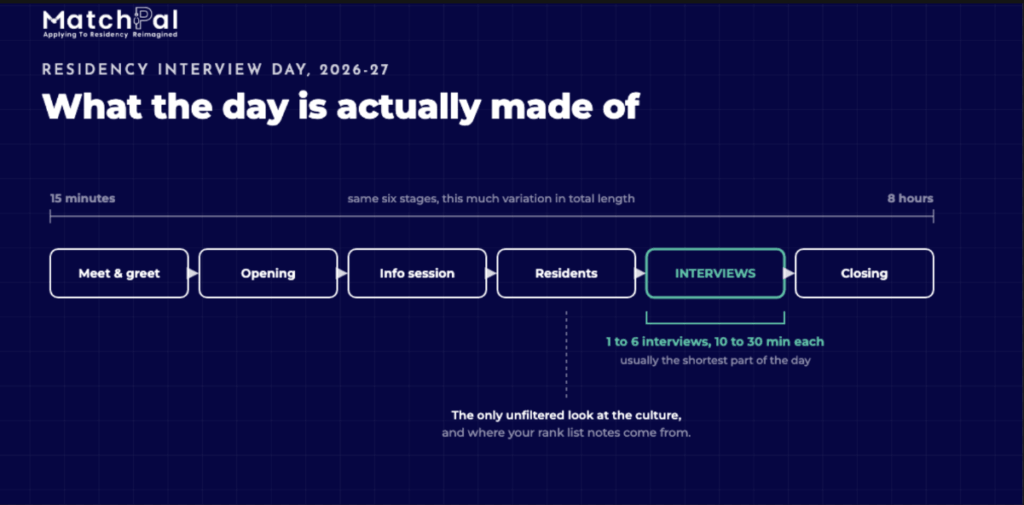
Quick answer: A residency interview day in the 2026-27 cycle can run anywhere from 15 minutes to 8 hours depending on the program. Most days follow the same shape: a pre-interview meet and greet, opening remarks from the program director, an information session, time with current residents, your actual interviews, and closing remarks. You will usually have 1 to 6 interviews of 10 to 30 minutes each, and you will almost always meet a program director or associate program director. The structure varies most by specialty and by position type, with transitional year and preliminary interview days typically the shortest.
Almost every piece of residency interview advice tells you the commonly asked questions. Very little of it discusses what the day itself is actually like, so most applicants spend their first interview of the season learning the format instead of performing in it.
That is an expensive way to learn, because your first interview is rarely at a program you do not care about. This post walks through the full day, where it differs by specialty and position type, and what our resident advisors see applicants consistently get wrong.
How long is a residency interview day?
Anywhere from 15 minutes to a full 8 hours.
That range surprises people, but it reflects real variation in how programs run the day. A large academic program in a competitive specialty may build a half or full day with presentations, a virtual tour, a resident panel and multiple interview blocks. A smaller community program may schedule you for two 20-minute conversations and nothing else.
Most interview days land somewhere in the middle: a half day of roughly three to four hours, of which only about 1-2hrs is actual interviewing. The rest is programming designed to sell you on the program, which matters more than applicants assume, because that content is where your rank list information comes from.
What to do with this: ask the program coordinator for the schedule in advance if it was not included in your invitation. Knowing whether you are facing 20 minutes or 6 hours changes how you plan the rest of that day, especially if you are interviewing from a hospital workroom between rotations.
One key point to note: As interview season unfolds, keeping track of the unique offers and downsides of each program can become quite cumbersome. That’s why we built the Interview Season tracker, a free tool designed to help you keep information about all of your interviews sorted in one place! You can download it for free below.
What actually happens on residency interview day?
Most residency interview days include some version of the following, in roughly this order:
- Pre-interview meet and greet. Often the evening before, sometimes the morning of. Usually residents only, usually optional in name and expected in practice.
- Opening remarks. The program director frames the program and the day.
- Information session. Curriculum, rotation structure, call schedule, benefits, research infrastructure.
- Time with residents. A panel, breakout rooms, or an informal block with no faculty present.
- Your interviews. The part you prepared for, and often the shortest segment of the day.
- Closing remarks. Logistics, timeline, how to follow up.
Some programs add a virtual tour or a session on a specific initiative such as a global health track or a research pathway. Others skip presentations entirely and email you a brochure instead, which shortens the day considerably.
The part too many applicants waste: the resident session. In a cycle that is still mostly virtual, that block is the only unfiltered look you get at what working there is actually like. It is also the single best source of the notes you will need in February when you build your rank list. Treat it as the most important hour of the day, and arrive with real questions rather than sitting silent.
How many interviews will you have, and who is in the room?
Typically 1 to 6 interviews, most running 10 to 30 minutes each.
The format varies by program:
- One-on-one. The most common format. A single faculty member or resident with your application open in front of them.
- Panel. Two to four interviewers at once. More common in competitive and surgical specialties, and more intimidating on video than in person because you cannot read the room as easily.
- Resident interview. Often framed as casual. It is not. Residents report back, and their read on whether you would be good to work with carries real weight.
You will almost always interview with at least one program director or associate program director. If you only prepare for one conversation, prepare for that one.
Ask in advance whether your interviews are one-on-one or panel. Coordinators answer this question readily, and knowing it helps remove first-day nerves.
How does residency interview day differ by specialty?
The underlying structure is similar across specialties. What changes is the content of the interviews themselves. Based on what our resident advisors across specialties report from both sides of the table:
- Surgical and procedural specialties (orthopaedics, otolaryngology, neurosurgery, plastics, vascular, general surgery) run the longest and most structured days, often with panels. These are also the fields where you are most likely to be asked a clinical question or, occasionally, to demonstrate a technical skill on camera such as a suturing or knot-tying task. This is still the exception rather than the rule, but it is concentrated here.
- Internal medicine, pediatrics and family medicine tend toward conversational one-on-one interviews with a heavier emphasis on fit, communication and how you talk about patients. Days are often shorter, with more programs per applicant.
- Emergency medicine often uses more standardized or scenario-based questions than other fields, and places heavy weight on the resident interaction segment. Note that EM moved to ResidencyCAS this cycle, so confirm the platform and timeline directly.
- Dermatology, radiology, radiation oncology and pathology frequently include a research-focused conversation. If you have a project on your application, expect to be asked to explain why it was studied, what the results mean clinically, and exactly what your role was.
- Psychiatry interviews tend to run longer per conversation and probe self-awareness and motivation more deeply than most fields.
- OB/GYN also moved to ResidencyCAS this cycle. Days are often structured with multiple short interviews.
Treat these as patterns rather than guarantees. Program-level variation within a specialty is larger than the variation between specialties, which is why the most useful preparation is talking to someone who recently interviewed in your specific field. If you want more information on Specialty-matched mock interviews, feel free to schedule a free consultation with us here.
What are transitional year and preliminary interview days like?
Shorter – often much shorter.
Transitional year (TY) and preliminary (prelim) interview days are frequently the most abbreviated days of the entire season. Some are a single 15 to 20 minute conversation with no programming at all. If you are applying to an advanced specialty such as dermatology, radiology, radiation oncology, anesthesiology or PM&R, you are running two application tracks at once, and the intern-year interviews will feel noticeably lighter than your categorical interviews.
Three things worth knowing:
- Do not treat them as throwaways. You will spend an entire year there, and a bad intern year is a genuinely bad year. Ask about workload, call structure, and how the program treats prelims relative to categorical residents.
- Prelim and TY programs know they are often a second thought, so genuine interest is unusually noticeable and unusually effective.
- Your rank list gets more complicated. Advanced applicants rank two separate lists with supplemental rank logic, and that is worth planning before February rather than during it.
If the categorical, prelim, TY and advanced distinction is still fuzzy, we wrote a full breakdown of the residency position types and how they interact.
What is different about virtual interviews in the 2026-27 cycle?
Most interviews remain virtual, and the logistics layer around them changed this cycle:
- Thalamus is now near-universal. More than 90% of ERAS programs use it to send residency interview invitations and schedule interviews. Finish your profile, install the mobile app, and turn on text and push notifications before invites start landing.
- Coordinated release dates are spreading. Several specialties now release all first-round invitations on a single shared date rather than trickling them out, with response windows that can be as short as 24 to 72 hours.
- EM and OB/GYN apply through ResidencyCAS, not ERAS, with their own timelines and scheduling.
For the day itself: camera at eye level, light in front of you rather than behind, a neutral background, and a wired connection or a tested backup hotspot. If anything is visible behind you, be ready to talk about it. We have heard of applicants asked about a guitar on the wall that they did not actually play, which is a small thing that leaves an odd impression.
One scheduling note that matters more than any of this: when an invitation arrives, take the latest available date at the programs you care most about. You want your early interviews to be at lower-stakes programs so you are warmed up by the time you talk to your top choice. More on that in our post covering how to respond to interview invitations.
What should you do in the 24 hours after the interview?
- Take notes the same day. Names, impressions, concerns, anything specific you want to remember. By February you will have a dozen programs blurred together, and your rank list is built from exactly these notes.
- Follow each program’s stated policy on thank-you notes. Programs differ, and some explicitly ask you not to send them. Do what that program asked rather than what you read somewhere.
- Know your rights. Under NRMP rules, no program can require you to commit to ranking them. If a conversation moves that direction, you are not obligated to answer, and it is worth noting when it happens.
- Flag anything that felt off. Interviewers occasionally ask questions that violate NRMP rules, such as marital status, plans for children, or where else you are interviewing. You do not have to answer, and you should record it.
How do you prepare for the parts of the day you cannot predict?
You can prepare your answers alone. You cannot prepare your delivery alone, because you cannot hear your own filler words, your own tangents, or the moment an interviewer stopped following you.
Two things we would do before your first real interview:
- Work through the full interview preparation guide. Our Residency Interview Preparation Guide covers the day structure, the ten most common questions, the STAR and 4 C’s answer frameworks, sample answers, and the pearls our advisors give students one-on-one. It is free, and it is the fastest way to turn this article into actual preparation. Pair it with our word-for-word scripts for the questions programs actually ask and the full interview day checklist.
- Do at least 2 mock interviews with a resident in your specialty. This is the single highest-yield part of preparation available to you, and almost nobody does it. A resident who recently interviewed in your field (and who now sits on the other side of the table) can tell you what your answer actually sounded like, which specialty-specific questions you are answering generically, and whether your answers land or ramble.
Our team offers 1:1 specialty-specific mock interviews with residents from our team of 80+ resident physician advisors – with MD/DOs available in every single specialty!
Book a free strategy call and we will tell you honestly whether a mock interview is what you need, and which advisor in your specialty to work with.
Frequently asked questions
How long does a residency interview day last?
Between 15 minutes and 8 hours, depending on the program. Most are a half day of three to four hours, of which roughly an hour is actual interviewing. Transitional year and preliminary interview days are typically the shortest.
How many interviews are in a residency interview day?
Usually 1 to 6, most lasting 10 to 30 minutes each. You will almost always interview with at least one program director or associate program director, and formats include one-on-one, small panel, and resident interviews.
Will I be asked clinical questions on interview day?
Usually not. Most residency interviews are purely conversational. Being asked a clinical question or to demonstrate a technical skill on camera happens mainly in procedural and surgical subspecialties, and it remains the exception rather than the rule.
Are transitional year and prelim interviews different?
Yes. TY and prelim interview days are often much shorter, sometimes a single 15 to 20 minute conversation with no presentations. They still matter, because you will spend a full year in that program, so ask about workload and how prelims are treated relative to categorical residents.
Do residency interviews still happen virtually in 2026-27?
Most do. Interviews are scheduled through Thalamus at more than 90% of ERAS programs, and several specialties now release first-round invitations on coordinated dates with response windows as short as 24 to 72 hours. Emergency medicine and OB/GYN apply through ResidencyCAS rather than ERAS this cycle.
What should I ask at the end of a residency interview?
Bring three program-specific questions to every interview, written the night before. Good directions include what surprised residents when they started, how the curriculum has changed based on resident feedback, and what residents do outside the hospital. Never ask something answered on the program website.