
Last updated: 10/05/2026 · Written by the MatchPal Advising Team · Reviewed by Daniel Veyg, DO
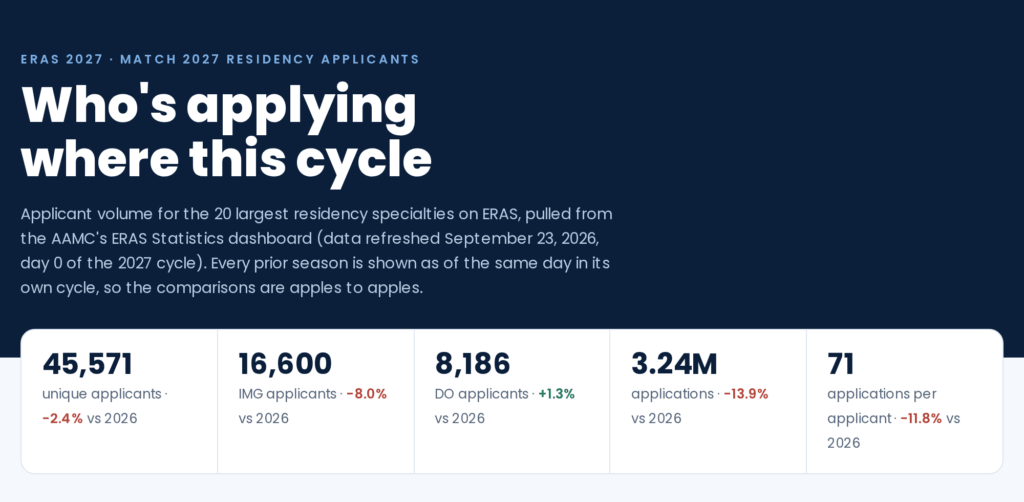
Quick answer: On opening day of the 2027 cycle (September 23, 2026), 45,571 applicants had applied to residency through ERAS, down 2.4% from the same day last year. MD applicants rose 1.0% and DO applicants rose 1.3%, while IMG applicants fell 8.0%. Interventional Radiology (+17.9%), PM&R (+12.8%) and ENT (+11.4%) grew fastest. Med-Peds (-17.5%), Pathology (-8.8%) and Neurology (-8.2%) fell most.
Key takeaways
- 10 of the 20 largest specialties hit a five-year high in opening-day applicants, led by procedural fields.
- Psychiatry, Pathology and Diagnostic Radiology hit five-year lows.
- The whole overall decline came from IMGs (1,440 fewer than last year). US MD and DO volume grew.
- Applicants are sending far fewer applications: 71 per applicant, down from 96 in 2023.
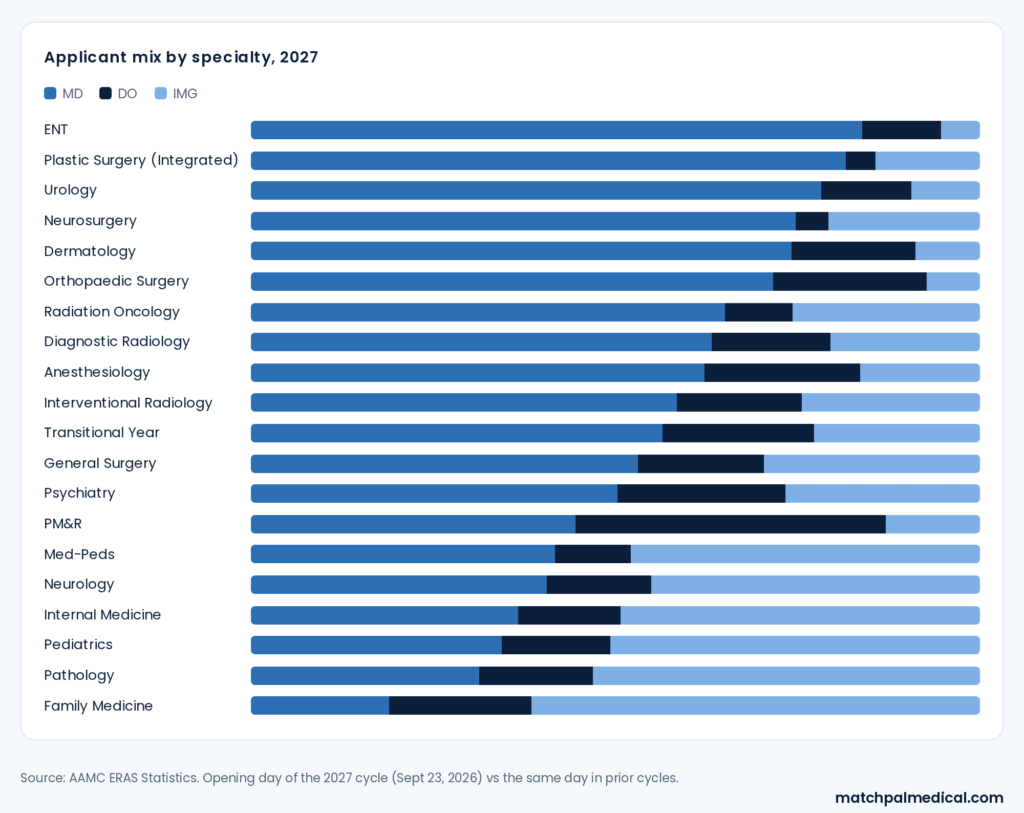
- DOs are reshaping PM&R and Anesthesiology. DOs are now 43% of PM&R applicants.
It’s the first week of October, which means ERAS just opened to programs a couple of weeks ago, and every applicant in the country is refreshing their inbox.
It also means the AAMC just released the first real look at who applied where this cycle.
We pulled the data straight from the AAMC’s ERAS Statistics dashboard for the 20 largest residency specialties, then compared each one to the same day in the four prior cycles. Same day, same point in the season, so the comparisons are fair.
Some of it confirms what you’ve heard on Reddit. Some of it flat-out contradicts it.
Which residency specialties gained the most applicants in ERAS 2027?
Interventional Radiology gained the most, up 17.9% (475 to 560 applicants). PM&R (+12.8%), ENT (+11.4%), Anesthesiology (+9.6%) and Radiation Oncology (+9.0%) round out the top five. Ten of the 20 largest specialties hit a five-year high on opening day.
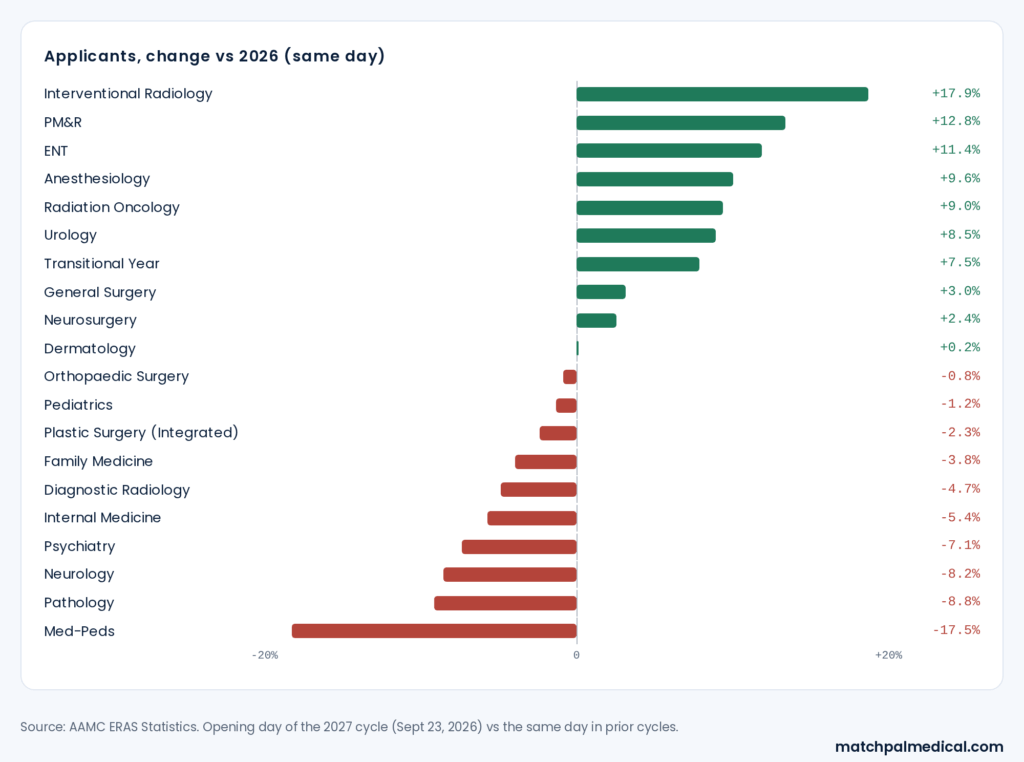
Here’s the pattern: procedural fields are pulling harder than ever.
- Interventional Radiology (+17.9%): a five-year high, with DO applicants up 41%.
- PM&R (+12.8%): 1,180 applicants, and DOs now make up 43% of the pool.
- ENT (+11.4%): up 29% since 2024.
- Anesthesiology (+9.6%): 339 more applicants for 3,856 total, its highest in five cycles.
- Radiation Oncology (+9.0%): 315 applicants. After years of “is Rad Onc dying?” threads, it’s up 48% since 2023.
- General Surgery (+3.0%): 5,402 applicants, a five-year high.
Dermatology is the quiet surprise. After three straight years of growth, it came in at 1,303 applicants, just 2 more than last year.
Which residency specialties lost the most applicants?
Med-Peds dropped the most, down 17.5% (1,047 to 864). Pathology (-8.8%), Neurology (-8.2%), Psychiatry (-7.1%) and Internal Medicine (-5.4%) followed.
- Internal Medicine (-5.4%): 1,401 fewer applicants, the largest raw drop of any specialty. Nearly all of it was IMGs (down 1,364). US MD applicants were flat.
- Psychiatry (-7.1%): 3,357 applicants, its lowest opening-day total in five cycles, with declines across MD, DO and IMG.
- Pathology (-8.8%): 1,155 applicants, also a five-year low.
- Neurology (-8.2%): falls after three straight years of growth, driven by a 19% IMG decline.
- Diagnostic Radiology (-4.7%): 1,894 applicants, down 16% since 2023.
Lower volume does not mean “easy.” It means the math on interview offers may be a little kinder than last year. Your application still has to earn the interview.
Are fewer IMGs applying to residency in 2027?
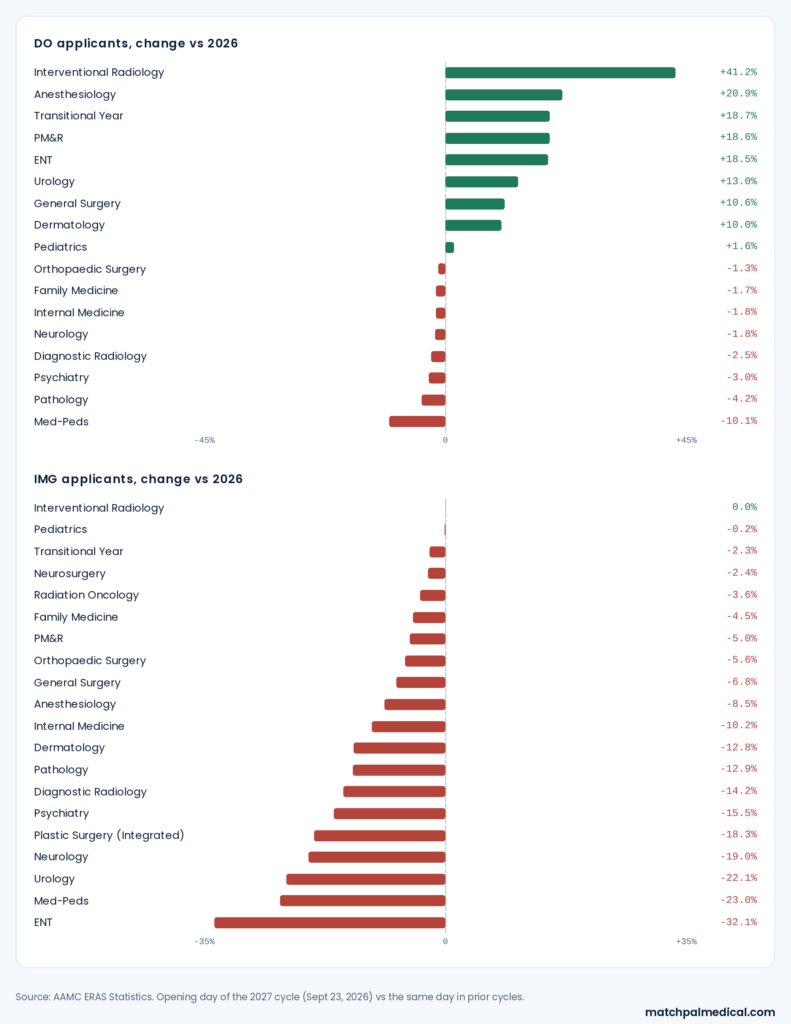
Yes. IMG applicants fell 8.0% on opening day (18,040 to 16,600). That single group accounts for the entire overall decline. US MD applicants rose 1.0% and DO applicants rose 1.3%.
The IMG drop is not even across specialties:
- Steepest IMG declines: ENT (-32%), Med-Peds (-23%), Urology (-22%), Neurology (-19%), Plastic Surgery (-18%), Psychiatry (-16%).
- Where IMG volume held: Pediatrics (-0.2%) and Family Medicine (-4.5%).
One important caveat before anyone panics or celebrates. IMGs historically apply later than US students. In the last four cycles, only 81 to 87% of the eventual IMG applicants had applied by opening day, compared with about 97% of MD applicants. Some of this gap will close over the next couple of weeks.
Where are DO applicants growing fastest?
DO applicants to Interventional Radiology rose 41%, and DO applicants to Anesthesiology rose 21% to 820. DO applicants also grew 19% in PM&R, Transitional Year and ENT.
PM&R is now close to evenly split: 44.5% MD and 42.6% DO.
The one notable reversal is Neurosurgery, where DO applicants fell from 35 to 26.
If you’re a DO applicant eyeing Anesthesiology or PM&R, the takeaway is not “it’s getting harder.” It’s that more of your classmates are making the same bet, so the parts of your application that set you apart (letters, sub-I performance, your personal statement) carry more weight. Our Sub-I playbook covers how to turn a rotation into a strong letter.
How many applications does the average residency applicant send in 2027?
The average applicant has sent 71 applications so far this cycle, down from 80 last year and 96 in 2023. Total applications fell 13.9% to 3.24 million, even though applicant volume only fell 2.4%.
That is the clearest sign yet that program signals and geographic preferences are changing behavior.
The steepest drops are in the most competitive specialties:
- Dermatology: 84 applications per applicant in 2023. 32 in 2027.
- Urology: 88 down to 43.
- ENT: 83 down to 39.
- Orthopaedic Surgery: 79 down to 36.
- Anesthesiology: 67 down to 34.
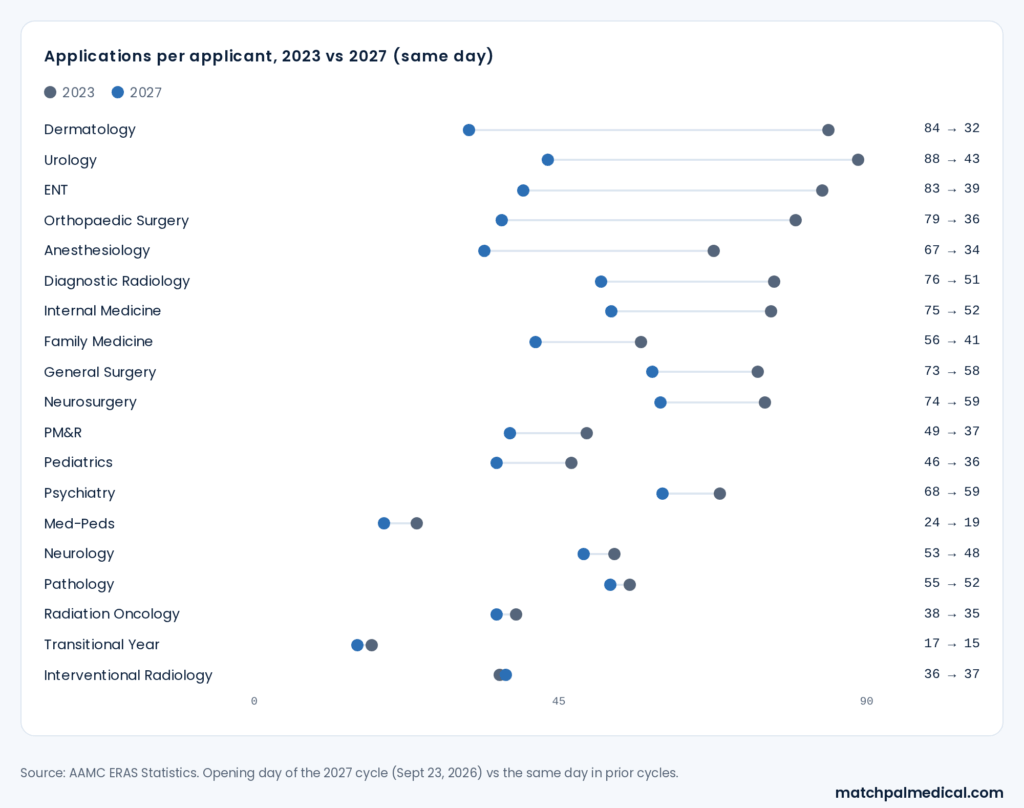
For years, the standard advice was “apply broadly to be safe.” In 2027, applicants are applying smarter, not wider.
A targeted list plus well-placed signals beats a shotgun list.
If you’re still building your list, our breakdown of how many residency programs to apply to by specialty walks through the numbers, and our signal tokens explainer covers how signals change your odds.
ERAS 2027 applicants by specialty: the full table
All 20 specialties, opening day of each cycle, sorted by 2027 applicant volume. Specialty counts add up to more than 45,571 because applicants who apply to more than one specialty are counted in each.
| Specialty | 2026 applicants | 2027 applicants | Change vs 2026 | Change vs 2024 | MD / DO / IMG share (2027) | Apps per applicant |
|---|---|---|---|---|---|---|
| Internal Medicine | 25,723 | 24,322 | -5.4% | +8.7% | 37% / 14% / 49% | 52 |
| Family Medicine | 10,549 | 10,148 | -3.8% | +22.0% | 19% / 19% / 62% | 41 |
| Transitional Year | 6,557 | 7,052 | +7.5% | +29.6% | 56% / 21% / 23% | 15 |
| General Surgery | 5,245 | 5,402 | +3.0% | +15.6% | 53% / 17% / 30% | 58 |
| Pediatrics | 5,129 | 5,066 | -1.2% | +22.3% | 34% / 15% / 51% | 36 |
| Anesthesiology | 3,517 | 3,856 | +9.6% | +13.2% | 62% / 21% / 16% | 34 |
| Psychiatry | 3,612 | 3,357 | -7.1% | -5.3% | 50% / 23% / 27% | 59 |
| Neurology | 2,511 | 2,306 | -8.2% | +13.8% | 41% / 14% / 45% | 48 |
| Diagnostic Radiology | 1,987 | 1,894 | -4.7% | -8.5% | 63% / 16% / 20% | 51 |
| Orthopaedic Surgery | 1,862 | 1,847 | -0.8% | +12.1% | 72% / 21% / 7% | 36 |
| Dermatology | 1,301 | 1,303 | +0.2% | +21.9% | 74% / 17% / 9% | 32 |
| PM&R | 1,046 | 1,180 | +12.8% | +22.5% | 44% / 43% / 13% | 37 |
| Pathology | 1,266 | 1,155 | -8.8% | -8.8% | 31% / 16% / 53% | 52 |
| Med-Peds | 1,047 | 864 | -17.5% | +5.9% | 42% / 10% / 48% | 19 |
| ENT | 640 | 713 | +11.4% | +29.2% | 84% / 11% / 5% | 39 |
| Urology | 585 | 635 | +8.5% | +20.5% | 78% / 12% / 9% | 43 |
| Neurosurgery | 573 | 587 | +2.4% | +25.2% | 75% / 4% / 21% | 59 |
| Interventional Radiology | 475 | 560 | +17.9% | +31.5% | 58% / 17% / 24% | 37 |
| Plastic Surgery (Integrated) | 480 | 469 | -2.3% | +26.1% | 82% / 4% / 14% | 63 |
| Radiation Oncology | 289 | 315 | +9.0% | +32.4% | 65% / 9% / 26% | 35 |
| All residency (unique applicants) | 46,707 | 45,571 | -2.4% | -2.7% | 46% / 18% / 36% | 71 |
What the ERAS 2027 data means for your application
Data is only useful if it changes what you do this week. Here’s how we’d read it if we were applying right now.
- Competitive procedural fields are more crowded. IR, ENT, Anesthesiology and Urology all grew. Your signals, letters and sub-I performance carry more weight than ever.
- Quality beats quantity. Applicants are sending 26% fewer applications than in 2023. A targeted list with strong signals wins over a long, unfocused one.
- Some fields are easing. Psychiatry, Pathology and Diagnostic Radiology are at five-year lows on opening day. If you’re applying there, the interview math may be friendlier, but not automatic.
- The numbers will move. This is the data from opening day. IMG and late applicants will add volume through the fall, so don’t over-read a single snapshot.
- “Why You” matters more than ever before. Signals let applicants target programs more precisely, so the programs you signal are seeing a more committed pool. Standing out through your application materials and interview performance is more critical than ever.
That last one is the part most applicants underestimate.
When everyone signaling a program is serious about it, the tiebreaker is your story: a personal statement that sounds like you, experiences that show fit, and an interview where you can answer “Why our program?” without reciting the website.
Start with our free Personal Statement Guide and the free Interview Prep Guide on our resources page, and keep the ERAS 2027 timeline open so you don’t miss a date. Still deciding between fields? The Specialty Selector is free too. If you want a resident to run mock interviews with you, see our interview preparation options.
Stop Guessing. Start Strategizing.
Your school’s advising office can tell you what worked five years ago. The 2027 data says the game has changed: fewer applications, more signaling, and more weight on the things only you can write and say.
MatchPal is a team of 80+ resident physicians who were on the other side of this process recently, in your specialty, and now help thousands of students annually match their top choice specialty and programs.
We help with everything from board prep, to VSLO application guidance, signal token strategy, personal statement/ERAS editing, and interview prep, all built around the most up to date data for your background and specialty choice.
Interested in learning more about how working with us can help you match your #1?
Book a free strategy call with our team below
Frequently asked questions
How many people applied to residency through ERAS for the 2027 Match?
As of opening day (September 23, 2026), 45,571 unique applicants had applied to residency programs through ERAS, according to AAMC data. That is 2.4% fewer than on the same day of the 2026 cycle. The final total will be higher, since the 2026 cycle finished with 50,540 applicants.
Which residency specialty had the biggest increase in applicants in 2027?
Interventional Radiology had the largest percentage increase, up 17.9% from 475 to 560 applicants. PM&R (+12.8%), ENT (+11.4%), Anesthesiology (+9.6%) and Radiation Oncology (+9.0%) followed. Anesthesiology added the most applicants of any specialty besides the Transitional Year, with 339 more.
Which residency specialties had fewer applicants in 2027?
Med-Peds fell the most (-17.5%), followed by Pathology (-8.8%), Neurology (-8.2%), Psychiatry (-7.1%) and Internal Medicine (-5.4%). Psychiatry, Pathology and Diagnostic Radiology all hit their lowest opening-day totals in five cycles.
Did IMG applications to residency decrease in 2027?
Yes. IMG applicants fell 8.0%, from 18,040 to 16,600 on opening day, while US MD applicants rose 1.0% and DO applicants rose 1.3%. IMGs tend to apply later in the cycle, so part of this gap may close by the end of the season.
How many residency programs does the average applicant apply to in 2027?
The average applicant had sent 71 applications by opening day, down from 80 in 2026 and 96 in 2023. The drop is largest in competitive specialties: Dermatology applicants average 32 applications, down from 84 in 2023.
Is Dermatology more competitive in 2027?
Dermatology applicant volume was flat: 1,303 applicants versus 1,301 in 2026, after three years of growth. What changed is behavior: applicants send far fewer applications and rely on signals, so each signal matters more.
Why aren't Emergency Medicine and OB/GYN in the ERAS data?
Both specialties moved to ResidencyCAS: OB/GYN for the 2025 season and Emergency Medicine for the 2026 season. ERAS no longer captures their applicants, so they are not included in this comparison.
When will the final ERAS 2027 numbers be available?
The AAMC updates its ERAS Statistics dashboard in the first week of each month. We’ll update this post as new data comes in.
How we pulled this data
- Source: the AAMC’s ERAS Specialty Applicants and Applications Dashboard, data refreshed September 23, 2026 (day 0 of the 2027 residency cycle).
- Apples to apples: every prior season (2023 to 2026) is shown as of the same day in its own cycle, not its end-of-cycle total.
- Specialty counts overlap: an applicant who applies to two specialties is counted in both. Overall, 38.4% of applicants applied to more than one specialty.
- Emergency Medicine and OB/GYN are excluded because they now use ResidencyCAS instead of ERAS.
- Plastic Surgery (Integrated) 2025: the AAMC shows only 96 opening-day applicants that year, versus 372 to 480 in the other years. We treat it as a data anomaly and compare against 2024 and 2026.
- Percentages are our calculations from the AAMC’s published counts.