
Last updated: 8/16/26 · Written by the MatchPal Advising Team
The residency application isn’t won in September. It’s won in the quiet months before, when the applicants who match are already lined up while everyone else is still gathering letters. Here’s the full ERAS 2027 timeline, plus the three key deadlines that actually decide your cycle.
The short answer: the ERAS 2027 timeline dates you need
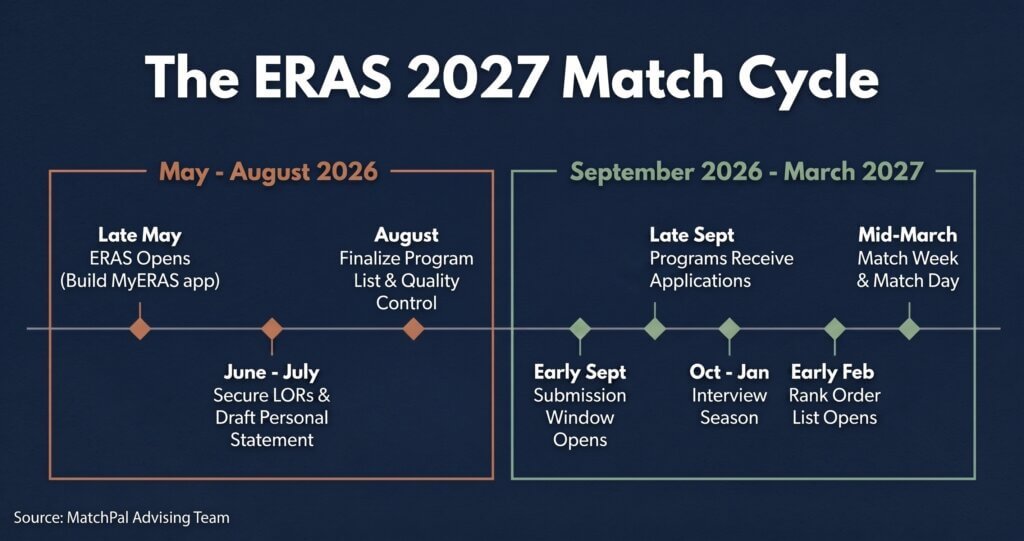
For the 2027 Match cycle (applying in 2026), the key ERAS dates are:
- Late May 2026: ERAS opens; you can begin building your MyERAS application
- Early September 2026: Applicants may begin submitting applications to programs
- Late September 2026: Programs begin receiving applications and can start reviewing
- September 2026 through late winter: Interview offers and interviews
- Early February 2027: Rank order list entry opens
- Late February 2027: Rank order list certification deadline
- Mid-March 2027: Match Week, culminating in Match Day
The mistake most applicants make: treating September as the starting line. By September, the competitive applicants have finished their personal statements, locked their letters, and finalized their program lists. September is a submission date, not a preparation window.
The thing nobody tells you about the September submission window
Here’s the detail that changes how you should plan: the exact day you submit in September doesn’t show programs how early you were ready.
When applications are released to programs in late September, every application submitted during the early-September window arrives at the same time. A student who submitted the first day and a student who submitted three weeks later look identical to program directors on release day. They all show up together.
This means that the race isn’t to submit at 12:01 AM on September 2nd. The race is to have every component (personal statement, letters, experiences, program list) finished and quality controlled before programs can begin viewing your app on Sept 23. The applicants who lose sleep over submitting at the exact minute are optimizing the wrong thing.
Why letters of recommendation are the real ERAS 2027 deadline
You control your personal statement. You control your experience entries. You do not control when your letter writers upload their letters, and that is the single most common reason applications sit incomplete while the cycle moves on without them.
Letter writers are busy attendings.
They forget. They travel. They upload late.
An application missing letters is an incomplete application, and incomplete applications don’t get reviewed on release day with everyone else.
The fix is boringly simple and almost nobody does it early enough:
- Ask for letters by early summer (June to July), not late summer
- Give writers everything they need up front: your CV, personal statement draft (or at least an outline), a summary of your work together, and the exact deadline
- Follow up in August, politely and specifically, to confirm upload
- Build in a buffer: assume at least one writer will be late, and line up a backup
If you do only one thing early this cycle, secure your letters. Everything else on the timeline is within your control. Letters are the piece that quietly sinks otherwise-strong applications.
The full ERAS timeline, month by month
May – June: Foundation
ERAS opens in late May. This is when your MyERAS application becomes available and you begin entering your experiences, education, and biographical information. Start your personal statement draft now, because the students who edit five times read better than the ones who wrote once in August. Begin formally requesting letters of recommendation.
July to August: Build and finalize
This is the real work window. Finalize your personal statement through multiple rounds of editing. Confirm every letter writer is on track. Build your program list: where you’ll apply, how many, and your signaling strategy. For competitive specialties, this is also peak away rotation and sub-internship season, which doubles as your audition and your best source of strong letters.
September: Final Check & ERAS Submission
Applications may be submitted to programs in early September, and programs begin receiving them in late September. Your job here is not to scramble. It’s to submit a complete, finished application into a window you prepared for all summer. Make sure you submit at least 24 hours before the deadline to avoid the overloaded servers of everyone submitting last minute.
October to January: Interviews
Programs extend interview invitations and conduct interviews (nearly all virtual). This is where mock residency interviews and specialty-specific prep pay off. Invitations can come fast and overlap, so being ready before your first one matters.
February: Rank lists
Rank order list entry opens in early February, with the certification deadline in late February. Your rank list is a strategy document, not a formality: how you order programs directly shapes your Match outcome.
March: Match Week
Match Week arrives in mid-March. You’ll learn if you matched at the start of the week, go through SOAP if needed, and learn where you matched on Match Day at the end of the week.
We put together a Complete ERAS Timeline Guide – including all of the strategies for every single step of the way. Fill out the form below to receive this resource right to your inbox!
How many programs should I apply to?
This is the other question every applicant asks, and the answer is specialty-dependent. We already covered this topic extensively in our blog “How Many Residency Programs Should I Apply To in 2026? (By Specialty)”, but briefly:
Competitive specialties like dermatology, plastic surgery, orthopedic surgery, and interventional radiology require broader lists and a deliberate signaling strategy, while less competitive fields need fewer.
It also shifts for DO and IMG applicants, who often apply more broadly. The number that’s right for you depends on your specialty, your board scores, your signals, and your competitiveness, which is exactly the kind of thing worth working through with someone who matched in your field recently.
The timeline works only if you start now
The pattern in every matched applicant’s story is the same: they front-loaded the work. Personal statement drafted in June, letters secured by July, program list built in August, application complete before the September window opened. The timeline above isn’t a countdown to September. It’s a countdown to being ready for September, and the ready work happens in the months most applicants waste.
If you want a resident who recently matched in your specialty to help you build this timeline around your actual application (your letters, your personal statement, your program list, your signaling strategy), that’s exactly what MatchPal does.
Book a free 15-minute strategy call and we’ll tell you where you stand and how we can help.