
Last updated: 8/21/2026 · Written by the MatchPal Advising Team
Quick answer: The NRMP Couples Match lets two applicants link their rank order lists so the algorithm only matches them to pairs of programs they both accept. It costs more (the standard $85 registration plus a $45 couples fee per person, plus higher application volume to increase your chances), rewards geographic flexibility, and lives or dies on how you build your paired rank list.
You can submit up to the allowed number of pairings, so use them: rank real combinations in order of what you’d both actually accept, program first, and be honest early about how far apart you’re willing to be.
If you’re couples matching, you already know the feeling: two applications, two specialties, two sets of interviews, and one shared question that no ranking algorithm can answer for you. Where do we both end up, together?
Here’s the good news your school’s generic advising probably glossed over. The couples match isn’t a gamble you make and hope on.
It’s a system with rules, and couples who understand the rules match together at high rates every year. The couples who struggle are almost always the ones who treat it like two separate applications that happen to share a dinner table.
This is the playbook, built from the residents who ran it themselves and the advisors who coach couples through it every single cycle.
How the NRMP couples match actually works
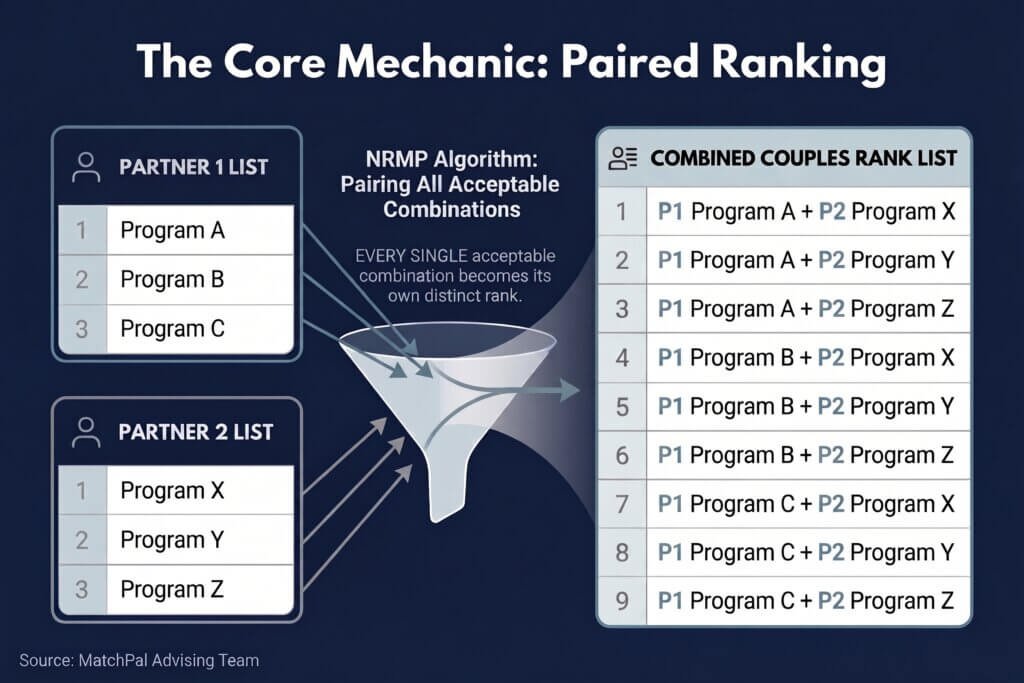
You and your partner register to match as a couple through the NRMP and link your rank order lists. Instead of ranking individual programs, you rank pairs: my program A with your program B, my program A with your program C, and so on. The algorithm walks down your combined list and matches you to the highest pair where you both land a spot. If a pairing fails on either side, it moves to the next one.
The single most important consequence: an unranked or impossible pairing is a pairing you can’t match into. The list you build is the entire universe of outcomes. That is why the ranking section below is the heart of this whole post.
The logistics and the real costs of the NRMP couples math
Couples matching costs more than matching solo, in two ways people underestimate:
- Fees. Standard NRMP registration runs about $85 per person, plus a couples fee of roughly $45 per person.
- Application volume. Application fees scale with how many programs you apply to (roughly $11 per application through the first 30, then about $30 per application after that). Couples generally apply to more programs than solo applicants, because two people both need to match, so this line item climbs fast.
- Rank list length. NRMP charges an additional fee once your rank list passes 100 ranks, and couples lists get long quickly because every pairing is its own rank.
None of this should scare you off. It should just be in your budget from day one, so the cost of ranking thoroughly never becomes the reason you rank thin. The NRMP’s “Couples in the Match” resources lay out the current numbers, and you should read them before you register. You can find that on NRMP’s official site.
Step 1: Decide your priorities before you look at a single program
The couples who match happily are the ones who had the hard conversations in July, not the ones who had them in February with a rank list due.
Consider each, separately:
Your individual match goals (each partner, on your own):
- What do you want out of residency training, independent of your partner?
- Are you aiming at academic or community programs?
- Is fellowship on the table? That shapes which programs matter.
- If one of you is applying to a competitive specialty, your list has to flex wider geographically, because the specialty is already constraining your options.
Your goals as a couple in the NRMP Match:
- How important is the same city? The same hospital? Name it out loud.
- What is the maximum distance you’re each willing to be apart?
- The question everything else hangs on: are you willing to do residency in different cities if it comes to that?
- If the answer is no, you’ll compromise on program prestige to protect location. If the answer is yes, you rank differently.
Rank your priorities from highest to lowest, together. When the algorithm forces a tradeoff, and it will, you want to already know which one wins.
Step 2: Target locations, not just programs
Build your search around cities and regions with multiple programs each of you could match into as a couple. A metro with three programs in your specialty and four in your partner’s gives the algorithm room to find a pairing. A city with exactly one option for each of you is a coin flip.
Look past the hospital. You’ll both be living there through the hardest years of your training. Do you actually like the area? Is there family nearby? Things you enjoy doing? Residency is hard enough without spending it somewhere one of you quietly resents.
Academic programs cluster in cities, which usually means more paired options, an advantage for couples. Community programs have fewer spots but can be the perfect fit when both of you are strong applicants who value a specific location.
Step 3: Signal and interview as a unit
This is where couples leave easy wins on the table and could lose a match.
- If your specialty uses signals, coordinate them. When you both genuinely want the same city, aim your signals at programs in that metro together so each of your applications carries intent to the same place.
- If one of you doesn’t get an interview at a shared-target program, reach out early, not late. A polite, prompt note to the program director explaining your couple’s situation can matter. Programs can sometimes work with a couple when they know early; they rarely can in January.
- Tell programs you’re couples matching, and ask about it directly in interviews. Program directors need to see you as a unit to rank you in a way that keeps you together. Good questions to ask:
- “Has this program matched couples before?”
- “Does the program coordinate with nearby programs to accommodate couples’ schedules?”
- Try to interview at paired programs on or near the same day. It’s efficient, and it signals to both programs that you’re seriously considering their city as a package.
After every interview, debrief together the same night: What did each of you actually like? Any dealbreakers? Does this program serve both of your training priorities? Could you both be happy living here? Those four questions, asked consistently, become your rank list.
Step 4: Build the rank list (where the couples match is won)
First, do this: watch the NRMP’s “Couples in the Match” video on YouTube. It walks through the pairing mechanics visually and it’s the single best free resource on this. Watch it together.
Then build your paired list on these principles:
- Program first, then pair around it. Identify each partner’s top individual choices, then construct the combinations: A1 with B1, A2 with B1, A1 with B2, and so on. Work outward from your best-case pairings to your acceptable ones.
- Use your pairings generously. You’re allowed a large number of combinations (up to the NRMP’s cap, which is high). Couples who rank thin miss matches that a fuller list would have caught. Any pairing you’d both genuinely accept belongs on the list.
- Enter combinations by hand, deliberately. Do not outsource the pairing logic to an AI tool or a shortcut. Go through the combinations yourselves so no acceptable pair is accidentally left off. A missing pairing could cost you the match.
- Apply to a few more programs than a solo applicant would. If your specialty caps signals or applications, respect the cap, but lean toward the wider end of the range, because two people have to match, not one.
A useful way to structure the list, best to last resort:
- Same hospital, or same city, at the best programs you both interviewed at
- Same or nearby location, both at strong programs
- Same area, one partner at a top choice and the other slightly lower on their list
- Different locations but both at solid programs you’d accept
- The scenario to discuss heavily and only if you must: one partner matches and the other does not. Decide, in advance and together, whether that pairing belongs on your list at all.
Step 5: Trust the process you built throughout your couples match journey
You are not the first couple to try and match together, and you won’t be the last. Thousands match together every year on exactly this system.
Control what you can control: strong applications, well-targeted interviews, coordinated signals, and a thorough, honest rank list. Then let the algorithm do the job it was built for.
Planning is the anxiety cure.
Match Together, On Purpose
The couples match rewards preparation more than almost any other part of the application, because you’re solving for two people at once and the rank list has to hold all of it. Done deliberately, it’s not a gamble. It’s a strategy.
Our advisors include resident physicians who couples matched themselves and coach couples through priorities, program lists, signaling, and the paired rank list every cycle. If you and your partner want a plan built around your two specialties and your one shared life:
FAQ
How does the couples match work?
Two applicants register as a couple through the NRMP and link their rank order lists as pairs of programs. The algorithm matches you to the highest-ranked pairing where you both secure a position, so you only match to combinations you both accept.
How much does the couples match cost?
More than matching solo: standard NRMP registration (about $85 per person) plus a couples fee (about $45 per person), plus application fees that scale with volume and an added fee for rank lists over 100 ranks. Confirm current figures on the NRMP fee page.
How many programs should a couple apply to?
Generally more than a solo applicant, because both partners need to match. Respect your specialty’s signal and application conventions, but lean wider, especially if either partner is in a competitive specialty.
Should we tell programs we’re couples matching?
Yes. Programs need to see you as a unit to rank you in a way that keeps you together. Ask directly whether the program has matched couples before and whether it coordinates with nearby programs.
What happens if only one of us matches?
It’s possible, which is exactly why you decide in advance whether that scenario belongs on your rank list. Couples with strong, geographically flexible lists minimize the risk; the unmatched partner may also enter SOAP during Match Week.
Is it better to rank more combinations or fewer?
More, within reason. Every acceptable pairing you leave off is an outcome you can’t match into. Use your combinations generously and enter them by hand so none are missed, but don’t list pairings you would not genuinely accept.