Last updated: 8/26/2026 · Written by Daniel Veyg DO, resident physician and MatchPal advisor · Reviewed by the MatchPal Advising Team
For two years, medical school rewarded one skill: sit in a quiet room and absorb an enormous volume of facts. Then you start clinical rotations, and the ground moves. The students who feel lost in MS3 are almost never less capable than they were in MS2. They are running a playbook that stopped applying the day they walked onto the wards.
Since Step 1 became pass/fail, this matters more than it used to. The weight of your application shifted onto the clinical years. Clerkship grades and Step 2 CK now carry what a Step 1 score once did (see the NRMP Program Director Survey for how directors weight these factors). Here is exactly what changes, and how to get ahead of it.
How is MS3 different from MS2?
MS3 changes three things at the same time: what you are evaluated on, how you have time to study, and what makes you a competitive applicant. Preclinical years test one of those variables. Clinical year moves all three at once, which is why the transition feels so abrupt.
1. The MS3 shift from recall to clinical judgment
Preclinical exams, Step 1, and Level 1 reward retrieval. Memorize the mechanism, reproduce the fact, pass the test. The blueprint is well defined, even with first-time pass rates under pressure.
MS3 is a different story. Your preceptors, your NBME shelf exams, and Step 2 / Level 2 all reward clinical judgment. The question is no longer “what is the mechanism” but “given this patient, what is the next best step, and how do you manage them?” Easily retrievable facts become just a factor; how you think through a treatment algorithm matters most.
What to do about it: flip your study method. Preclinical studying is reading-first: learn the material, then test yourself on it. Clinical studying is question-first. You learn medicine by working through questions and discussing real patients, then you read to fill the specific gaps those questions expose.
Resources like UWorld and AMBOSS stop being a review layer and become your actual curriculum. Anchor what you study to the patients you see: the diagnoses you touch on the floor are the ones that stick for the shelf.
2. The shift from dedicated time to daily consistency
In preclinical years you could reserve a weekend to study. In MS3, your time is no longer yours. You have 8 to 12 hour days at the hospital, and you are tired when you get home.
The students who stay ahead do not wait for a free weekend that never comes. They commit to a consistent daily dose of questions and targeted reading, on every rotation, regardless of how busy it is. A smaller amount done daily beats a heroic weekend done occasionally, because the knowledge compounds.
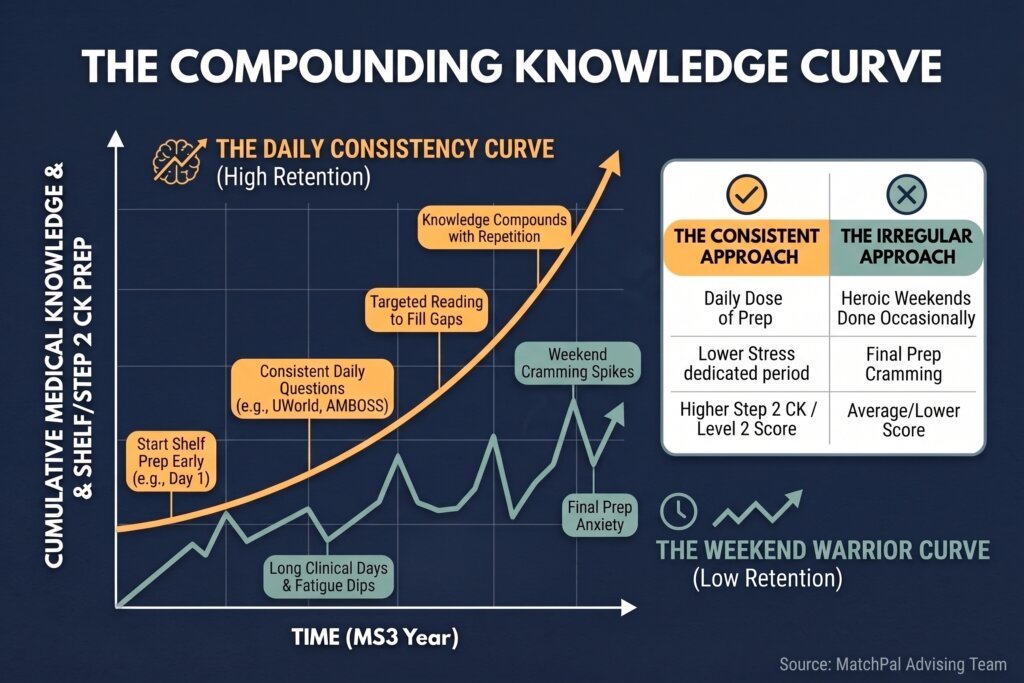
What to do about it: front-load every block and treat Step 2 as a year-long project. Start shelf preparation on day one of each rotation, not the week before the exam. Build in review of content from past rotations so it does not evaporate. Your Step 2 / Level 2 score is built across all of MS3, not recovered in a dedicated period.
Every shelf you take seriously is a live rehearsal for Step 2. Compounding the knowledge through repetition all year means a lower-stress dedicated period and a higher board score.
3. Academics are only part of the ERAS equation throughout MS3
Strong scores and clerkship evaluations are critical. They are also not, by themselves, what makes an application stand out. When programs read applications at ERAS time, the students who separate from the pack show sustained involvement in research and leadership, ideally aligned with the specialty they are targeting.
What to do about it: invest early in research, mentorship, and access. This is where effort yields outsized returns. A case report or research project you begin in MS3 is worth far more than three you scramble to assemble the summer before you apply.
The attendings and residents who watch you work become the writers of the letters that actually carry weight. Getting into your specialty’s world early, through interest groups, student societies, conferences, and mentorship, builds the relationships, the research pipeline, and the clarity about your field that a strong application is built on. The students who feel behind are usually the ones who waited to be invited.
The honest truth about MS3
MS3 is not simply harder than MS1 and MS2. It rewards a fundamentally different approach, both for how you study and for how you develop your candidacy, and most schools never hand you that playbook. The good news is that all three shifts are learnable, and the earlier you make them, the bigger the advantage.
That is exactly why MatchPal exists. Our advisors are 80+ resident physicians who ran these exact transitions recently, matched into their target specialties, and can help you build the study system, the research on-ramp, and the strategy that clinical year demands, tailored to your specialty and to whether you are an MD or DO applicant.
If you are heading into clinical rotations, or already in them and want a clearer plan, talk through your year with a resident on our team for free.
Planning ahead for a competitive specialty as an MS1 or MS2? Our Competitive Specialty Accelerator helps you build the research and strategy foundation before clinical year even begins.
Data note: Step 1 became pass/fail in January 2022. For how program directors weight Step 2 CK and clerkship performance, see the NRMP Program Director Survey (https://www.nrmp.org/).
FAQ
Why is the MS2 to MS3 transition so hard?
Because three things change simultaneously: evaluation shifts from recall to clinical judgment, dedicated study time disappears in favor of long clinical days, and the definition of a competitive applicant broadens to include research and leadership. Preclinical years only test one of these at a time, so changing all three at once feels abrupt.
How should I study for shelf exams and Step 2 differently than Step 1?
Switch from reading-first to question-first. Use a question bank like UWorld Step 2 as your primary learning tool, anchor your studying to the patients you see on rotations, and read to fill the gaps your questions reveal. Judgment and management matter more than raw recall.
When should I start studying for a shelf exam?
On day one of the rotation, not the week before. Consistent daily questions throughout the block outperform last-minute cramming, and they build the Step 2 knowledge you will rely on later.
Is Step 2 CK built during MS3 or during dedicated?
Both, but mostly during MS3. Your Step 2 / Level 2 score is accumulated across every rotation through consistent practice. A strong, steady MS3 makes dedicated lower-stress and produces a higher score than trying to build the knowledge from scratch at the end.
What do successful MS3 students do that others do not?
Beyond strong scores and evaluations, they invest early in specialty-specific research, seek out mentorship and networking, and get involved in their field through societies and leadership. Starting early, rather than waiting to be invited, produces outsized returns at ERAS time.