
Last updated: September 21, 2026 · Written by the MatchPal Advising Team · Reviewed by Daniel Veyg, DO
Quick answer: Most residency interviews in 2026 draw from the same core set of questions: “tell me about yourself,” “why this specialty,” “why this program,” a strength-and-weakness pair, one behavioral question, and “what questions do you have for me.” Programs start reviewing applications on September 23, 2026, and interview invitations follow within days for many specialties, so the applicants who prepare now, while they’re still on clerkships, walk in with answers instead of improvising them. Below are word-for-word scripts for each category, a DO and IMG section, and the questions worth asking back.
It’s the third week of September. You’re on an away rotation, you just submitted your application, and somewhere between rounding and writing notes you’re supposed to also be getting ready for residency interviews that could start landing in your inbox within days.
That’s the real timeline this year: programs get access to review applications at 9:00 AM ET on September 23, 2026, and invitations for several specialties follow almost immediately (AAMC ERAS timeline). There usually isn’t a clean gap between “still on service” and “first interview” to prepare in.
So this blog is built to be used in fifteen-minute blocks between patients, rather than a weekend project you don’t have time for.
What are the most common residency interview questions in 2026?
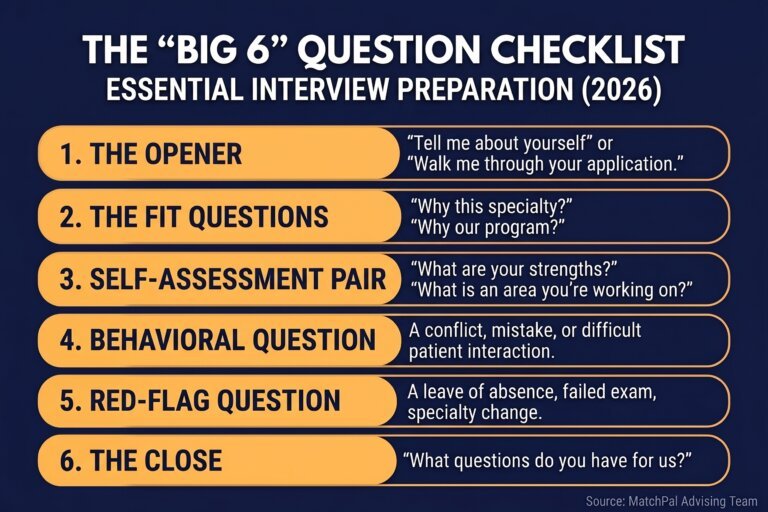
Nearly every residency program draws from the same short list of interview questions. If you’re limited on time to prepare, these are the most important questions to focus on:
- The opener: “Tell me about yourself” or “walk me through your application.”
- The fit questions: “Why this specialty?” and “Why our program?”
- The self-assessment pair: “What are your strengths?” and “What’s an area you’re working on?”
- One behavioral question: a conflict, a mistake, or a difficult patient interaction.
- A red-flag question, if your application has one: a leave of absence, a failed exam, a specialty change.
- The close: “What questions do you have for us?”
Program directors consistently name the personal statement as one factor they weigh when deciding who to interview (NRMP Program Director Survey, 2025: 84% cite it as a factor). The interview is where you confirm, in person, that the story on paper is really you.
How do you answer the "tell me about yourself" question in a residency interview?
This question is not an invitation to recite your CV. The interviewer already has it. It’s an invitation to give it a narrative.
The structure: where you started, the moment or pattern that pointed you to this specialty, and what you’re looking for in a program. Give this 90 seconds max.
“I grew up wanting to work with my hands and solve problems in real time, which is part of why engineering was my major before medicine. During my surgery clerkship, I was in a case where the plan changed twice in ten minutes because of what the attending saw on the monitor, and I realized that’s exactly the kind of thinking I wanted to spend my career doing. Since then I’ve sought out every OR day I could get, and I’m looking for a program that will let me start operating early and push me hard in the process.”
Write your own version of this before you write anything else. Every other answer in the interview should trace back to it.
How do you answer behavioral residency interview questions?
Behavioral questions ask about a specific past situation: a conflict with a team member, a mistake, a time you had to deliver bad news. Programs ask them to see how you actually behave under pressure, not how you say you’d behave.
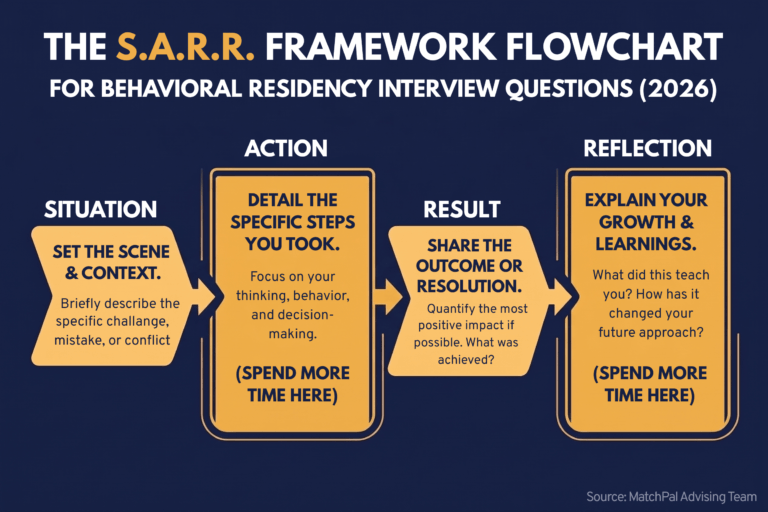
Use a four-part structure: situation, action, result, reflection. Keep the situation short. Spend most of your time on the action you took and what you learned.
“On my medicine sub-internship, a nurse flagged that I’d written an order that conflicted with the patient’s home medication list. My first reaction was defensive, but I stopped, looked at the chart again, and she was right. I thanked her, corrected the order, and asked her to flag anything like that directly to me going forward rather than waiting. It taught me that being checked by someone on the team isn’t a threat to my competence, it’s the system working the way it’s supposed to.”
Pick your stories now, before the interview. Trying to search for an example in real time is how answers ramble and lose focus. Because these prompts inevitably center on conflict, mistakes, or high-pressure moments, prepare two versatile experiences that hit more than one of these themes. You’ll be ready for almost any variation they throw at you.
How do you answer "why this specialty" and "why this program"?
Generic answers here are the easiest way to sound like every other applicant.
“Why this specialty” should name a specific moment, not an abstraction. Not “I love the variety and the patient relationships,” but the actual case, patient, or rotation day that made you feel that way.
“Why this program” requires two things you found by researching that program specifically: something about its structure, faculty, or patient population that maps to what you want, and something you’d bring that fits what it’s building.
“I was drawn to your program because of the community health rotation in the second year, which lines up with the underserved-care work I’ve already been doing through [specific experience]. I’d also bring [specific strength or interest], which I noticed fits with the research your faculty are doing in [area].”
If you signaled this program, this is also where that signal becomes real in the room. Our program signals framework covers how programs read them going in.
How do you answer a weakness or a red flag question?
For a weakness: name something real, show you’re actively working on it, and keep it to three or four sentences. A rehearsed non-answer (“I work too hard”) reads worse than an honest one.
“I tend to want to double-check every detail myself before handing work off, which slowed me down on a busy rotation. I’ve been working on trusting the team’s checks and building in a specific point where I hand something off instead of holding it. It’s made me faster without making me less careful.”
For a red flag (a leave of absence, a failed exam, a specialty change): address it directly in three to four sentences, own your part in it, and pivot to what’s different now. Do not over-explain. A short, confident answer moves the conversation forward. A long one keeps you stuck in it.
“I didn’t pass Step 2 CK on my first attempt. I took a hard look at how I’d been studying, changed my approach, and retook it with a plan that worked, which you can see in the score. I’m glad it happened when it did because it changed how I study for the rest of my training.”
What should DO and IMG applicants prepare differently for residency interviews?
The core questions above are the same for every applicant. But DO and IMG applicants are more likely to get a direct question about their path, and it’s worth having a tight answer ready rather than being caught improvising.
For DO applicants, a version of “why DO” or a question about OMM still comes up in some residency interviews. Answer it as a strength, not a defense.
“I chose the DO path because the osteopathic philosophy of treating the whole patient matched how I already wanted to practice, and OMM gave me another clinical tool most of my MD colleagues don’t have. It hasn’t been a different path to the same goal. It’s been an advantage on it.”
For IMG applicants, be ready to speak plainly about your training, your path to the US system, and your visa status if it applies, without over-explaining or sounding apologetic.
“I trained at [school] and pursued additional US clinical experience because I wanted to be evaluated against the standard I’d be practicing under. That’s also why I sought out [specific research or clinical experience] once I got here. I’ll need a J-1 visa, which your program has sponsored before, and I’m glad to answer any questions about the process.”
Neither of these needs a long explanation. Say it once, clearly, and move on. Our Comprehensive Interview Preparation Guide has more on framing questions like these with confidence. Enter your details below to receive it directly to your inbox.
What questions should you ask the interviewer?
The close, “what questions do you have for us,” is not a formality. Showing up with nothing reads as low interest.
Ask questions you actually can’t answer from the website:
- “What do residents in this program end up doing that surprised them, in a good way?”
- “How does the program support residents who want to go into [subspecialty/fellowship] afterward?”
- “What’s changed about the program in the last two years?”
Avoid questions with answers already on the program’s site (case volume, rotation schedule) and avoid asking about salary or benefits in the interview itself.
Stop Guessing. Start Strategizing.
An application gets you the interview. What you say in the room is what moves you up the rank list. The applicants who walk in most prepared aren’t smarter, they’ve just rehearsed out loud with someone who has sat on the other side of the table.
That’s what MatchPal is: 80+ resident physicians across every specialty, many of whom sit on their own programs’ selection committees, running mock interviews and building your residency interview answers with you before the real questions happen.
Start with our free Comprehensive Interview Preparation Guide. When you want a live mock interview with a resident in your specialty, see residency interview preparation or book a free 15-minute strategy call. Our ultimate residency interview checklist covers everything else you need the week of the interview itself.
FAQ
What is the most common residency interview question?
“Tell me about yourself.” It’s the question that opens nearly every residency interview, virtual or in person, and sets the tone for the rest of the conversation, so it is worth scripting and rehearsing out loud rather than winging it.
How long should a residency interview answer be?
About 60 to 90 seconds for most questions, longer for “tell me about yourself” (up to 2 minutes) and shorter for quick factual questions. If you notice yourself past the two-minute mark, wrap up.
Should you memorize your residency interview answers word for word?
Memorize your opening line and your closing line for each answer, then work from bullet points in between. A fully memorized answer tends to sound recited, and interviewers will notice.
Is it okay to ask the interviewer questions during a residency interview?
Yes, and you should. Nearly every residency interview ends with “what questions do you have for me,” and showing up without any is read as a lack of genuine interest in the program.
Do DO and IMG applicants get asked different interview questions?
The core residency interview questions are the same, but DO and IMG applicants are more likely to get a direct question about their pathway. Programs are not testing whether you belong. They are testing whether you can explain your path with confidence.