
Last updated: November 11th, 2026 · Written by the MatchPal Advising Team & reviewed by Daniel Veyg, DO.
Quick answer: The mean Step 2 CK score for first-time takers from LCME-accredited schools is now 251, up from 240 a decade ago, and the standard deviation has tightened from 18 to 15. On the official August 2026 USMLE percentile table, 250 is the 44th percentile, 255 is the 58th, and 260 is the 71st. Matched median scores in 2026 ranged from 244 in family medicine to 261 in otolaryngology. The two tables below let you convert your score into a percentile and then check it against the specialty you actually want.
Most Step 2 CK advice is built on numbers that stopped being true around 2019. “240 is average” and “250 is a strong score” were both reasonable statements once. Neither survives contact with the current data.
Everything below comes from two primary sources: the USMLE Score Interpretation Guidelines updated in August 2026, and NRMP’s Charting Outcomes in the Match, 2026. No estimates or forum math.
What is the average Step 2 CK score in 2026?
251, for first-time takers from LCME-accredited US medical schools.
That number has moved steadily:
| Testing year | Mean Step 2 CK score |
|---|---|
| 2014-15 | 240 |
| 2023-24 | 249 |
| 2024-25 | 250 |
| 2025-26 | 251 |
Eleven points in roughly a decade. If you are working from a mental benchmark you picked up from an upperclassman two or three years ago, it is probably one to two points stale, and if you picked it up from a blog post written before 2020 it is a full decade stale.
What percentile is my Step 2 CK score?
This is the official percentile table from the USMLE Score Interpretation Guidelines updated August 2026, based on 67,824 first-time examinees from MD-granting schools who tested between 2023 and 2026.
| Step 2 CK score | Percentile rank |
|---|---|
| 270 | 93rd percentile |
| 265 | 83rd percentile |
| 260 | 71st percentile |
| 255 | 58th percentile |
| 250 | 44th percentile |
| 245 | 32nd percentile |
| 240 | 23rd percentile |
| 235 | 15th percentile |
| 230 | 9th percentile |
Three things in that table surprise almost everyone:
- 250 is below the median. It sits at the 44th percentile. Most students hear 250 and think “above average.”
- 240 is now the 23rd percentile. A score that was the national mean in 2014-15 now sits in the bottom quarter.
- The top is compressed. 260 to 270, a ten-point span, covers the 71st through 93rd percentile. Near the top, every single point moves you considerably more than it does in the middle.
Why did Step 2 CK percentiles shift?
Two things happened at once.
Step 1 went pass/fail. The screening pressure that used to be distributed across two numeric scores landed on one. Students responded by preparing for Step 2 CK the way they used to prepare for Step 1, and the distribution moved.
The curve tightened. The standard deviation fell from 18 to 15. That is the part most people miss, and it matters more than the mean shift: in a tighter distribution, the same ten-point difference spans more of the cohort. A 10-point gain is worth more percentile movement today than it was five years ago.
The practical consequence is that score improvement is more valuable now, not less, which is the opposite of what students assume when they hear “everyone’s scores went up.”
Free Dedicated Study Blueprint · Built by 260+ Scorers
In a tighter curve, every point counts. Lock in your Step 2 CK study plan.
With the standard deviation down to 15, a 10-point score jump moves you past a much larger share of the national cohort. Grab the exact week-by-week dedicated framework built by resident physicians who scored in the 90th+ percentile:
- Week-by-Week Dedicated Schedule: How to structure a 4–8 week dedicated block from baseline NBME to test day.
- QBank & Practice Exam Pacing: When to take each NBME/UWSA self-assessment and how to turn incorrect blocks into real point gains.
- Dual-Exam Pacing (MD & DO): Exact resource selection for Step 2 CK, plus how DO applicants can layer in COMLEX Level 2-CE without burning out.
Prefer to view it in your browser? Go straight to the Step 2 / Level 2 Dedicated Study Plan page →
What Step 2 CK score do you need for your specialty?
These are the 2026 median Step 2 CK scores among US MD seniors who matched their preferred specialty, from NRMP’s Charting Outcomes in the Match, 2026.
One wording note, because it matters for how you read them: NRMP reports medians in the 2026 edition, not means. A median is the midpoint, so half of matched applicants in each specialty scored below the number listed.
| Specialty | 2026 matched median |
|---|---|
| Otolaryngology | 261 |
| Thoracic Surgery | 260 |
| Orthopaedic Surgery | 259 |
| Plastic Surgery | 259 |
| Dermatology | 258 |
| Diagnostic Radiology | 257 |
| Neurological Surgery | 256 |
| Vascular Surgery | 256 |
| Anesthesiology | 255 |
| Internal Medicine/Pediatrics | 255 |
| Interventional Radiology | 255 |
| General Surgery | 255 |
| Internal Medicine | 254 |
| Obstetrics and Gynecology | 253 |
| Neurology | 252 |
| Child Neurology | 251 |
| PM&R | 251 |
| Radiation Oncology | 251 |
| Emergency Medicine | 249 |
| Pediatrics | 249 |
| Pathology | 247 |
| Psychiatry | 247 |
| Family Medicine | 244 |
Across all specialties combined, US MD seniors who matched had a median of 253. Those who did not match had a median of 244. That nine-point gap is the single most useful number on this page, because it is the only one that compares matched against unmatched rather than specialty against specialty.
How do you use the percentile and the specialty median together?
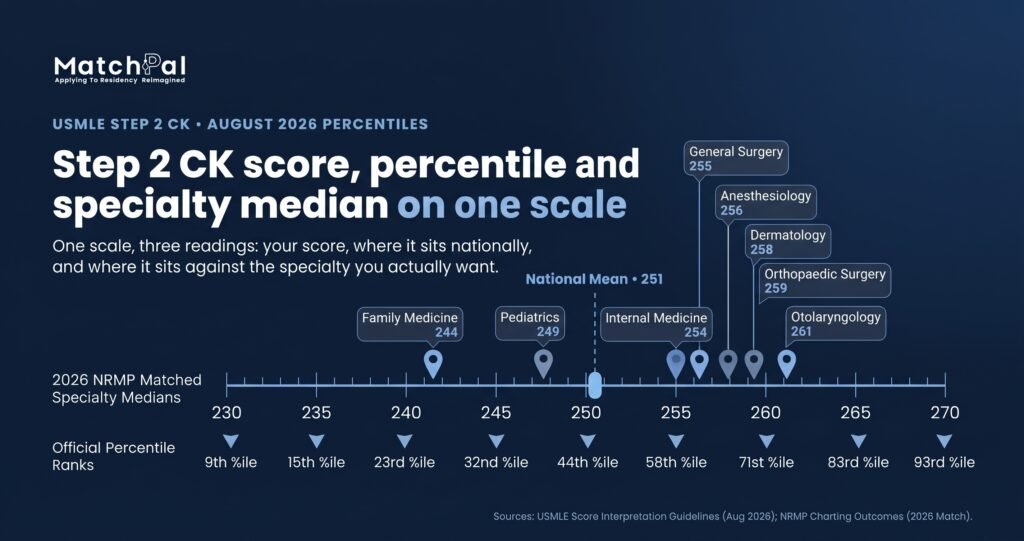
Separately, each table is trivia. Together they answer the real question.
Work it in three steps:
- Find your percentile in the first table. This tells you where you sit nationally.
- Find your target specialty’s median in the second. This tells you where the middle of your actual competition sits.
- Compare the two numbers, not the two feelings. A 255 is the 58th percentile nationally, which sounds middling, and it is also at or above the matched median for anesthesiology, internal medicine, OB/GYN, neurology, PM&R, emergency medicine, pediatrics, pathology, psychiatry and family medicine. The same score sits below the median for otolaryngology, orthopaedics, plastics and dermatology.
The percentile tells you how you compare to everyone taking the exam. The specialty median tells you how you compare to the people you are actually ranked against. Only the second one affects your Match.
1-on-1 USMLE & COMLEX Tutoring · 260+ Scoring Resident Mentors
Aiming for a competitive specialty median? Close the gap with a 90th+ percentile resident tutor.
MatchPal tutoring students average a 21-point increase on Step 2 CK (and a 252 average score) working one-on-one with resident physicians who scored 260+. From custom dedicated schedules and NBME diagnostic breakdowns to live QBank reasoning strategy, we help you turn weak systems into test-day points.
Is 250 a good Step 2 CK score?
It depends entirely on the specialty, which is an unsatisfying answer until you look at what it actually means here.
A 250 sits at the 44th percentile nationally. It is below the matched median for every specialty in the top half of that table. It is also at or near the matched median for family medicine, psychiatry, pathology, pediatrics and emergency medicine, and within a few points of internal medicine.
If you are applying into a field whose median is 247 to 251, a 250 is a perfectly competitive score and the rest of your application is where the work is. If you are applying into a field whose median is 258 to 261, a 250 is a real gap and your program list, signals and letters need to do more work. Both of those are plans. “Is 250 good” is not.
What if your score is below your specialty's median?
Start with the arithmetic: half of everyone who matched in your specialty scored below that median. It is a midpoint, not a cutoff.
Then work what you still control:
- Program list strategy. Apply where your file is genuinely competitive, and weight programs that have taken applicants with your profile before.
- Signals. Spend them where you have a real chance, not where you wish you did. See our program signal decision framework.
- Letters and aways. A month on service with a strong letter at the end outweighs several points.
- Research, with realistic expectations. We looked at what the NRMP data actually says about research and the Match, and the answer is more nuanced than “publish more.”
- A narrative that holds together. Programs want a clear story about why this specialty.
What about COMLEX and DO applicants?
The percentile table above covers MD-granting school examinees who took Step 2 CK. If you are a DO student, two things are worth knowing: COMLEX Level 2-CE percentiles work differently and come only from NBOME’s own converter, and many DO students also take Step 2 CK precisely because competitive programs read it more fluently.
We cover the osteopathic side in our guide to COMLEX percentiles, the full MD and DO comparison in what Step 2 and Level 2 score you need for your specialty, and where the DO disadvantage is real and where it is not in our DO vs MD match rates by specialty analysis.
If you have not taken it yet
Every number on this page is fixed the day you sit for the exam. Before that, it is still a variable.
Because the distribution tightened, points are worth more percentile movement than they used to be, and a focused prep plan has more leverage now than the same plan would have had five years ago. MatchPal tutoring students see an average increase of 21 points on Step 2 CK and 132 points on COMLEX Level 2 from baseline, working one-on-one with resident physicians.
Start with our free Step 2 and Level 2 dedicated study plan. If you want a tutor who has been in your seat, see USMLE and COMLEX tutoring.
And if you have already tested, the useful conversation is strategic rather than academic: which specialties are realistic, where to apply, where to signal. Book a free strategy call with a resident physician and get a candid read on what your score means for your target specialty.
Frequently asked questions
What is the average Step 2 CK score in 2026?
251 for first-time takers from LCME-accredited US medical schools, up from 250 the previous year and 240 in 2014-15. The standard deviation has also fallen from 18 to 15, meaning the distribution is tighter than it used to be.
What percentile is a 250 on Step 2 CK?
The 44th percentile, according to the USMLE Score Interpretation Guidelines updated August 2026. Despite sounding like a solid score, 250 sits just below the national median.
What percentile is a 260 on Step 2 CK?
The 71st percentile. A 265 is the 83rd and a 270 is the 93rd, so the ten points between 260 and 270 cover more than twenty percentile points.
What is a competitive Step 2 CK score for a competitive specialty?
For the most competitive fields, the 2026 matched medians were 261 for otolaryngology, 259 for orthopaedic surgery and plastic surgery, and 258 for dermatology. Half of matched applicants scored below those numbers, so treat them as midpoints rather than cutoffs.
Why have Step 2 CK scores gone up?
Step 1 moved to pass/fail, which concentrated screening pressure onto a single numeric score, and students shifted preparation accordingly. The standard deviation also tightened from 18 to 15, so the distribution is both higher and narrower than it was.
Is the Step 2 CK percentile table the same for DO students?
No. The published percentile table covers first-time examinees from MD-granting schools. DO students taking COMLEX Level 2-CE should use NBOME’s own percentile conversion tool, which is the only authoritative source for that exam.
MatchPal is a resident-run residency advising and tutoring platform with 80+ resident physician advisors. Our students match their preferred specialty 99% of the time, and 84% match in their top three categorical programs. Built by residents. For the students who are next.