
USMLE/COMLEX Dedicated Study Tips for 2026
Last updated: October 13, 2026 · Written by the MatchPal Advising Team · Reviewed by Ian Rumball, MD
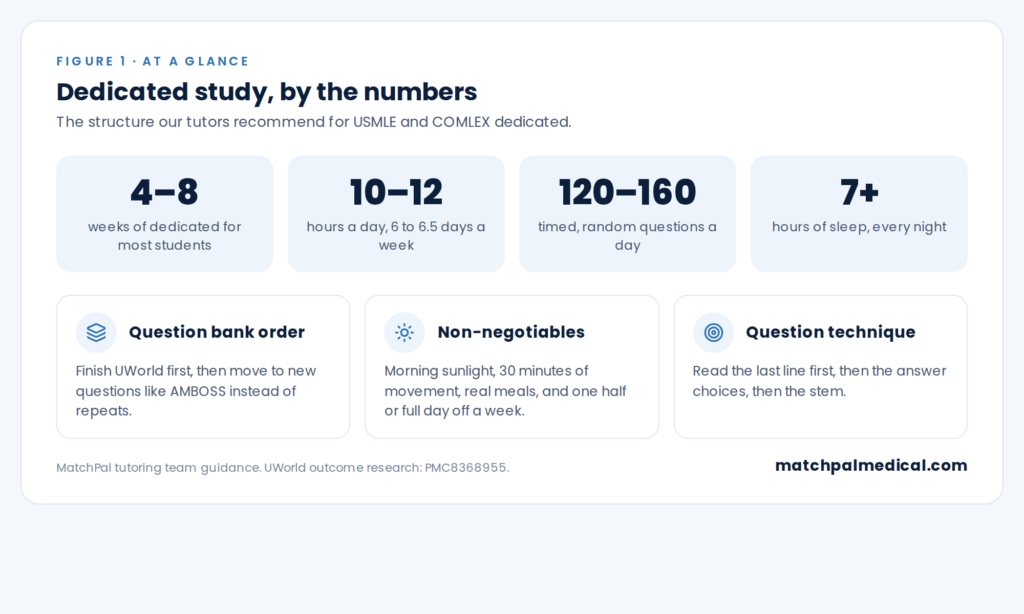
Quick answer: A strong Dedicated period runs 4 to 8 weeks, roughly 8 to 12 hours a day, 6 to 6.5 days a week (accounting for a small break to protect sleep and sanity). Finish UWorld first, then move to new practice questions (e.g., AMBOSS), aiming for 120 to 160 timed, random questions a day. Incorporate practice exams, most importantly UWSA1 around 4 weeks out, UWSA2 around 1 week out, and the NBME Free 120 about 3 to 4 days before test day. DO students sitting both boards typically take COMLEX 3 to 6 days after USMLE and use that window to cram OMM specifically. Your habits around studying, sleep, and health (e.g., movement/exercise, nutrition, sunlight, and small genuine breaks each week) determine whether you can sustain this pace long enough for it to work.
Its mid-October. If your test date is in November or December, you are already in it. If you are aiming for January or February, you are in the planning window right now, which is the best time to be reading this.
In any case, your Dedicated study period can make you nervous, and that is normal. It can be intellectually rewarding, but mentally and physically draining.
Here is what our advisors see that distinguishes students who hit their target score from students who underperform relative to their expectations. It is almost never raw ability. The most important factor in. meeting your goal is mastering the basics and running a well-planned schedule, instead of improvising each day.
Here are our biggest tips, updated for the 2026 exam format and whichever board exam you are sitting.
How long should a dedicated study period be for Step 1, Step 2 CK, or COMLEX?
Four to eight weeks for most students.
Where you land depends on your score goals and expectations, your practice exam baseline going in, and how much content you are going to be relearning versus reinforcing. Closer to four weeks works if your rotation-year question bank performance is already near your target. Closer to eight makes sense if you had a shaky study schedule leading up to Dedicated or need to relearn content before you can focus on test-taking skills.
What’s the ideal daily schedule during dedicated?
About 10 to 12 hours a day, 6 to 6.5 days a week, for most students who perform well.
That a half day to full day off, Saturday or Sunday, whichever fits your needs. It is necessary. You need the recovery to sustain intensity the rest of the week.
Treat dedicated like training for an endurance event, because that is exactly what it is. A marathon runner who skips recovery does not finish faster. They get fatigued, injured, and break down earlier.
What lifestyle habits actually improve your performance during dedicated?
These sound obvious, but some students skip them in hopes of cranking out more studying, and that is precisely why they are worth stating plainly.
- Sleep at least 7 hours a night. Cutting sleep to add study hours is a net loss. Retention and critical thinking will degrade from sleep deprivation, negating marginal gains from staying up studying.
- Get direct sunlight daily, ideally in the morning. It has real impacts on your sleep and mood.
- Move your body, even 30 minutes. It helps break up the day and improves your mental performance. Incorporate stretching and pay attention to your posture, since sitting at a desk hitting the space bar or cranking questions for hours on end is not great for your body.
- Eat and hydrate for brain function. Nutritious food is going to make a huge difference for your mental performance and health during this difficult period.
It sounds obvious now, but you’ll thank yourself six weeks in as you feel optimized, and watch classmates burn out from ignoring the basics. Skipping these steps is going to hurt your performance.
What’s the best question bank workflow during dedicated?
Finish UWorld for a complete first pass, then move into new practice questions like AMBOSS. Target 120 to 160 questions a day, timed, random mode.
Research has shown that students who completed UWorld achieved significantly higher USMLE scores than those who did not, but no significant differences were seen between students who completed that UWorld once versus twice.
In our opinion, seeing new questions beats repeating old ones nearly every time, because recognizing a question you have already seen is a different skill from reasoning through one you have not, under time pressure.
The question strategy that can quickly boost your score: read the last line of the question first, the thing actually being asked. Then the answer choices. Only then go back and read the stem from the top. That sequence puts you in the right frame before you wade through a paragraph of clinical detail, and it is worth building your habits on every single question from now until test day, not just ones that feel hard.
When should you take practice exams during dedicated?
A framework that works for most students:
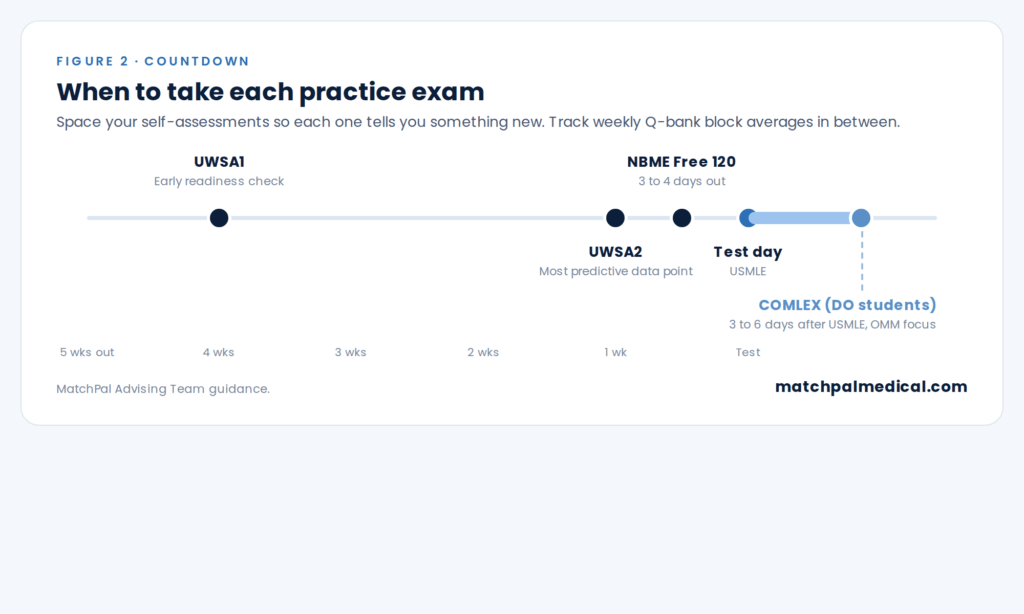
- UWSA1 around 4 weeks out, as an early readiness check.
- UWSA2 around 1 week out, as your final and most predictive data point.
- NBME Free 120 about 3 to 4 days out, close enough to matter without disrupting your last stretch of review.
You should take additional NBMEs before and between the UWSAs, especially if you want more questions and more data points, but don’t get too attached to practice test scores.
Your weekly question bank block-score trend tells you more about where you actually stand than a single practice exam. The progress happens in the daily grind.
How is Step 2 CK dedicated different now that it’s the highest-stakes exam?
Step 1 has been pass/fail since January 2022, which makes Step 2 CK the single highest-stakes standardized metric left in the residency application. Effective May 7, 2026, the USMLE format has also moved to 16 blocks of 30 minutes each (18 to 20 questions per block, 316 questions total, still a 9-hour day) (USMLE, 2026 format update).
Step 2 CK rewards clinical reasoning under time pressure more than isolated recall. Memorization still matters, but the skill actually being tested is navigating a novel scenario and landing on a sound decision. Build the knowledge base, then devote your time to timed, mixed-subject practice, probably more heavily then pure content review (unless you need to rebuild the fundamentals).
Knowing your target matters here too. A matched ENT applicant’s 2026 Step 2 CK median was 261. A matched Family Medicine applicant’s was 244. Pull your own number from our full 2026 NRMP breakdown by specialty before you decide how hard to push these last weeks, and start from our free Step 2 CK and Level 2-CE dedicated study plan if the week-by-week schedule is not built yet.
What should DO students know about dedicated and COMLEX?
If you are taking both board examss, a common and workable approach is taking COMLEX 3 to 6 days after USMLE.
Use that window to cram OMM specifically. Do not restart broad content review you have already covered.
The DO-specific playbook for those few days: narrow entirely to osteopathic principles and OMM technique recall. Our free OMM Review Guide was built for exactly this stretch, a tight high-yield pass through what COMLEX actually tests for OMM.
If you want more than a review guide can give you, our OMM Bootcamp covers the hands-on technique repetition most DO students do not get enough of during the preclinical years.
Stop Guessing, Start Strategizing.
A good dedicated schedule on paper and a dedicated period that actually produces your target score are two different things. The gap between them is usually accountability: someone reading your block scores weekly, adjusting when a weak area shows up, and keeping you honest about the basics when week five gets hard.
That is what our team of 80+ resident physicians does with students one-on-one, and it shows up in the numbers: a 99% USMLE/COMLEX pass rate, including retakers, and average increases of 21 points on Step 2 CK and 132 points on COMLEX Level 2-CE from baseline.
Book a call before you lock your dedicated schedule, or go straight to USMLE and COMLEX tutoring if you already know you want a resident in your corner for the next several weeks.
Built by residents. For the students who are next.
How long should a dedicated study period be?
Four to eight weeks for most students, depending on your starting point and target score. Shorter dedicated periods work for students who are already strong on practice material; longer ones suit students rebuilding weaker content areas from scratch or who’s target is further from their baseline.
How many hours a day should you study during dedicated?
Most students who do well study roughly 10-12 hours a day, 6-6.5 days a week. Consistency matters more than any single marathon day, and the scheduled time off should not be optional.
When should you take UWSA1, UWSA2, and the NBME Free 120?
A common, effective sequence is UWSA1 around 4 weeks out, UWSA2 around 1 week out, and the NBME Free 120 about 3 to 4 days before your test date. Do additional practice exams before and between UWSAs as needed. Your weekly question bank score trend across that stretch is a more reliable signal of readiness than any single practice exam.
How soon after USMLE should DO students take COMLEX?
A common approach is sitting for COMLEX 3 to 6 days after USMLE, using that short window to cram OMM specifically rather than restarting broad review. Our free OMM Review Guide is built for exactly that window.
How is Step 2 CK dedicated look different now that Step 1 is pass/fail?
Step 2 CK is now the single highest-stakes standardized exam in a residency application, and it rewards clinical reasoning under time pressure more than isolated recall. Dedicated for Step 2 CK should weight timed, mixed-subject practice more heavily than content review.