
Program Signals Explained: Your 2026-27 ERAS Preference Signaling Numbers
Last updated: November 6, 2026 · Written by the MatchPal Advising Team · Reviewed by Ian Rumball, MD
Quick answer: Program signals (also called signal tokens) are a tool for expressing interest in a particular residency program, sent via ERAS, with the number of signals varying by specialty. Because you have a limited number of signals, sending a one to a program shows genuine interest and is weighed heavily in interview selection. For the 2026-27 application cycle, 29 specialties participate is signaling. Six use a two-tier gold and silver system (Anesthesiology, Child Neurology, Dermatology, Diagnostic Radiology, Internal Medicine, and Vascular Surgery-Integrated), while the rest have a single tier of signals. The number of signals ranges widely from 4 signals in fields like Radiation Oncology up to 30 in Orthopedic Surgery and Urology. Emergency Medicine, OB/GYN, and Ophthalmology do not use ERAS signals, but have a parallel process in their own application platforms. Knowing the specifics for your specialty, and optimizing your signal strategy is critical to your interview yield and Match outcome.
This key piece of application strategy can change from year to year, and specialty to specialty, which is why we are updating this information for 2026-27. After this introduction, follow up with our decision framework for signal strategy, so you can allocate this limited resource optimally.
What is a Program Signal in the residency match?
The program signal is a tool for expressing interest in a program. Imagine ERAS giving you a limited number of “super-likes” to allocate to residency programs that you would like to increase your chances of receiving an interview at. Because signals are a finite resource, programs take them seriously when considering which applicants to invite for an interview. However, the specific impact will vary by specialty (given different signal limits) and program, and a signal alone is not enough to ensure an interview if your application is not competitive for a given residency program.
How many signal tokens do I get for the 2026-27 application cycle?
It depends entirely on your specialty. For the 2026-27 cycle, 29 specialties participate in preference signaling.
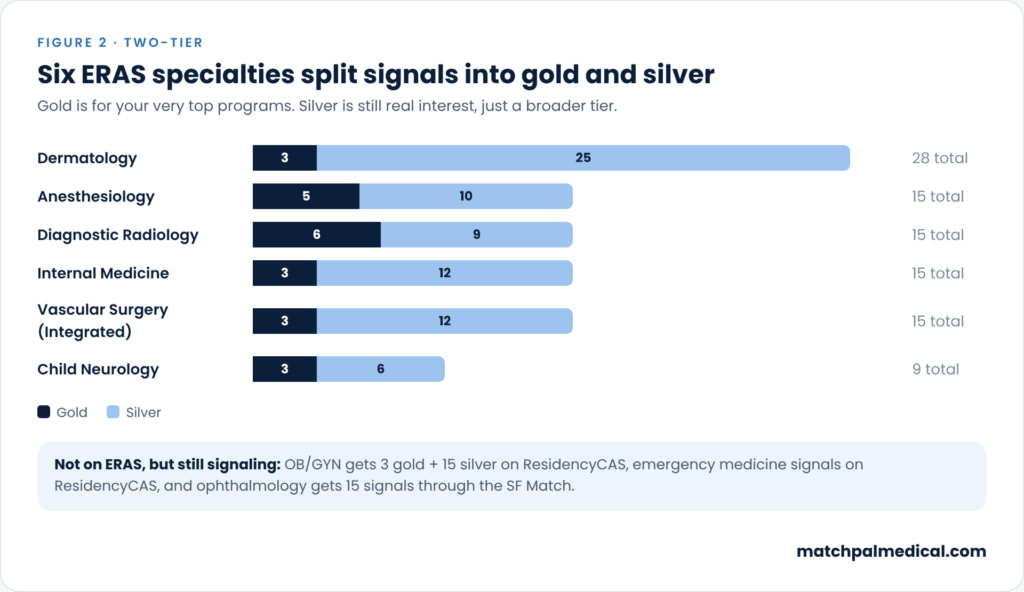
Six specialties use a two-tier gold and silver system, where gold signals carry more weight than silver signals:
- Anesthesiology: 5 gold / 10 silver
- Child Neurology: 3 gold / 6 silver
- Dermatology: 3 gold / 25 silver
- Diagnostic Radiology: 6 gold / 9 silver
- Internal Medicine: 3 gold / 12 silver
- Vascular Surgery (Integrated): 3 gold / 12 silver
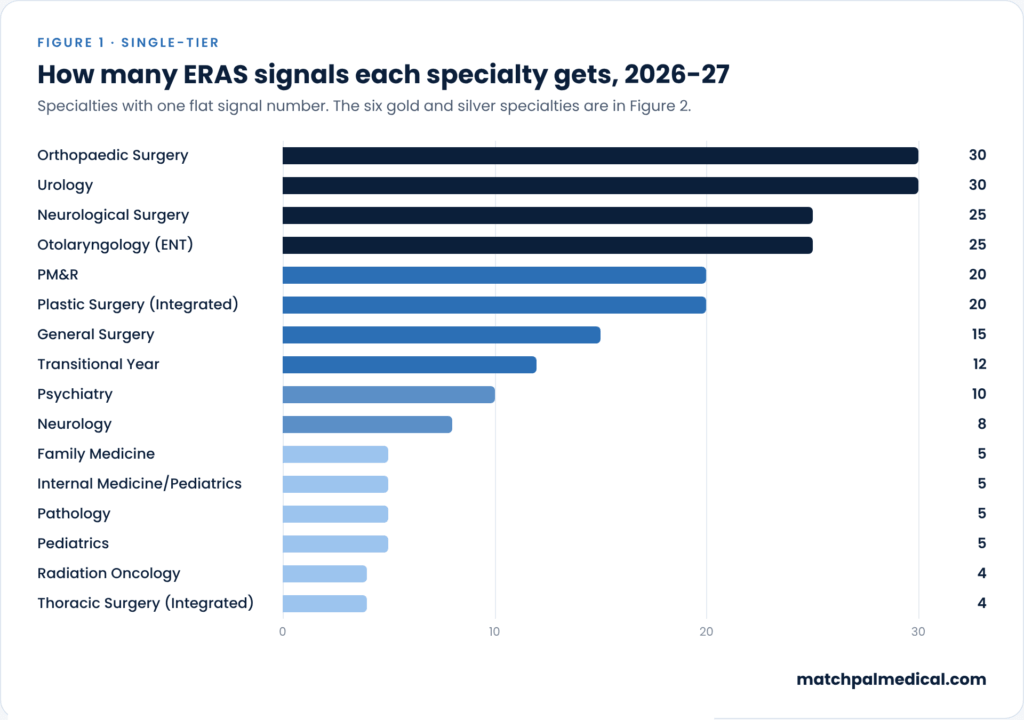
The remaining participating specialties use a single tier of signals, including:
- Family Medicine: 5
- General Surgery: 15
- Internal Medicine/Pediatrics: 5
- Neurosurgery: 25
- Neurology: 8
- Orthopedic Surgery: 30
- Otolaryngology (ENT): 25
- Pathology: 5
- Pediatrics: 5
- Physical Medicine and Rehabilitation: 20
- Plastic Surgery (Integrated): 20
- Psychiatry: 10
- Radiation Oncology: 4
- Thoracic Surgery (Integrated): 4
- Transitional Year: 12
- Urology: 30
Which specialties don’t use ERAS program signals?
Emergency Medicine, OB/GYN, and Ophthalmology do not participate in ERAS program signaling for the 2026-27 cycle. They do, however, signal through alternate application platforms.
- EM: 5 signals, allocated on ResidencyCAS
- OB/GYN: 3 gold / 15 silver signals, allocated on ResidencyCAS
- Ophthalmology: 15 signals, allocated on SF Match
This goes to show how specialty-specific this entire application process is, and why you need the most up-to-date information to plan appropriately.
What’s the difference between a gold signal and a silver signal?
In the two-tier signaling specialties, gold signals indicate your “most preferred” programs whereas silver signals indicate your “preferred” programs, per the AAMC. The gold signal is your strongest, most selective indicator of interest, generally reserved for the programs at the very top of your list. Silver signals still carry real weight in interview selection, but they are more numerous and somewhat less valued.
If you have access through your school, the Texas STAR database can provide specific information about how gold and silver signals were used by programs. One research paper into the Dermatology residency process used Texas STAR data to suggest that gold signals were independently predictive of recieving an interview invitation (OR 14.1) and matching at a program (OR 6.1), whereas silver signals were just weakly predictive of an interview (OR 2.5). For a summary of specialty specific trends, check out the NRMP report on program signaling.
The practical implication: gold signals are highly valuable, and have more impact on your application than your silver signals. Developing an evidence-based strategy is key.
How do I decide which programs actually get my signals?
As we stated, this introduction just introduces you to the idea of program signals. Specialty-specific strategy is highly variable, largely based on one or two signal tiers and number of signals.
You can imagine that for a specialty like orthopedic surgery that allows 30 signals, program signals function almost like an application cap, and your odds of receiving an interview from a non-signaled program are very low. Maybe you can also realize that using all of your signals on the top residencies in a given field could severely harm your interview yield if you are a less competitive applicant, since these programs will generally receive signals from more applicants than they have capacity to interview.
You clearly need an up-to-date, specialty-specific strategy to make the most of this limited resource. To get more into the specifics, specialty by specialty, check out our 2026 signaling decision framework.
What should DO and IMG applicants know about signaling?
The signal allocation numbers above apply the same way regardless of your degree or pathway. What should change is how you think about which specific programs to signal.
Program receptiveness to DO, IMG, and MD applicants varies meaningfully, and that variation is specialty- and program-specific. You can review program websites for a history of matching DO and IMG applicants, which is an informative but painstaking process, and program websites are not always up-to-date. These are the kinds of insights a mentor actually training in your target specialty can easily give you: which programs have historically been receptive to your pathway, based on their recent experience in the residency application process.
The unwritten rule here: a signal sent to a program that has never matched someone with your background is not automatically wasted, but it should be approached with appropriate caution. You could be the first DO or first IMG to match there. This is a topic you definitely need to discuss with a mentor in your specialty, as you build your signal list.
Stop Guessing, Start Strategizing.
Program signals are valuable specifically because they are limited. If you spend them without a strategy, you are wasting one of your most powerful tools in the residency application process.
MatchPal’s advising team includes 80+ resident physicians currently in training, many of them reviewing signaled applications for their own programs right now, which means they know exactly how signals actually get weighed on the other side of the process. Work with a specialty-specific mentor to build your signaling strategy before application season locks in your choices, or book a free strategy call to get started.
Built by residents. For the students who are next.
How many program signals does each specialty get for the 2026-27 cycle?
It varies by specialty (see Figure 1-2). Some use two-tiered (gold/silver) signaling, some use a single tier.
Which specialties do not use ERAS program signaling?
Emergency Medicine, OB/GYN, and Ophthalmology do not participate in ERAS program signaling, but allow signaling by other application platforms (e.g., ResidencyCAS, SF Match).
What is the difference between gold and silver signals?
For specialties with two-tiered signaling, gold signals are more limited, and indicate “most preferred” programs; silver signals still carry real weight in interview selection but represent a slightly broader tier of interest.
How do I decide which programs to send my signals to?
This is a complex application strategy question that depends on your intended specialty, and individual competitiveness and priorities. This process is covered in our 2026 signaling decision framework blog post, but you should also talk this over with a mentor in your specialty.
Sources cited
- AAMC: Program Signals Overview for ERAS Applicants
- AAMC: Program Signaling for the 2027 MyERAS® Application Season
- CORD: Medical Student and Advisor Resources
- ACOG: Recommended Standards for the Obstetrics and Gynecology Residency Application and Interview Processes
- OPDA: Program Director Associations Guide for Residency Applicants
- Effect of tiered signaling and geographic preferences in dermatology match outcomes: era-specific analysis of the Texas STAR database
- NRMP: Report on Program Signaling