The Pass/Fail scoring for USMLE Step 1 & COMLEX Level 1 is here to stay – and it has fundamentally changed the residency application landscape. With one of the most prominent academic metrics now neutralized, program directors increasingly turn to other signals of applicant strength — and research experience will likely emerge as one of the most powerful currencies in the Match. But… it will probably not be used the way you think it will by PDs.
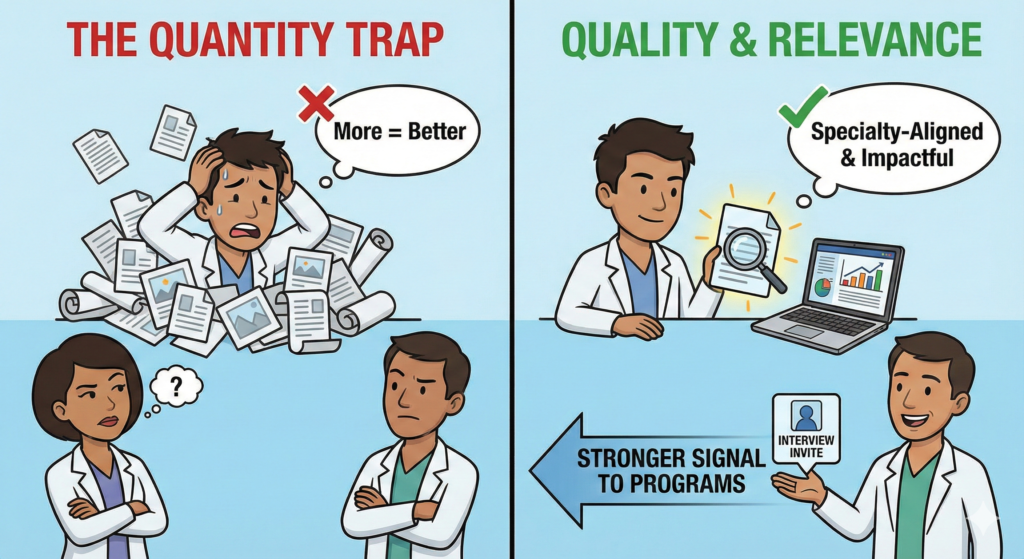
Many medical students fall into the trap of believing “more research = better chances.” The reality is more nuanced.
Quality, relevance, and strategic choices matter far more than sheer volume. Here’s a breakdown of how research fits into modern residency selection, what program directors truly value, and which project types deliver the best return on investment for your time and effort.
What a Strong Research Portfolio Signals to Programs
When program directors review your ERAS application, a solid research section communicates several key attributes beyond just publications:
- Time management and juggling responsibilities — Balancing research with classes, rotations, Step studying, and life shows discipline.
- Genuine enthusiasm for science and your chosen specialty — Especially when projects align with the field.
- Development of complementary physician skills — Critical thinking, data analysis, writing, and evidence-based practice.
- Teamwork — Most projects involve collaboration with mentors, residents, and peers.
These traits resonate strongly, particularly in competitive specialties.
Research’s Role in the Current Match Environment
According to NRMP Program Director surveys and Match data, involvement in research remains a top factor for offering interviews in highly competitive fields like:
- Dermatology
- Plastic Surgery
- Orthopedic Surgery
- Interventional Radiology
Even less competitive specialties (e.g., primary care) weigh research positively, though to a lesser degree. The key shift post-Step 1 P/F: research helps differentiate applicants when board scores no longer provide the same sorting power.
Types of Research Projects: Ranked by Value and Feasibility
Not all research carries equal weight. Here’s a practical hierarchy:
Original Research (The Gold Standard)
- Examples: Randomized Controlled Trials (RCTs), prospective studies, or large retrospective cohort analyses.
- Pros: Highest prestige; demonstrates ability to navigate IRB processes, data collection, and advanced analysis.
- Cons: Extremely time-intensive (often 1+ years); difficult to initiate and complete during medical school.
- These projects are rare for students but carry massive weight when achieved.
Systematic Reviews & Meta-Analyses
Why they win: systematic reviews sit at the top of the evidence pyramid due to large pooled sample sizes and rigorous methodology. No IRB approval needed. Can often be completed remotely from a laptop in 3–6 months with a motivated team and good mentorship.
- Ideal for: Busy med students seeking strong, publishable output without years of commitment.
- Case Reports and Case Series
- Pros: Quick turnaround; excellent for building mentor relationships and showing specialty interest; beginner-friendly.
- Cons: Lower perceived impact; program directors recognize them as relatively “easy” to produce.
- Best use: Leverage them to spark conversations during interviews and demonstrate commitment, but don’t rely on them as your primary research pillar.
Case Reports
- Best for reporting on single interesting cases involving a patient presentation or procedure that is sparse in the existing literature
- Low overall value but significantly easier to find and get involved with
- Great for beginners with minimal scientific writing experience.
Quality Improvement, MedEd, Policy, and other non-clinical research projects
- Great if you have a true strong passion in any of these areas
- Can be easier to put together than clinical studies (which require IRB/data mining/statistical analysis)
- Not recommended unless you care deeply about the space you are writing about (less clinical relevance, less likely to be relatable to most of your residency interviewers).
Abstracts/Posters vs. Full Manuscripts
- Manuscripts (full peer-reviewed papers, ideally PubMed-indexed) always outrank conference abstracts, posters, or oral presentations.
- Aim for publication whenever possible — even if it takes extra months.
What Program Directors Actually Prioritize
NRMP surveys reveal a critical truth: Perceived interest in the specialty consistently ranks higher than raw number of publications.
A program director in Neurology, for example, will value two first-author papers in neurology far more than eight case reports on unrelated topics like gout.
Bottom line: Specificity and relevance trump quantity every time. Tailor your research to your target specialty to send the strongest possible signal.
Final Thoughts: Make Research Work for You
Research is no longer optional in most competitive fields — it’s a key differentiator. Focus on high-impact, specialty-aligned projects that fit your timeline and resources. Avoid chasing low-yield output just to pad your CV.
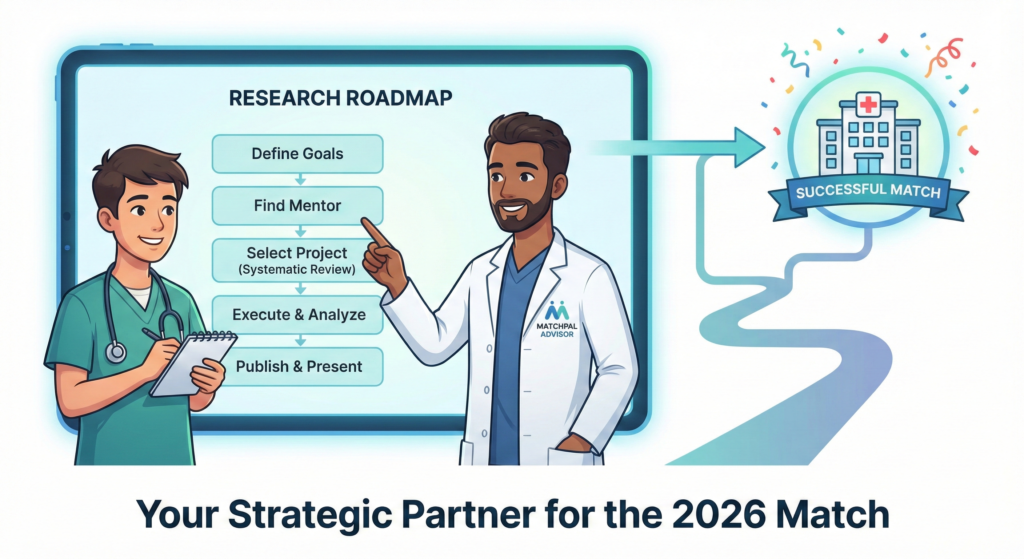
If you’re navigating the Match process and want personalized guidance on finding meaningful research opportunities, building connections, securing away rotations, or optimizing your VSLO & ERAS application strategy, thats exactly what our platform is all about!
Matchpal helps thousands of students turn dreams into successful Matches every year by setting you up to work 1:1 with an MD/DO resident that is currently in your future specialty.
Schedule a free strategy call below to see where you stand & learn more about how we can help you match your dream specialty/program!