
Research 101 for Medical Students: A Guide to Getting Started in 2026
Last updated: November 12, 2026 · Written by the MatchPal Advising Team · Reviewed by Joseph Gofman, DO
Quick answer: Research matters in medical school for several reasons, some more noble or scholarly (e.g., exploring and innovating in your specialty, advancing patient care), and some practical, namely increasing your residency application competitiveness. How much research matters, and what type of research is valued varies enormously by specialty. A vague, “more is better,” approach isn’t always optimal. Keep in mind your role and authorship, study type, and journal/conference reputation, because it is easy for residency programs to gauge your research experience quality based on these factors. Build your own opportunities. If your school helps provide research experience, take full advantage. Otherwise, get involved through faculty networking, specialty and research organizations, and learning how to perform systematic reviews and meta-analyses through available data on PubMed. For the numbers behind how much research matters by specialty and how you should adapt your strategy, see our dedicated breakdowns on the 2026 NRMP research data and research in med school after Step 1 went pass/fail.
Someone has probably told you that you should “get involved in research,” but often this advice is nonspecific without guidance on how to actually do this, how much you need, and how to balance it with other medical school responsibilities. Depending on your specialty, putting off research because no one clearly explained it can come back to bite you when your application is not as competitive as you hoped. This guide gives you the clarity you need, so you can to where you need to be in time for your residency application.
Why does research actually matter for a residency application?
First, participation in research builds highly valued physician skills: critical appraisal of evidence, scientific writing, data analysis, and the discipline of seeing a project through to publication. Research experience and output signals to a residency program director that you have these valuable traits, and can bring them to their program.
Second, residency programs use research output as one signal among several for ranking applicants pre- and post-interview, since it may reflect specialty interest, scholarly ability, and time-management skills. The weight given to research varies heavily by specialty. Since Step 1 moved to pass/fail, research has (to some extent) taken on more importance to differentiate otherwise similar applicants. Check out our deep dive on what factors actually move the needle in 2026 now that Step 1 is pass/fail for a full break down on this dynamic
What types of research projects actually count?
Almost all research is valuable, but the relative importance comes down to three main factors.
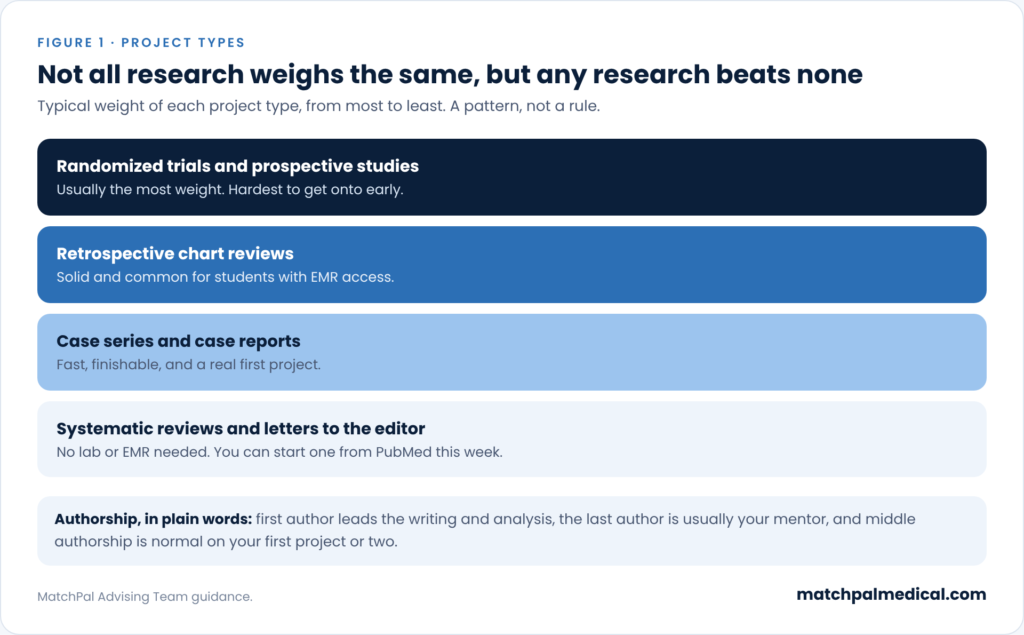
- Role/authorship: First author research outputs are most valued, and hardest to come by. They indicates you did the majority of the work in study design and execution, as well as abstract, poster, or manuscript preparation. Unless you led the project start to finish, expect to be a middle author.
- Note: If you did work on a research project, you should be credited as an author. Clarify authorship expectations early on with the resident or faculty that is your point of contact on the project.
- Study type: Randomized control trials, prospective clinical studies, or bench research projects are the most impressive to be involved in. However, it is likely the majority of research opportunities you find will be retrospective clinical studies, and systematic reviews or meta-analyses. Other types of projects (e.g., case series, case reports, conference educational exhibits, non-peer reviewed medical writing) are good to show interest and involvement, but understand projects that require less work also carry less weight.
- Project output and conference/journal reputation: The gold standard is published manuscripts or textbook chapters. Oral and poster presentations, as well as published abstracts are good to have, but nothing beats taking a project across the finish line by getting a paper published. Publishing in a preeminent journal for your specialty is much more impressive than a publication in a low-tier or predatory journal, or a more general online journal like Cureus.
Note: With recent changes in ERAS, your research output also will be organized into scholarly works, so a poster, abstract, and manuscript from one project will be grouped together instead of appearing as three separate entities. For more insights, check out our breakdown of the most recent NRMP research data, which now reports research output by type (i.e., manuscript, abstract, or presentation).
Bottom line: A first author publication for a RCT in NEJM or bench research project in Nature means more to the medical community and probably takes more work than publishing 30 case reports in Cureus. However, programs look at quality and quantity, and which matters more might depend on how quickly they are glancing at your application. Figure out how much research is expected in your specialty and generate as much high quality research as you can.
How much research do I need for a competitive specialty?
This is probably the most commonly asked question by students, and varies widely by specialty and how you specifically categorize the available data. Be skeptical of anyone who gives you a precise, generalized figure.
The nuance: starting with the 2026 cycle, the NRMP shifted its research reporting from a single combined mean across all research output to medians reported separately by category (i.e., manuscripts, abstracts, and presentations). That is a meaningfully more accurate way to understand what matched applicants actually did, and it means older combined-mean figures were bloated by both the bundling of multiple research output types, and by outlier applicants skewing the mean. The trend of emphasizing transparency and quality over quantity is also why ERAS now asks applicants to organize their research into scholarly works, so multiple outputs from the same project are grouped together rather than double or triple counted by residency programs.
To illustrate this shift, among matched orthopedic surgery applicants in 2026, the median number of published manuscripts was about 7, compared to a previous mean research output of about 24. These numbers are highly specialty-specific, so for the full picture, see our breakdown of what the 2026 NRMP data really says about research and the match.
How do I find research opportunities as a medical student?
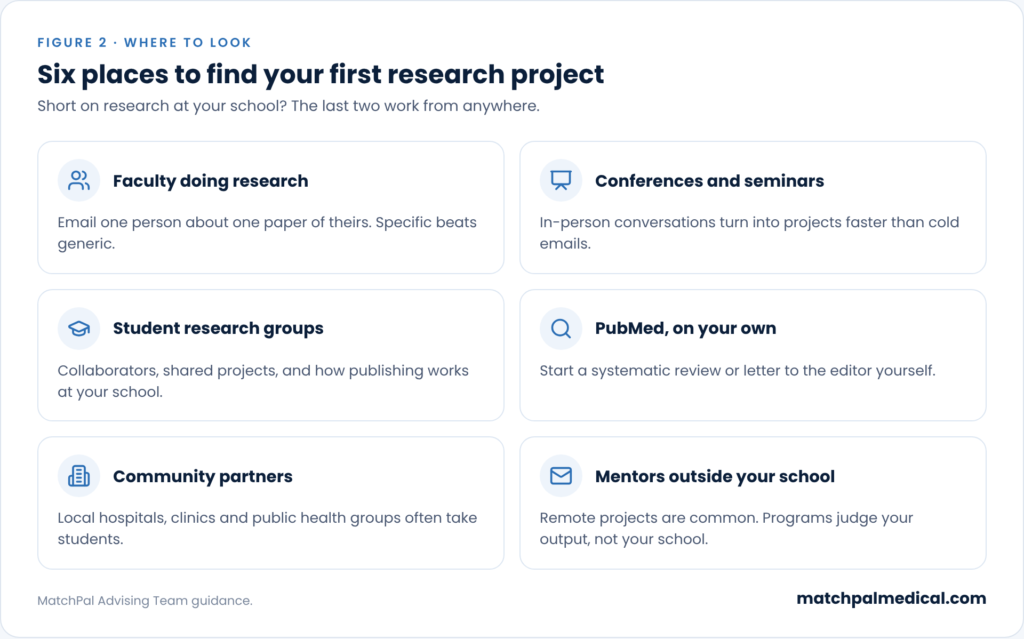
Network with faculty directly. Building relationships with faculty actively engaged in research is the single most reliable way to find research opportunities. A short, specific email outperforms a vague one every time.
Try something close to this:
“Dr. [Name], I’m a second-year medical student interested in [specific topic], and I read your recent work on [specific paper or project]. I’d love to learn more about ongoing projects in your lab and see if there’s an opportunity for me to contribute in any capacity. Would you be open to a brief call?”
Specific beats generic. Mentioning their actual work shows you are interested, not just sending a mass email.
Attend conferences, seminars, and academic events. These introduce you to research trends and potential mentors you would not otherwise meet, and conversations started in person often convert into opportunities faster than cold outreach.
Join research and specialty organizations. These give you a network for finding collaborators and ongoing projects, as well as doubling as a potential leadership opportunity if you stay involved in the organization over multiple years.
Use PubMed and online databases to generate your own project ideas. Yes, you can start your own research project without being recruited onto someone else’s. Systematic reviews and letters to the editor are project types that do not require EMR or lab access, and they are a realistic way to get a first authorship credit on your own initiative. You may need an attending physician to co-author the project with you, but they are far more likely to respond and agree if you already have a solid project planned and ready to execute.
Reach out to community partners. Local hospitals, clinics, public health organizations, and nonprofit research institutes may be running research projects and are frequently open to student involvement outside the traditional academic pipeline.
Bottom line: Reach out, as many times as it takes. You may be ignored or rejected, but one response from the right person could open the door that you need.
What if my school doesn’t have strong research affiliations?
This is a common obstacle, but should not be your reason for skipping research.
Students at schools without extensive research infrastructure can build a research network by reaching out directly to external institutions, cold-emailing attending, research coordinators, or alumni outside their program. Remote research arrangements are increasingly common, and plenty of students have published meaningful work with a mentor they never met in person.
Your institution’s research reputation and output matters less than your own initiative and follow-through. Programs evaluate your output, not how you got on a project.
Should I start research in MS1 and MS2, or wait?
Earlier is almost always better: research timelines are long and unpredictable, and projects you start early have more time to actually reach presentation or publication before your application is submitted
If you are still early in medical school and want a structured way to build both your board score foundation and a plan for your research and extracurriculars, MatchPal’s competitive specialty accelerator is built specifically for MS1 and MS2 students aiming at research-heavy, highly competitive fields.
Stop Guessing, Start Strategizing.
When someone told you to “get involved” in research, they probably didn’t offer a concrete plan. Use the tips above to build your own plan for research, and take advantage of any opportunities given to you by your school. If you are needing more guidance, talking with a mentor in your specialty is the next best step.
MatchPal’s advising team is made up of 80+ resident physicians currently in training, many of them sitting on admissions committees for the specialties you are considering. They know what a realistic research timeline and expected output looks like for your intended field. Book a free strategy call to build a research plan instead of guessing at one. If you are still weighing which specialty to target research toward, the free specialty selector quiz is a useful starting point too.
Built by residents. For the students who are next.
How much research do I need to match into a competitive specialty?
There is no single universal number, and the best estimate depends on how the data is presented. Since the 2026 NRMP reporting change, research output is reported as medians split by category (abstracts, presentations, publications) rather than one combined mean, and the expected amount varies significantly by specialty. Check our full breakdown of the 2026 NRMP research data for your specific field, linked above.
What type of research project should I pursue first as a medical student?
Whatever is available to you. Randomized trials and prospective studies generally carry more weight than case reports, but any completed research project is better than none. First authorship is great, but matters less than actually getting research output on your CV.
Can I do medical research without EMR access?
Yes. Systematic reviews and letters to the editor are legitimate, independent project types that do not require EMR access, and they are a realistic way to start your own first-author project using PubMed and existing published literature.
What if my medical school doesn't have research opportunities?
Reach out directly to external institutions, physicians, research coordinators, or alumni, and consider remote research arrangements. Plenty of students have built productive, publishable research records with mentors they never met in person.
Has the way research is reported to residency programs changed recently?
Yes. Starting with the 2026 cycle, the NRMP switched from reporting a single combined mean for applicant research output to reporting medians split by category (abstracts, presentations, and publications), which is a more accurate way to compare applicants than the older combined averages. ERAS has also started instructing applicants to group their research into scholarly works, so multiple outputs from the same project are accurately displayed.